
Digital transformation is driving companies to adopt Audio Visual Technology That Must Be in Modern Meeting Rooms 2026 as a core part of their business communication strategy. The shift toward flexible work has changed the role of meeting rooms. These spaces are no longer just places to gather, but have evolved into collaboration hubs that connect teams across locations in real time.
Modern companies demand meeting systems that deliver seamless communication. Audio must be clear, visuals must be sharp, and interactions must feel natural. With the right technology in place, meetings become more effective and productive.
This article explores the essential audio visual technologies that define modern meeting rooms. Each element plays a crucial role in creating a professional and efficient meeting experience.
Audio Visual Technology That Must Be in Modern Meeting Rooms
Technological advancements have reshaped how companies operate on a daily basis. Meetings are no longer dependent on the physical presence of all participants. Many organizations now adopt hybrid work models that combine in-person and remote participation.
This shift requires more adaptive meeting environments. Systems must support various communication scenarios, from internal presentations to team discussions and client meetings.
Companies also recognize that meeting quality directly impacts team productivity. Poor communication often leads to misunderstandings and delays in decision-making.
With the right approach, meeting rooms can become strategic assets that support business growth.
Professional Audio Systems for Clear Communication
Audio is the most critical element in any meeting. Without clear sound, discussions become difficult to follow. This can lead to costly miscommunication.
Professional audio systems are designed to capture sound evenly across the room. Modern conference microphones can detect speakers accurately, ensuring everyone is heard clearly.
Some systems use beamforming technology. This allows microphones to focus on the main speaker while reducing background noise.
High-quality speakers also ensure sound is distributed clearly throughout the room. Together, these components create a comfortable and effective communication environment.
Read Also: Advanced Hybrid Meeting Room: A Modern Meeting Room Solution for Companies
Smart Cameras for Hybrid Meetings
Cameras play a key role in modern meeting rooms. Today’s camera technology goes beyond simple video capture. Smart cameras can automatically track the active speaker.
Auto-tracking features allow the camera to focus on whoever is speaking. This helps remote participants follow the discussion more easily.
Video quality is equally important. High-resolution cameras capture facial expressions and body language clearly, which is essential for business communication.
With this technology, hybrid meetings feel more natural. Remote participants remain engaged throughout the discussion.
Interactive Displays for Effective Presentations
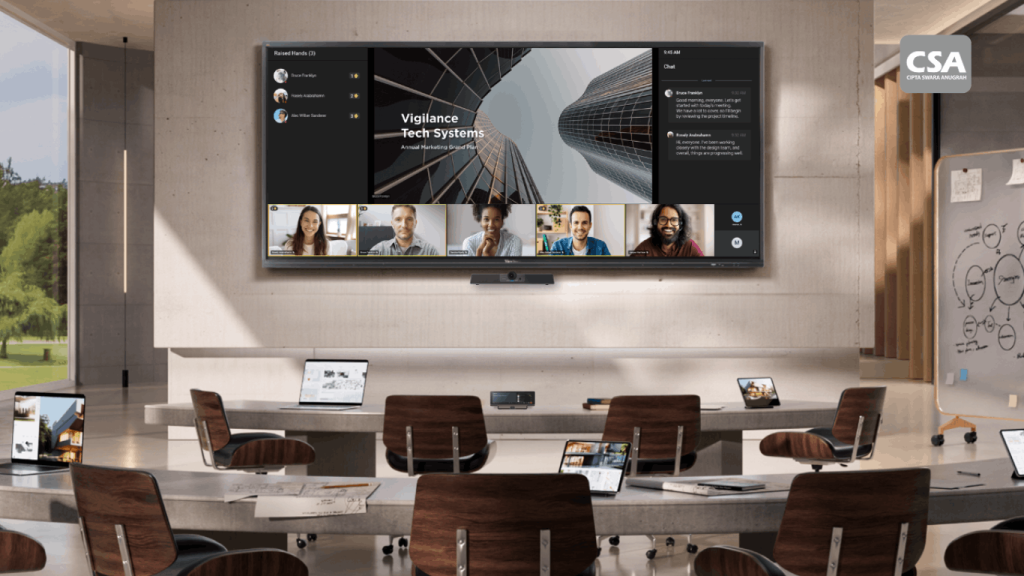
Visual elements play a major role in delivering information. Modern meeting rooms are typically equipped with large displays or interactive screens.
Interactive displays allow users to write, draw, and edit content in real time. This feature is especially useful for brainstorming sessions and presentations.
High-resolution screens ensure that all content is clearly visible to participants. Data, charts, and visuals can be presented more effectively.
Integration with other devices is another advantage. Users can easily connect laptops or mobile devices to display presentation materials.
AV over IP Systems for Greater Flexibility
AV over IP technology offers a modern solution for distributing audio and video signals. This system uses IP-based networks to transmit media.
This approach provides high flexibility in system management. Companies can expand or modify configurations without replacing the entire infrastructure.
Audio and video quality remains consistent even when distributed across multiple devices. This makes the system both efficient and scalable.
AV over IP also simplifies integration with other technologies. It has become a preferred solution for building modern meeting environments.
Centralized Control Systems for Meeting Efficiency
Modern meeting rooms require systems that are easy to operate. Centralized control systems allow users to manage all devices through a single interface.
Users can control cameras, microphones, displays, and lighting effortlessly. This reduces the complexity of using multiple technologies.
With this system, meetings can start quickly without technical delays. Teams do not waste time adjusting equipment manually.
This efficiency is essential in fast-paced business environments where every minute matters.
Technology Integration for Smart Meeting Rooms
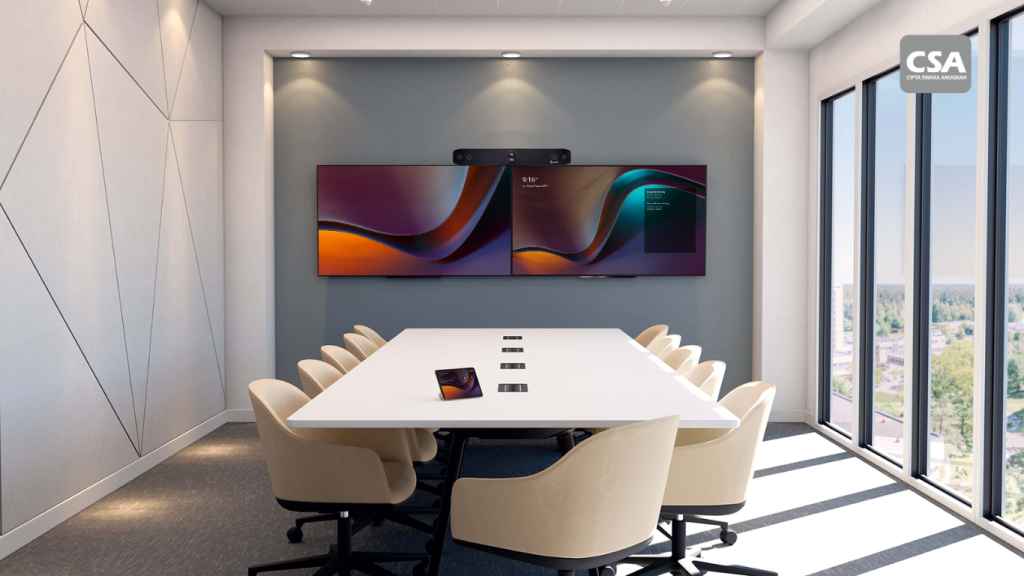
Audio Visual Technology Modern meeting rooms rely on the integration of multiple technologies. Audio, video, control systems, and networks must work together seamlessly.
This integration ensures that all devices support one another. As a result, meetings run smoothly without technical disruptions.
Smart meeting rooms enable dynamic collaboration. Participants can share content, communicate, and work together in real time.
With fully integrated systems, companies can improve operational efficiency. Technology operates in the background without interrupting the meeting flow.
Room Design That Supports Technology
Audio Visual Technology must be supported by proper room design. Layout and structure influence communication quality.
Camera placement should provide a clear view of all participants. Microphones must be positioned to capture sound evenly.
Lighting also plays an important role. Proper lighting improves video quality. In addition, room acoustics must reduce sound reflections.
A well-designed space ensures that technology performs at its best. This combination creates a better meeting experience.
The Impact of Technology on Company Productivity
Implementing Audio Visual Technology directly impacts productivity. Effective meetings help teams work more efficiently.
Discussions become more focused, and decisions can be made faster. This gives companies a competitive advantage.
Technology also reduces operational costs. Companies can minimize business travel without sacrificing communication quality.
With the right investment, organizations can significantly improve overall team performance.
The Role of System Integrators in Implementation
Adopting modern meeting technology requires careful planning. Companies often work with system integrators to ensure optimal results.
System integrators design audio visual systems based on room requirements and business needs. They ensure that all devices are properly integrated.
The process includes needs analysis, system design, installation, and testing. Each stage ensures the system functions as intended.
With professional support, companies can avoid costly implementation mistakes. The result is a fully optimized meeting environment.
The Future of Meeting Rooms in 2026
Technological innovation continues to shape the future of meeting spaces. By 2026, meeting rooms are expected to become even smarter.
Artificial intelligence is starting to play a role in meeting systems. Some technologies can generate automatic transcripts and analyze discussions.
Integration with digital platforms is also becoming stronger. Meetings can be conducted more flexibly without location limitations.
Companies that adapt to these changes will gain a competitive edge. Meeting rooms will evolve into central hubs for collaboration and innovation.
The Role of CSA Indonesia in Delivering Modern Audio Visual Meeting Solutions
CSA Indonesia is a system integrator with strong expertise in Audio, Visual, Lighting, and Automation solutions for business environments. The company helps organizations build modern meeting rooms that support seamless and effective communication. Through a structured approach, CSA Indonesia ensures that every meeting space meets the demands of today’s hybrid work environment.
During the implementation process, CSA Indonesia conducts a comprehensive analysis of room requirements and communication patterns. The technical team then designs a system tailored to the room size, number of participants, and types of meetings conducted. This careful planning ensures that every component works optimally.
CSA Indonesia integrates advanced technologies such as AV over IP systems, auto-tracking cameras, and professional conference microphones. This integration ensures stable, high-quality audio and video distribution. As a result, participants can interact naturally, whether they are physically present or joining remotely.
With extensive experience and a professional approach, CSA Indonesia helps companies create meeting environments ready for modern challenges. Well-integrated technology not only improves communication quality but also enhances productivity and supports faster decision-making.
Conclusion
Modern companies need more than just traditional meeting spaces. They require systems that support clear and efficient communication.
Implementing Audio Visual Technology That Must Be in Modern Meeting Rooms 2026 is a strategic step toward improving meeting quality. Clear audio systems, smart cameras, interactive displays, and integrated technologies are essential components.
With the right technology, companies can create more productive work environments. Meetings are no longer obstacles but become tools that drive business growth.
FAQ About Audio Visual Technology in Meeting Rooms
What is audio visual technology in meeting rooms?
Audio visual technology combines sound and visual systems to support communication during meetings.
Why do companies need modern audio visual systems?
Because these systems improve communication quality and make meetings more effective.
What equipment is essential in a modern meeting room?
Key equipment includes conference microphones, auto-tracking cameras, interactive displays, and control systems.
What are the advantages of AV over IP compared to traditional systems?
AV over IP is more flexible, scalable, and easier to integrate with other technologies.
Are these technologies necessary for all companies?
Yes, especially for organizations that adopt hybrid work models or have teams in multiple locations.