
How to Achieve Clear Sound in a Meeting Room Sound System has become a critical concern for companies that rely on seamless communication. In any meeting environment, audio quality determines how well participants understand information, engage in discussions, and make decisions. When the sound is clear, meetings become more efficient, productive, and professional. On the other hand, unclear or unstable audio can disrupt focus, slow down discussions, and reduce overall meeting effectiveness.
Achieving clear sound in a meeting room sound system is essential for companies that rely on effective communication. In today’s fast-paced business environment, audio quality plays a crucial role in the success of presentations, internal discussions, and decision-making processes. When voices are heard clearly, participants stay focused and information is understood without miscommunication.
Many meeting rooms still struggle with issues like humming noise, feedback, or uneven sound distribution. These problems often occur not because the equipment is inadequate, but because the setup, configuration, or acoustics are not optimized. With the right approach, even a standard meeting room can deliver professional-grade clarity.
This article explores proven strategies to improve audio quality—covering device placement, microphone selection, and the application of supporting technologies. The explanations are presented clearly and practically, making them easy to apply in any modern workspace.
Understanding Technical Factors That Affect Sound Quality
The first step toward achieving clear sound is understanding the technical elements that influence audio performance. Room acoustics is a major factor. Meeting rooms with hard surfaces, high ceilings, or large windows often create excessive sound reflections. These reflections cause echo, making voices difficult to understand.
Room size also plays a role. Small rooms do not need high-powered speakers, as the sound may become harsh or distorted. Larger rooms, however, require systems that can cover wider areas without sacrificing clarity.
Device quality matters as well. Low-grade microphones, speakers, or mixers produce unstable audio. In contrast, the right equipment ensures depth, clarity, and consistency.
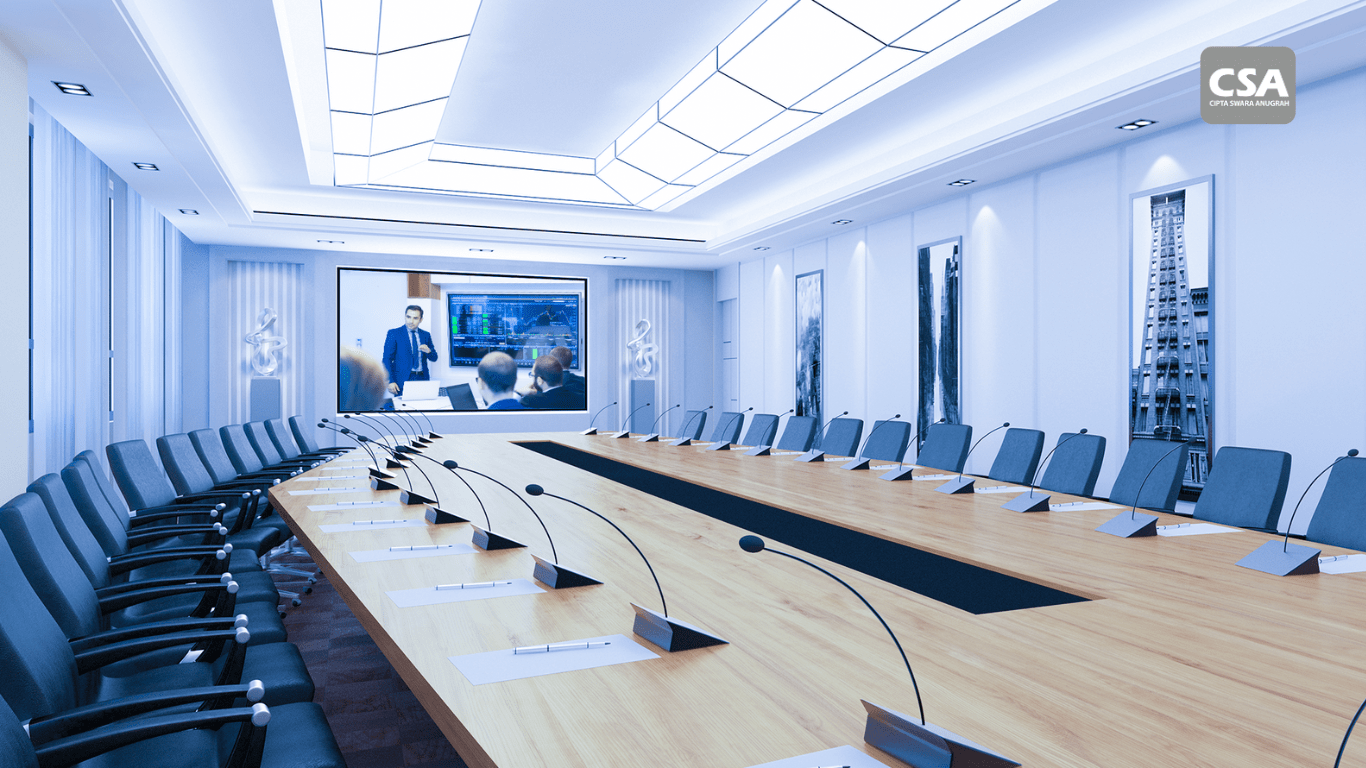
How to Achieve Clear Sound in a Meeting Room Sound System
Choosing the Right Microphone for Maximum Clarity
Microphone selection is a key element in producing clear sound. Common types used in meeting rooms include:
Condenser Microphones
Highly sensitive and capable of capturing detail. Ideal for quiet rooms and formal presentations.Dynamic Microphones
Less sensitive to noise. Suitable for busy meeting environments with frequent movement.Wireless Microphones
Offer flexibility and unrestricted movement for speakers.
For best results, choose cardioid-pattern microphones. They capture sound from the front while reducing noise from other directions. This ensures that the speaker’s voice comes through clean and uninterrupted.
Proper Speaker Placement for Even Sound Distribution
Speaker placement heavily affects perceived sound quality. Speakers positioned too low may be obstructed by participants, while speakers placed too high can cause reflections.
The ideal height is slightly above ear level. In larger rooms, use multiple speakers at lower volumes instead of one loud speaker. This setup spreads sound more evenly and prevents echo.
Ceiling speakers are an option for minimalist room designs, but their quality must still meet meeting-room standards to maintain clarity.
Adjusting Gain and EQ for Clearer Sound
Incorrect gain settings often cause distortion or low volume. Too much gain leads to cracking sound, while too little makes voices inaudible. Aim for a balanced input level.
Equalizers (EQ) also help shape the sound. Adjust the bass, mid, and treble to fit the speaker’s voice. Reduce low frequencies if the voice sounds too heavy, or increase mid frequencies for better clarity.
These adjustments are best handled by someone who understands basic audio processing. Still, the goal is simple: prioritize clarity over loudness.
Reducing Noise and Preventing Feedback
Feedback occurs when microphones catch sound from speakers repeatedly, creating a sharp ringing tone. To prevent this, avoid pointing microphones toward speakers and maintain proper distance between them.
Use acoustic treatments like carpets, panels, or heavy curtains to minimize sound reflections. These treatments also improve comfort in the room.
If possible, choose systems with built-in noise cancellation. Many modern conferencing devices already include this feature for consistent clarity.
Using Digital Technology for More Stable Audio
Modern audio systems are often supported by digital technology. Digital Signal Processors (DSP) optimize sound automatically by reducing noise, adjusting levels, and preventing distortion.
All-in-one conference systems are becoming more common in smart meeting rooms. They combine microphones, speakers, and auto-tuning features, simplifying setup and improving reliability.
This technology is ideal for organizations that want great sound without manual adjustments.
Training Users to Maximize the System
Even the best sound system performs poorly if users don’t know how to operate it. Provide brief training on microphone handling, speaking distance, and basic audio adjustments.
Teach users when to mute and unmute microphones. These habits prevent interruptions and keep the discussion clear.

Read Also: Sound System Conference Room with CSA Indonesia
Routine Maintenance for Long-Term Sound Quality
Regular maintenance helps ensure long-lasting performance. Clean microphones, inspect cables, and check speakers for distortion or vibration.
Perform a full system check every three to six months. Routine maintenance keeps the system stable and extends its lifespan.
Want Professional Results? Trust CSA Indonesia
For businesses that need professional-grade clarity in their meeting room sound system, partnering with an experienced team is the smart choice. CSA Indonesia is a Specialist in Meeting Room Sound Systems, trusted across corporate, educational, and government environments.
CSA Indonesia offers comprehensive services including consultation, acoustic analysis, device recommendation, installation, and detailed system tuning. Their technical expertise and professional equipment ensure optimal clarity tailored to your meeting room’s size and needs.
With CSA Indonesia, your meeting room can operate at the same quality level as high-end conference facilities—clear, stable, and ready for any communication challenge.
Conclusion
Achieving clear sound in a meeting room sound system is not complicated. The key lies in understanding acoustics, choosing the right equipment, setting up the system properly, and ensuring users operate it correctly. When these elements work together, meetings become smoother, more productive, and more professional.
For companies looking to modernize their meeting environment, integrating smart audio technology can be an effective upgrade. With structured planning and consistent maintenance, your meeting room can deliver excellent audio clarity every single day.