
The concept of 10 Benefits of Smart Meeting Rooms has become a key foundation in modern workplace transformation. Companies are no longer relying on conventional meeting spaces. Instead, they are shifting toward smarter, integrated, and technology-driven environments. This transformation is driven by the need for faster communication, seamless collaboration across locations, and higher operational efficiency.
In today’s digital era and hybrid working landscape, smart meeting rooms offer a powerful solution. They enhance team performance while improving the overall quality of interaction in every meeting. With technologies such as interactive displays, video conferencing systems, and cloud integration, meeting rooms are no longer just spaces—they are strategic collaboration hubs.
Benefits of Smart Meeting Rooms to Boost Productivity, Efficiency, and Collaboration in the Digital Era

1. Maximizing Meeting Productivity
Smart meeting rooms enable teams to be productive from the very beginning of each session. Integrated systems allow users to start meetings instantly without complicated setup processes.
There is no more wasted time dealing with cables, configuring projectors, or fixing technical issues. Everything is connected automatically. This allows teams to focus directly on the meeting agenda.
Productivity improves because:
- Meetings become more structured
- Technical disruptions are minimized
- Discussions stay focused and goal-oriented
2. Accelerating Data-Driven Decision Making
In business, speed in decision-making is crucial. Smart meeting rooms provide real-time data access displayed in clear and interactive formats.
With interactive screens, teams can:
- Analyze data instantly
- Compare reports visually
- Make collaborative decisions faster
Better data visualization reduces misinterpretation and enhances the quality of decisions.
3. Enhancing Interactive Team Collaboration
Smart meeting rooms encourage more active and dynamic collaboration. Touchscreen technology allows participants to engage directly with content during discussions.
Participants can:
- Write ideas directly on the screen
- Draw diagrams in real time
- Edit documents collaboratively
This level of interaction creates a more engaging brainstorming environment where ideas flow naturally.
4. Supporting Effective Hybrid Meetings
Smart meeting rooms are designed to meet the demands of hybrid work environments. Remote participants can fully engage as if they were physically present.
With high-quality audio and video:
- Communication remains clear
- Latency is minimized
- Interactions feel natural
This is essential for companies with distributed teams or multiple office locations.
5. Saving Time in Daily Operations
Time efficiency is one of the most valuable advantages of smart meeting rooms. Meetings can start within seconds.
Features such as:
- Auto-connect systems
- Wireless screen sharing
- One-touch meeting controls
help eliminate preparation time and streamline operations. The saved time can be redirected toward more productive activities.

Read Also: What Is a Smart Meeting Room? Definition, Concept, and How It Works in the Digital Era
6. Reducing Operational Costs
Beyond saving time, smart meeting rooms also help reduce company expenses.
Organizations can:
- Cut down travel costs
- Reduce paper usage
- Minimize the need for additional devices
Virtual meetings can be conducted with high quality, delivering cost efficiency without compromising communication.
7. Improving Presentation Quality and Engagement
Presentations become more engaging and impactful in a smart meeting room environment. Advanced technology enables dynamic and visually rich content delivery.
Users can:
- Display high-quality videos and visuals
- Use real-time annotations
- Interact directly with presentation materials
This increases audience engagement and improves information retention.
8. Seamless Integration with Digital Platforms
Smart meeting rooms support popular platforms such as Zoom, Microsoft Teams, and Google Meet.
This integration offers:
- No need for additional installations
- No need to switch devices
- Centralized access within one system
The result is a seamless and user-friendly meeting experience.
9. Strengthening Professional Image
A modern meeting room reflects a company’s professionalism. Clients and business partners will see that the organization is forward-thinking and technology-driven.
Smart meeting rooms demonstrate that a company:
- Adapts to technological advancements
- Prioritizes efficiency
- Is ready for global collaboration
This helps build trust and enhances brand credibility.
10. Delivering Long-Term Investment Value
Implementing a smart meeting room is not just a short-term upgrade. It is a strategic long-term investment.
Key benefits include:
- Increased team productivity
- Operational efficiency
- Reduced long-term costs
Although the initial investment may be significant, the return on investment (ROI) becomes evident over time.
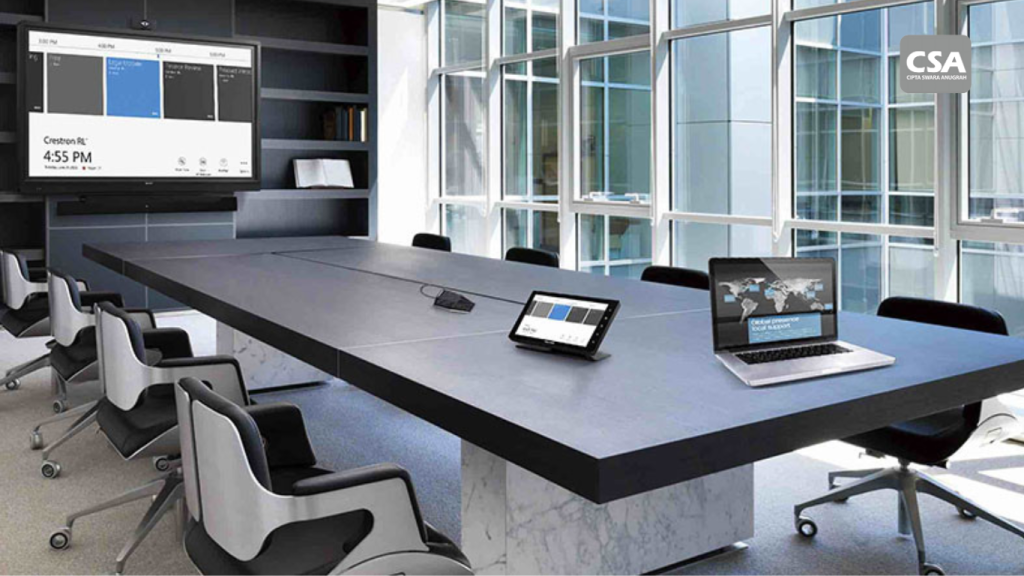
The Impact of Smart Meeting Rooms on Digital Transformation
Smart meeting rooms are more than just technology—they are a core part of digital transformation. By adopting modern systems, companies can build a more adaptive and collaborative work culture.
Teams become:
- More responsive to change
- More open to innovation
- Faster in executing ideas
This is critical in today’s highly competitive business environment.
Why Smart Meeting Rooms Are Essential in 2026
The shift toward digital work environments is inevitable. Companies that fail to adapt risk falling behind.
Smart meeting rooms are essential because:
- Hybrid work is becoming the norm
- Global communication is increasing
- Operational efficiency is a top priority
Early adopters gain a significant competitive advantage.
Tips to Maximize Smart Meeting Room Usage
To fully leverage the benefits, companies should implement the following strategies:
Use Technology Consistently
Ensure all teams regularly utilize the available systems.
Provide User Training
Train employees to maximize the use of technology.
Choose User-Friendly Systems
Simple and intuitive systems accelerate adoption.
Perform Regular Maintenance
Keep all devices in optimal condition to avoid disruptions.
Conclusion
Understanding the 10 Benefits of Smart Meeting Rooms is essential for companies aiming to improve productivity and operational efficiency. With its wide range of advantages, a smart meeting room transforms how teams collaborate—making it faster, smarter, and more effective.
This transformation is not just about adopting new technology. It is about building a future-ready workplace that is competitive, efficient, and innovative.
FAQ About Smart Meeting Rooms
1. What is a smart meeting room?
A smart meeting room is a meeting space equipped with advanced technology to support digital collaboration and communication.
2. What are the main benefits?
The main benefits include improved productivity, efficiency, and communication quality.
3. Is it suitable for small businesses?
Yes, it can be tailored to fit different business sizes and budgets.
4. How much does it cost?
Costs vary depending on the scale and technology used.
5. Is it difficult to use?
No, modern systems are designed to be user-friendly.
6. Does it require internet connectivity?
Yes, especially for video conferencing and cloud integration.
7. What are the main components?
Key components include interactive displays, cameras, microphones, and speakers.
8. Can it be used for training?
Yes, it is highly effective for presentations and training sessions.
9. Can it integrate with meeting platforms?
Yes, it supports platforms like Zoom, Microsoft Teams, and Google Meet.
10. How do you get started?
Start by identifying your needs and choosing a reliable solution provider.