
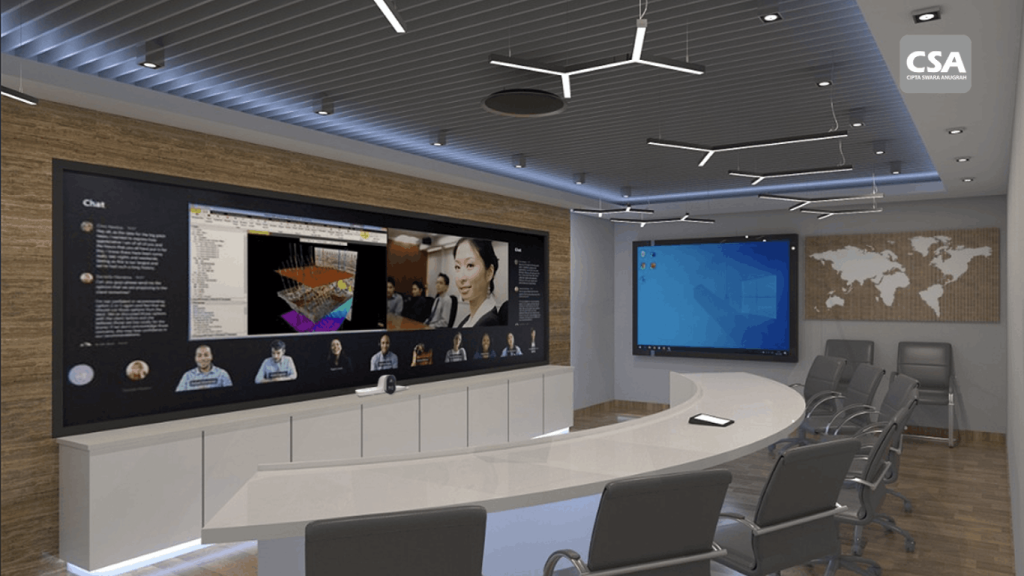
The way organizations conduct meetings has changed dramatically in recent years. Companies no longer rely solely on traditional face-to-face discussions. Teams now collaborate across offices, cities, and even continents. In this environment, the concept of Hybrid Meeting Room AV System with CSA Indonesia becomes increasingly relevant for businesses that demand seamless communication and reliable collaboration technology.
Modern organizations often host meetings where some participants are physically present while others join remotely. Without the right technology, this setup can easily lead to communication gaps. Poor audio clarity, delayed video feeds, and complicated system controls can disrupt discussions and reduce productivity.
To address these challenges, companies are investing in advanced audio visual solutions designed specifically for hybrid collaboration. CSA Indonesia plays a key role in helping organizations build professional meeting environments that support both in-room and remote participants. Through thoughtful system design and reliable AV integration, meeting spaces can operate smoothly and efficiently.
The Evolution of Meeting Rooms in the Hybrid Work Era
Meeting rooms have evolved significantly over the past decade. In the past, conference rooms were designed primarily for in-person discussions. A simple projector and speaker system were often sufficient.
Today, the demands are much higher. Businesses must support video conferencing, real-time presentations, remote collaboration, and content sharing across multiple devices. Meeting rooms must function as digital communication hubs rather than simple physical spaces.
The rise of hybrid work has accelerated this transformation. Many employees now split their time between office and remote work. As a result, organizations must ensure that everyone can participate in discussions equally, regardless of location.
This is where Hybrid Meeting Room AV System with CSA Indonesia becomes essential. By integrating professional AV technology with modern communication platforms, organizations can create meeting environments that connect people seamlessly.
Participants inside the room can interact naturally with colleagues who join remotely. Discussions remain focused, clear, and productive.
The Importance of Professional Audio Visual Systems
Audio visual technology forms the foundation of a modern meeting room. Without a reliable AV system, even the best collaboration platforms cannot deliver a smooth experience.
Audio clarity is one of the most important aspects of any meeting. When voices are unclear or distorted, discussions quickly become frustrating. Participants may miss key points or struggle to stay engaged.
Video quality also plays a major role. Remote participants rely on video to observe body language, presentations, and speaker interactions. A poorly configured camera setup can make remote attendees feel disconnected from the conversation.
A professionally integrated system ensures that every component works together seamlessly. Microphones capture voices clearly, cameras frame speakers accurately, and displays present content with sharp detail.
Through careful design and system integration, Hybrid Meeting Room AV System with CSA Indonesia delivers a reliable environment for high-level corporate meetings.

AV over IP Infrastructure for Flexible Communication
One of the most significant innovations in modern AV integration is the use of AV over IP technology. This approach allows audio and video signals to travel through standard network infrastructure rather than dedicated cabling.
Traditional AV systems often require complex wiring for each device. Expanding or modifying the system can be difficult and expensive. AV over IP simplifies this process by using network switches and IP-based devices.
This architecture offers several advantages. It allows flexible routing of audio and video signals across the entire system. Multiple displays can receive the same video feed simultaneously. Cameras and presentation sources can be distributed to various outputs without complicated rewiring.
In a Hybrid Meeting Room AV System with CSA Indonesia, this infrastructure ensures efficient communication between devices. Video conferencing systems, cameras, displays, and presentation laptops can share content across the network smoothly.
The system also becomes more scalable. If the organization expands the room or adds new equipment, integrators can extend the network without major structural changes.
AI Auto-Tracking Cameras for Natural Discussions
Video conferencing technology has advanced significantly in recent years. One of the most impactful innovations is the introduction of AI auto-tracking cameras.
These cameras use artificial intelligence to detect and follow active speakers during meetings. When a participant begins speaking, the camera automatically adjusts its framing to focus on that person.
This capability creates a more natural viewing experience for remote participants. Instead of seeing a static wide shot of the room, they can clearly observe the current speaker.
Manual camera control is no longer necessary. The system responds automatically to changes in conversation flow.
Within a Hybrid Meeting Room AV System with CSA Indonesia, AI camera technology enhances engagement for both in-room and remote attendees. Everyone can follow the discussion easily because the video presentation highlights the relevant speaker.
This feature also improves meeting recordings. When sessions are archived or reviewed later, viewers can quickly identify who is speaking at each moment.
Wireless Delegate Systems for Structured Discussions
In professional meeting environments, clear communication is essential. A wireless delegate system helps maintain organized discussions while ensuring every participant can be heard clearly.
Each participant receives an individual microphone unit. When someone wishes to speak, they simply activate their microphone using a dedicated button.
Moderators can manage speaking order through the system interface. Some systems also include priority functions for chairpersons, allowing them to guide discussions effectively.
Wireless solutions provide additional flexibility. Microphone units can be placed anywhere without complex cabling. This approach simplifies room layout and maintains a clean aesthetic.
When integrated into Hybrid Meeting Room AV System with CSA Indonesia, delegate microphones ensure that every voice reaches both in-room and remote participants clearly.
The system captures audio directly from each speaker, minimizing background noise and maintaining consistent sound quality throughout the meeting.
Designing Meeting Rooms Around User Experience
Technology should enhance communication rather than complicate it. One of the biggest challenges in meeting room design is ensuring that advanced systems remain easy to operate.
Many organizations install sophisticated AV equipment, but users struggle to control it. This issue often leads to delays and frustration during meetings.
CSA Indonesia approaches system design with user experience as a top priority. The goal is to create an intuitive environment that anyone can operate with minimal training.
Control interfaces are typically built around touch panels with clear commands. Users can start video conferences, select presentation sources, and control displays with just a few taps.
In a Hybrid Meeting Room AV System with CSA Indonesia, simplicity and functionality go hand in hand. The system feels natural to operate, allowing meeting participants to focus entirely on the discussion.
This approach is particularly valuable for executive boardrooms where efficiency and professionalism are critical.
System Reliability for Executive-Level Meetings
High-level corporate meetings demand absolute reliability. Technical disruptions during important discussions can undermine confidence and slow decision-making.
Professional AV integration focuses heavily on system stability. Network infrastructure, signal processing, and device management must all function consistently under heavy usage.
CSA Indonesia implements rigorous testing procedures before delivering any integrated meeting room solution. Every device undergoes configuration and performance checks to ensure compatibility within the system.
By applying these standards, Hybrid Meeting Room AV System with CSA Indonesia supports critical discussions without technical interruptions.
Executives can enter the meeting room with confidence, knowing that the system will operate smoothly throughout the session.
The Future of Hybrid Collaboration Technology
Hybrid collaboration will continue to shape the design of meeting spaces in the years ahead. Organizations are constantly searching for ways to improve communication across distributed teams.
Emerging technologies such as artificial intelligence, smart room automation, and advanced analytics are already influencing meeting environments.
Future systems may automatically adjust lighting, camera angles, and microphone sensitivity based on the number of participants in the room. Intelligent software could analyze discussion patterns and generate meeting summaries.
Interactive displays will also play a greater role in collaborative work. Teams will be able to write ideas, share documents, and brainstorm visually in real time.
The foundation built by Hybrid Meeting Room AV System with CSA Indonesia allows organizations to adopt these innovations gradually. Because the infrastructure is flexible and scalable, new technologies can be integrated without rebuilding the entire system.
Meeting rooms will continue evolving into intelligent collaboration spaces that connect teams across the world.
The Role of AV Integrators in Modern Meeting Rooms
Building a hybrid meeting environment requires more than simply installing cameras and microphones. Successful integration demands technical expertise, strategic planning, and a deep understanding of communication workflows.
AV integrators evaluate room acoustics, lighting conditions, seating layouts, and user requirements before designing the system architecture. Every component must operate harmoniously within the overall infrastructure.
CSA Indonesia specializes in delivering professional audio visual integration for corporate environments. Their approach combines advanced technology with practical usability.
Through careful planning and implementation, Hybrid Meeting Room AV System with CSA Indonesia enables organizations to create meeting spaces that support effective hybrid collaboration.
These environments empower teams to communicate clearly, share ideas freely, and make decisions efficiently, regardless of physical location.
Frequently Asked Questions (FAQ)
What is a hybrid meeting room?
A hybrid meeting room is a conference space designed to support both in-person and remote participants simultaneously using integrated audio visual and communication technologies.
Why are hybrid meeting rooms important for modern companies?
They allow teams located in different places to collaborate effectively while maintaining clear communication and professional meeting experiences.
What are the key components of a hybrid meeting room AV system?
Typical components include conference microphones, professional speakers, video conferencing cameras, displays, control systems, and network infrastructure.
What is AV over IP technology?
AV over IP distributes audio and video signals through standard network infrastructure. This approach increases flexibility, scalability, and efficiency in AV systems.
How do AI auto-tracking cameras improve meetings?
These cameras automatically focus on the active speaker. Remote participants can clearly see who is speaking without manual camera adjustments.
What is the role of an AV system integrator?
An AV integrator designs, installs, and configures audio visual systems so that all components work together smoothly and are easy for users to operate.
Can hybrid meeting systems be expanded in the future?
Yes. Modern AV infrastructures are designed to be scalable. Organizations can add new devices and technologies without replacing the entire system.