
The rapid evolution of digital workplaces has significantly increased the demand for integrated technology systems. That is why understanding how integrated AV systems work has become essential for companies looking to build modern communication environments, efficient workflows, and more professional meeting experiences.
In 2026, integrated AV systems are no longer considered optional meeting room technology. They have become a critical part of workplace transformation because they connect multiple audiovisual devices into a single ecosystem that operates automatically and seamlessly.
Many companies are transitioning from conventional systems to integrated AV solutions due to the growing need for hybrid working, modern video conferencing, and digital collaboration.
Without proper system integration, technology can actually create more complicated workflows and reduce productivity.
Integrated AV systems help businesses create smarter, more efficient, and future-ready workplaces.
What Is an Integrated AV System?
An integrated AV system is a solution that connects multiple audiovisual devices so they can operate synchronously through a centralized control platform.
These systems typically include:
- display systems
- audio systems
- PTZ cameras
- microphone systems
- wireless presentation solutions
- automation controls
- video conferencing platforms
All devices work together within one connected ecosystem.
The primary goal of an integrated AV system is to create a seamless and user-friendly communication experience.
Users no longer need to operate devices separately because the entire system works through one integrated workflow.
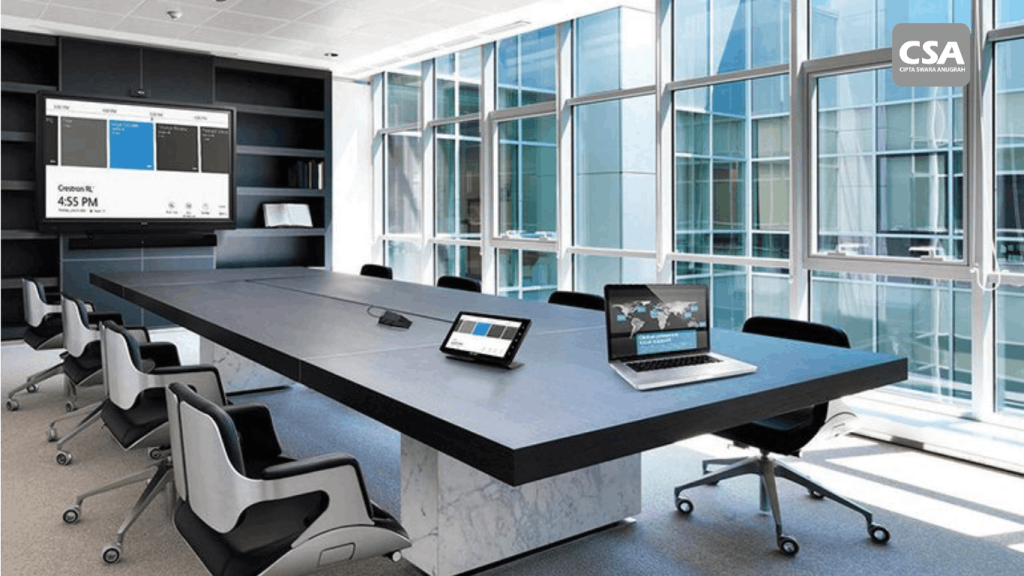
Why Integrated AV Systems Are Becoming More Important
Changes in working patterns have made business communication more complex than ever before.
Companies now need to support:
- hybrid meetings
- remote collaboration
- digital presentations
- video conferencing
- multi-device communication
Traditional audiovisual systems often struggle to support these needs efficiently.
As a result, many companies face issues such as:
- unsynchronized audio
- complicated device switching
- delayed meeting starts
- unstable communication quality
- frequent troubleshooting
Integrated AV systems solve these challenges through smarter and more connected technology integration.
Common Problems with Non-Integrated AV Systems
Many companies still rely on audiovisual devices that operate independently.
At first glance, these setups may seem functional. However, in daily operations, they often create technical challenges that reduce productivity.
Some of the most common problems include:
- delayed meeting starts
- audio feedback during conferences
- confusing HDMI switching
- cameras not synchronized with displays
- too many remote controls
- inconsistent sound quality
- time-consuming troubleshooting
Although these issues may appear minor, they can significantly impact operational efficiency.
In modern business environments, even a few minutes of delay can disrupt cross-department workflows.
This is why integrated AV systems have become essential for creating more seamless and professional workplaces.
How Integrated AV Systems Work in Modern Workplaces
The core concept behind integrated AV systems is device integration and automation.
The system connects all audiovisual devices into one centralized control ecosystem.
When users start a meeting, the system can automatically:
- activate displays
- power audio systems
- connect cameras
- activate microphones
- launch video conferencing platforms
either automatically or through a simple control panel.
This approach saves time and minimizes technical interruptions during meetings.
Real Example of Integrated AV Workflow in Modern Meetings
One of the biggest advantages of integrated AV systems is their ability to create practical automation workflows.
In modern implementations, users no longer need to turn on devices one by one manually.
When users enter a smart meeting room, occupancy sensors can immediately detect their presence.
The system then automatically:
- powers on the displays
- activates DSP audio
- starts the PTZ cameras
- connects the microphone systems
- adjusts lighting presets
Afterward, users simply select their preferred meeting platform through a touch panel.
The system instantly connects to:
- Microsoft Teams
- Zoom
- Google Meet
without requiring additional technical setup.
This workflow allows meetings to begin faster and operate more efficiently.
Centralized Control as the Core of the System
One of the most important components of an integrated AV system is centralized control.
This system allows users to manage multiple devices through a single interface.
Users can control:
- audio volume
- presentation sources
- lighting
- display switching
- camera tracking
- video conferencing systems
through one unified control platform.
This makes meeting workflows far more practical compared to traditional AV systems.
Integrated Audio Systems for Better Communication
Audio plays a critical role in integrated AV environments.
Modern audio systems commonly use:
- DSP processors
- ceiling speakers
- wireless microphones
- intelligent ceiling microphones
All audio devices work together to deliver clearer and more professional sound quality.
DSP processors help manage:
- echo cancellation
- noise reduction
- audio balancing
- voice clarity
to ensure comfortable communication throughout meetings.
Intelligent Microphones Improve Hybrid Meetings
The rise of hybrid meetings has increased the importance of intelligent microphone technology.
Modern ceiling microphones can capture participants’ voices naturally without requiring handheld microphones.
This creates communication that feels:
- more natural
- more comfortable
- more professional
Some intelligent microphones can even automatically detect the direction of the speaker’s voice.
This significantly improves the quality of hybrid communication.
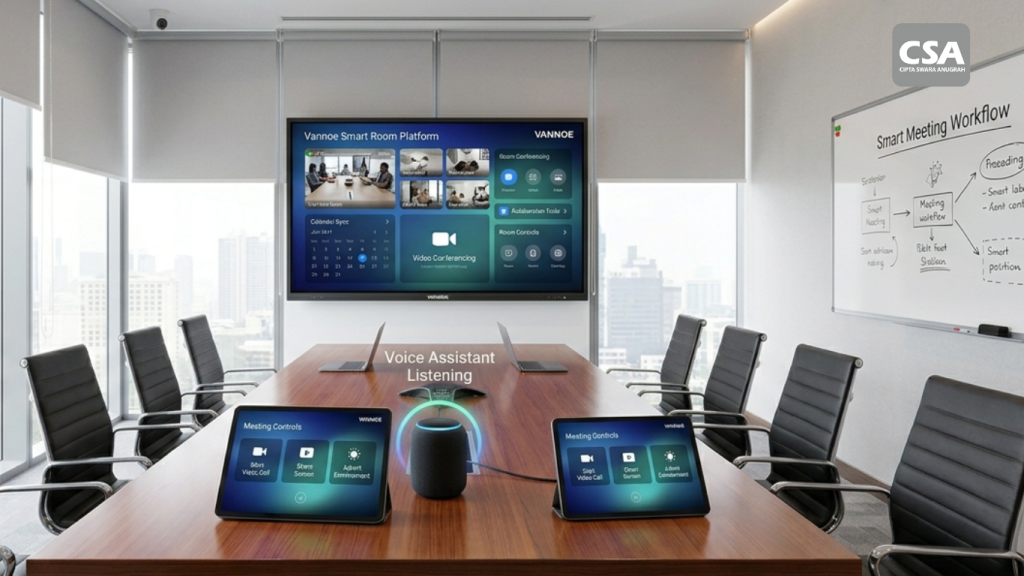
Read Also: How Smart Meeting Rooms Work at CSA Indonesia to Support More Efficient Modern Hybrid Meetings
PTZ Cameras Enable Automatic Speaker Tracking
Modern integrated AV systems commonly use PTZ cameras.
PTZ stands for:
- Pan
- Tilt
- Zoom
These cameras can automatically move and follow speakers during meetings.
AI-based camera tracking technology helps identify speaker positions and creates more professional video conferencing experiences.
PTZ cameras are especially important for:
- hybrid meetings
- executive boardrooms
- auditoriums
- training rooms
- smart meeting rooms
because they greatly improve visual communication quality.
Display Systems as Modern Collaboration Tools
Display systems serve as the visual communication center of integrated AV environments.
Modern companies commonly use:
- interactive displays
- video walls
- professional displays
- wireless presentation displays
These technologies make meetings:
- more interactive
- more collaborative
- easier to understand
Interactive displays also allow users to perform:
- digital annotations
- brainstorming sessions
- wireless screen sharing
- collaborative presentations
in real time.
Wireless Presentation Improves Workflow Efficiency
Wireless presentation technology has become one of the most valuable tools for modern workplaces.
Users no longer need complicated cable setups for presentations.
Wireless presentation systems allow:
- screen sharing
- presentation switching
- collaborative sharing
directly from laptops or mobile devices.
This approach makes meetings faster and more practical.
Automation Systems Create Seamless Meeting Experiences
Automation has become a major component of modern integrated AV systems.
Automation technology allows multiple devices to operate automatically based on predefined presets.
For example:
- lights automatically turn on when meetings begin
- displays activate instantly
- audio systems start automatically
- video conferencing platforms connect immediately
Automation workflows help reduce inefficient manual processes.
Direct Integration with Video Conferencing Platforms
Modern integrated AV systems are directly connected to popular video conferencing platforms such as:
- Microsoft Teams
- Zoom
- Google Meet
This integration allows hybrid meetings to run more smoothly and efficiently.
Users can switch between platforms without complicated setup processes.
This is especially beneficial for companies with cross-platform communication workflows.
Integrated AV Systems Improve Operational Efficiency
One of the biggest benefits of integrated AV systems is increased operational efficiency.
Integrated systems help companies:
- accelerate meeting workflows
- reduce troubleshooting
- improve communication quality
- enhance user experience
- simplify daily operations
In modern workplaces, efficiency plays a crucial role in maintaining productivity.
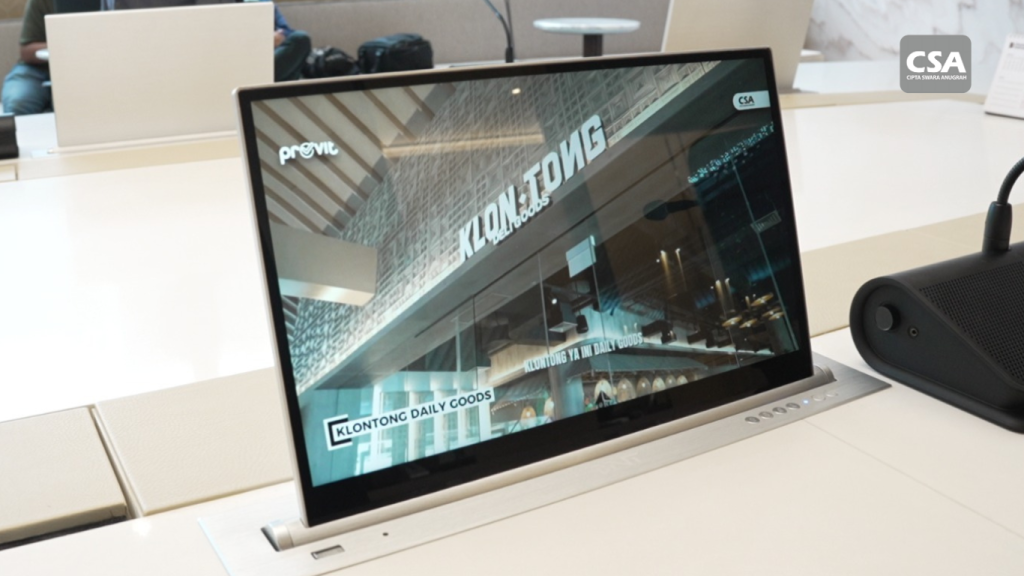
Read Also: Best Smart Meeting Room Vendor CSA Indonesia for Modern and Intelligent Meeting Solutions
Why Companies Need the Right AV System Integrator
Building an integrated AV system is not simply about purchasing premium hardware.
Companies also need proper system integration to ensure all technologies operate reliably.
That is why AV system integrators play a critical role.
Integrators help ensure:
- device compatibility
- optimized workflows
- user-friendly systems
- stable automation
- comfortable user experiences
AV system integrators also support companies through:
- system design
- programming
- deployment
- commissioning
- troubleshooting
- after-sales support
This approach helps businesses achieve reliable long-term system performance.
Why Traditional AV Systems Are Being Replaced
Many companies are moving away from traditional audiovisual systems because they lack flexibility.
Conventional setups often suffer from:
- standalone devices
- separate controls
- complicated installations
- unstable communication
In the era of hybrid collaboration, these approaches are no longer effective.
Modern companies require systems that are:
- more seamless
- more automated
- more scalable
- more future-ready
Integrated AV systems provide solutions for these evolving workplace demands.
Integrated AV Systems for Various Industries
Integrated AV systems are now widely used across many industries.
Each industry has different operational and communication requirements.
Therefore, integration systems must be designed according to specific business needs.
Common integrated AV implementations include:
Corporate Offices
Supporting hybrid meetings, executive boardrooms, and collaborative workspaces.
Command Centers
Providing real-time monitoring with integrated display management and communication systems.
Auditoriums and Training Rooms
Supporting large-scale presentations with professional audiovisual performance.
Educational Facilities
Enhancing digital learning through interactive displays and intelligent collaboration.
Hospitality Industry
Used for ballroom systems, conference rooms, and digital presentation environments.
This flexibility makes integrated AV systems ideal for modern business operations.
Integrated AV Systems Support Smart Meeting Rooms
Smart meeting rooms cannot function optimally without integrated AV systems.
Integration serves as the foundation of modern workplace communication.
Integrated AV systems help smart meeting rooms deliver:
- intelligent collaboration
- automation workflows
- wireless communication
- centralized control
- seamless meeting experiences
This creates meetings that are more efficient and more professional.
AI and Workplace Automation Will Continue to Evolve
As technology advances toward 2026, integrated AV systems are becoming increasingly intelligent.
Modern systems now adopt technologies such as:
- AI camera tracking
- occupancy sensors
- smart automation
- intelligent scheduling
- voice automation
These technologies help workplaces become:
- more automated
- more efficient
- more adaptive
- more user-friendly
Companies adopting workplace automation often achieve significantly more modern workflows compared to traditional systems.
The Future of Integrated AV Systems
The future of integrated AV systems is moving toward intelligent automation ecosystems.
Modern systems are increasingly adopting:
- AI camera tracking
- voice automation
- occupancy analytics
- smart scheduling
- intelligent sensor technology
These innovations help workplaces become more:
- automated
- efficient
- adaptive
- user-friendly
In the future, modern workplaces will rely heavily on intelligent automation and smart building technologies.
Integrated AV systems are no longer just communication tools. They are becoming the foundation of smart workplace development.
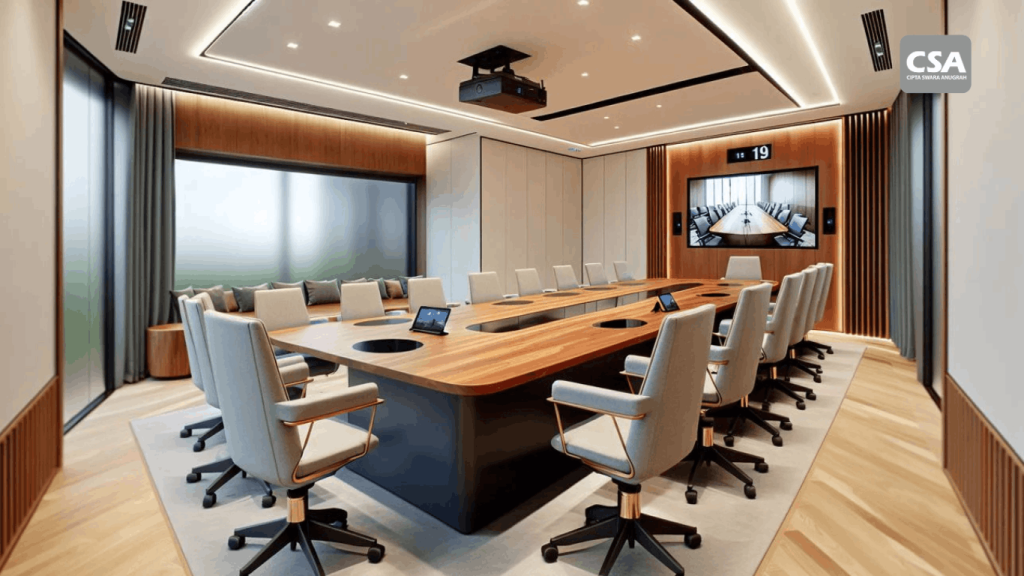
Integrated AV Systems as Long-Term Investments
Many companies now see integrated AV systems as long-term investments.
These systems help businesses:
- increase productivity
- improve communication speed
- enhance meeting quality
- support hybrid collaboration
- create modern workplaces
For this reason, integrated AV systems have become an essential part of digital transformation strategies.
Conclusion
Understanding how integrated AV systems work is essential for companies aiming to build efficient, connected, and future-ready workplaces.
By integrating audio systems, camera systems, display technologies, automation controls, and video conferencing platforms into one centralized ecosystem, integrated AV systems help businesses create more seamless and professional communication environments.
In the era of hybrid working and digital collaboration, integrated AV systems are no longer optional technologies. They have become the foundation of modern business communication.
FAQ About Integrated AV Systems
1. What is an integrated AV system?
An integrated AV system is a technology solution that connects multiple audiovisual devices into one centralized and synchronized control system.
2. What are the benefits of integrated AV systems?
Integrated AV systems improve meeting efficiency, simplify communication workflows, reduce technical issues, and create more professional collaboration experiences.
3. Why are integrated AV systems important for modern workplaces?
Modern workplaces require seamless communication, hybrid collaboration, and automation workflows that traditional AV systems often cannot provide efficiently.
4. What devices are commonly included in an integrated AV system?
Integrated AV systems typically include:
- displays
- PTZ cameras
- DSP audio processors
- microphones
- wireless presentation systems
- automation controls
- video conferencing platforms
5. What is centralized control in an AV system?
Centralized control allows users to manage multiple devices such as audio, video, lighting, and conferencing systems through one interface or touch panel.
6. How do PTZ cameras work in smart meeting rooms?
PTZ cameras automatically pan, tilt, and zoom to follow speakers during meetings, creating more professional video conferencing experiences.
7. Why are intelligent microphones important for hybrid meetings?
Intelligent microphones capture voices clearly without requiring handheld microphones, making hybrid communication more natural and comfortable.
8. What is the role of DSP processors in integrated AV systems?
DSP processors manage:
- echo cancellation
- noise reduction
- audio balancing
- voice clarity
to improve communication quality during meetings.
9. How does automation improve meeting room efficiency?
Automation systems can automatically activate displays, cameras, audio systems, and lighting presets when meetings begin, reducing manual setup time.
10. Which video conferencing platforms are compatible with integrated AV systems?
Most integrated AV systems support platforms such as:
- Microsoft Teams
- Zoom
- Google Meet
and other enterprise communication platforms.
11. Why do companies need professional AV system integrators?
AV system integrators ensure proper system design, compatibility, programming, deployment, and long-term operational stability.
12. Can integrated AV systems be used outside meeting rooms?
Yes. Integrated AV systems are also widely used in:
- command centers
- auditoriums
- educational facilities
- hospitality venues
- training rooms
- corporate offices
13. Are integrated AV systems scalable for future technology upgrades?
Yes. Modern integrated AV systems are designed to be scalable and adaptable for future workplace technologies and automation developments.
14. What industries benefit the most from integrated AV systems?
Industries that benefit greatly include:
- corporate enterprises
- education
- hospitality
- government
- healthcare
- entertainment
- smart building environments
15. Why are integrated AV systems considered future-ready technology?
Because they support automation, AI-based collaboration, hybrid working environments, and intelligent workplace ecosystems that continue evolving in modern businesses.