
A Meeting Room Sound System has become one of the most important elements in creating an effective, professional, and productive meeting environment. As hybrid work models, digital transformation, and remote collaboration continue to grow, companies can no longer rely solely on meeting tables, projectors, or presentation screens. Communication quality has become a critical factor in determining the success of every meeting.
Many organizations invest heavily in high-resolution cameras and large-format displays. However, they often overlook one component that has the greatest impact on the overall meeting experience: the audio system. Participants can usually follow a presentation even when video quality drops slightly. In contrast, communication immediately suffers when audio is unclear, distorted, interrupted, or filled with echo.
In 2026, meeting rooms have evolved into collaborative business hubs that connect employees, clients, vendors, and strategic partners across different locations. As a result, a professionally designed sound system has become an essential investment for companies looking to improve productivity while maintaining a professional corporate image.
Why Is a Sound System Important in a Meeting Room?
Every meeting is fundamentally about communication.
The primary goal of any meeting is to share information, discuss ideas, solve problems, and make decisions.
All of these activities depend on clear and reliable communication.
When participants cannot hear each other properly, discussions become less effective. Misunderstandings occur more frequently, and decision-making processes slow down.
Common audio issues include:
- Low speaker volume
- Uneven sound distribution
- Echo during video conferences
- Poor audio quality for remote participants
- Excessive background noise
These problems can negatively affect meeting efficiency and reduce team productivity.
For this reason, a sound system should never be treated as an optional feature. It serves as the foundation of effective communication in modern meeting spaces.
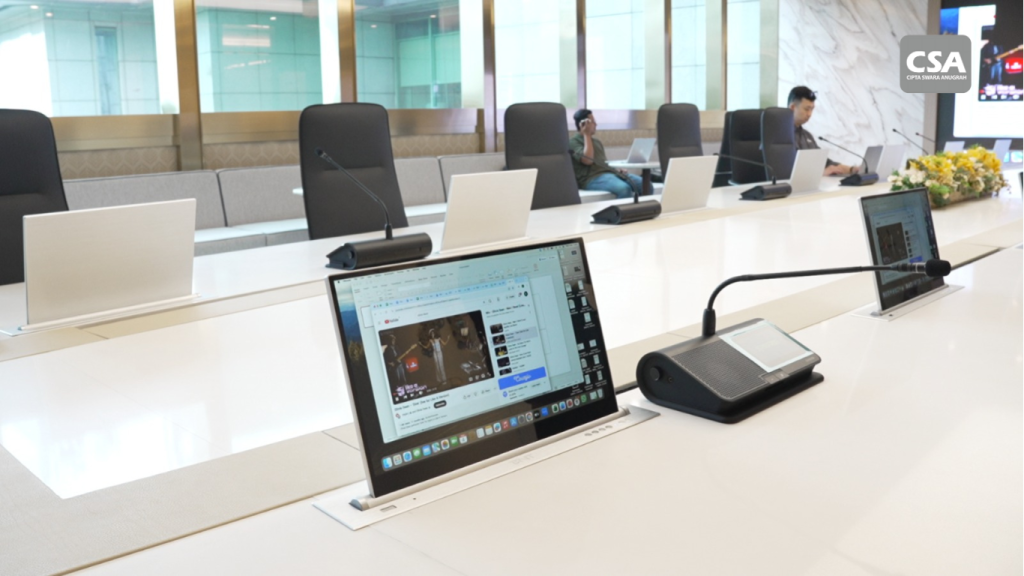
The Evolution of Meeting Rooms in the Hybrid Work Era
Work environments have changed significantly over the past few years.
Many organizations now operate with hybrid work models that combine in-office and remote employees.
This shift has introduced new communication challenges.
Participants attending physically must be able to communicate seamlessly with those joining through video conferencing platforms.
In this environment, audio quality becomes one of the most important factors in meeting success.
A properly designed sound system ensures an equal communication experience for all participants, regardless of their location.
Primary Functions of a Meeting Room Sound System
Modern audio systems do much more than simply amplify sound.
Today’s technology is designed to create natural, comfortable, and efficient communication experiences.
Delivering Clear Speech
Professional microphones capture voices accurately, ensuring everyone can hear clearly.
Maintaining Consistent Audio Levels
Modern systems keep sound levels balanced throughout the meeting.
Supporting Two-Way Communication
Both in-room and remote participants can communicate without interruptions.
Reducing Audio Disturbances
Advanced audio processing technologies help eliminate unwanted background noise.
Enhancing Video Conferencing Experiences
High-quality audio significantly improves the effectiveness of hybrid meetings.
Essential Components of a Meeting Room Sound System
To achieve optimal performance, a meeting room requires several key audio components.
Conference Microphones
Microphones capture participants’ voices during discussions.
Many organizations now use microphone array systems capable of capturing sound from multiple directions automatically.
This technology creates a more natural discussion environment.
DSP Audio Processor
A Digital Signal Processor (DSP) acts as the brain of a modern audio system.
It processes audio signals in real time to improve clarity and consistency.
DSP technology also helps eliminate echo and other audio issues.
Professional Speakers
Speakers distribute sound evenly throughout the room.
The type and number of speakers should match the room’s size and layout.
Amplifiers
Amplifiers strengthen audio signals before they are delivered to speakers.
They help ensure consistent and clear sound coverage throughout the meeting space.
Audio Networking Systems
Network-based audio technologies provide greater flexibility and efficiency for modern meeting room installations.
Audio Technologies Becoming Standard in 2026
Audio technology continues to evolve rapidly.
Several innovations are becoming standard features in modern meeting environments.
Echo Cancellation
This technology removes unwanted sound reflections that commonly occur during video conferences.
Noise Reduction
Advanced systems filter out background noise, allowing speech to remain clear and intelligible.
Automatic Gain Control
This feature automatically adjusts volume levels to maintain consistent speech clarity.
AI Audio Processing
Artificial Intelligence is increasingly used to identify human speech and optimize audio quality automatically.
Beamforming Microphones
These microphones focus on capturing voices from specific locations while minimizing unwanted sounds.
Common Mistakes in Meeting Room Sound System Installations
Many companies invest heavily in audio equipment but fail to achieve the desired results.
In most cases, the problem lies in poor planning rather than the equipment itself.
Ignoring Room Acoustics
Room acoustics play a major role in audio performance.
Excessive sound reflections can create echo and reduce speech intelligibility.
Choosing the Wrong Speakers
Speakers that do not match the room size often lead to uneven sound coverage.
Poor Microphone Placement
Microphone positioning directly affects audio quality.
Not Using DSP Technology
Without DSP processing, audio systems are more vulnerable to noise, echo, and inconsistent performance.
Overlooking Hybrid Meeting Requirements
Many meeting rooms are still designed primarily for in-person participants.
Modern workplaces require equal communication experiences for both on-site and remote attendees.
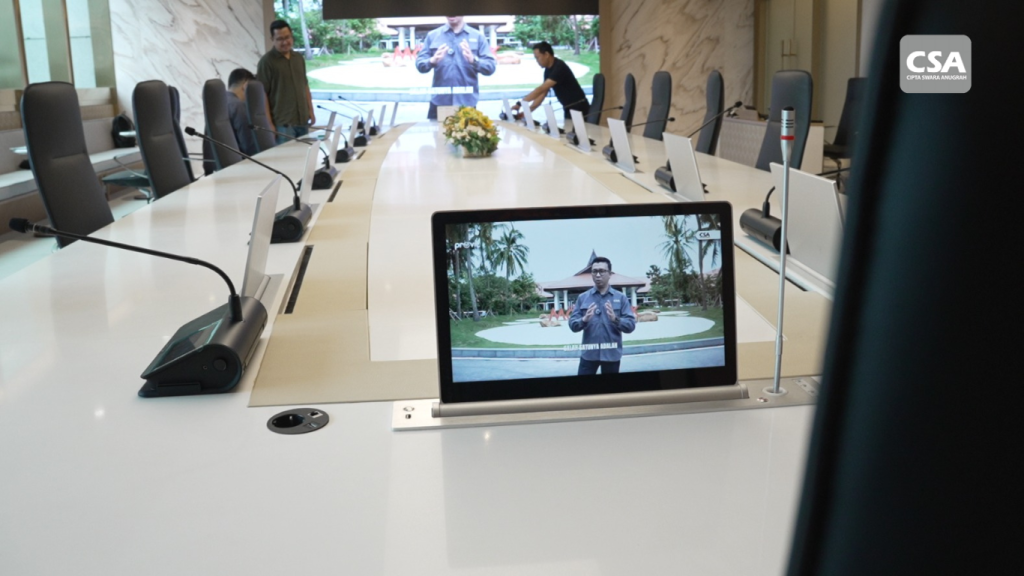
Read Also: Advanced Hybrid Meeting Room: A Modern Meeting Room Solution for Companies
How Sound Systems Improve Business Productivity
Investing in a professional audio system offers benefits that extend far beyond improved sound quality.
More Effective Communication
Information can be shared and understood more clearly.
Faster Decision-Making
Meetings proceed smoothly without technical interruptions.
Better Time Efficiency
Less time is wasted troubleshooting audio issues.
Stronger Professional Image
Clear communication creates a positive impression on clients and business partners.
Improved Team Collaboration
Participants can engage actively regardless of their location.
How to Choose the Right Meeting Room Sound System
Every meeting room has unique requirements.
Several factors should be considered when selecting an audio solution.
Room Size
Room dimensions affect speaker coverage, microphone requirements, and amplifier selection.
Number of Participants
Larger groups often require more advanced audio configurations.
Meeting Activities
Internal meetings, client presentations, training sessions, and hybrid conferences all have different audio needs.
Video Conferencing Integration
The audio system should work seamlessly with platforms such as Microsoft Teams, Zoom, Google Meet, and Cisco Webex.
Ease of Use
Technology should remain user-friendly and accessible to all employees.
Integrating Sound Systems with Modern Meeting Room Technologies
Today, organizations rarely deploy audio systems as standalone solutions.
Instead, they integrate multiple technologies into a unified meeting room ecosystem.
Common integrations include:
- Video conferencing systems
- Interactive displays
- Wireless presentation solutions
- Room automation systems
- Digital signage
- Centralized control platforms
This integrated approach creates a more efficient and professional meeting experience.
Users can manage multiple technologies through a single, intuitive interface.
The Future of Meeting Room Sound Systems
Audio technology will continue becoming smarter and more sophisticated.
Artificial Intelligence, cloud-based management, and automation will play increasingly important roles in modern meeting environments.
In the future, sound systems will serve as more than communication tools.
They will become strategic assets that support collaboration, digital transformation, and business growth.
Organizations that invest in professional audio solutions today will be better positioned to meet future communication demands.
CSA Indonesia as a Professional Meeting Room Sound System Solution Provider
Building an effective meeting room sound system requires more than high-quality equipment. System planning, acoustic design, equipment selection, technology integration, and commissioning all play equally important roles in determining the final outcome.
Many organizations struggle with poor audio performance because their systems are not designed according to room characteristics and user requirements. As a result, sound quality suffers even when premium equipment is used.
To avoid these challenges, businesses need a trusted partner with a comprehensive understanding of modern communication requirements.
CSA Indonesia specializes in Audio, Visual, Lighting, and Automation solutions, helping organizations create modern meeting environments tailored to their business needs.
Through a consultative approach, CSA Indonesia assists companies in designing systems that match room size, participant capacity, hybrid meeting requirements, and video conferencing integration needs.
Solutions offered include:
- Meeting room sound systems
- Video conferencing solutions
- Integrated AV systems
- Smart meeting rooms
- Wireless presentation systems
- Automation control systems
- Centralized room management platforms
With proper planning and implementation, organizations can achieve clearer audio, more professional meeting experiences, and systems that are easy for users to operate.
As digital collaboration continues to expand in 2026, investing in professionally designed meeting room sound systems is no longer simply a technical decision. It has become an essential strategy for improving productivity, accelerating communication, and supporting long-term business growth.
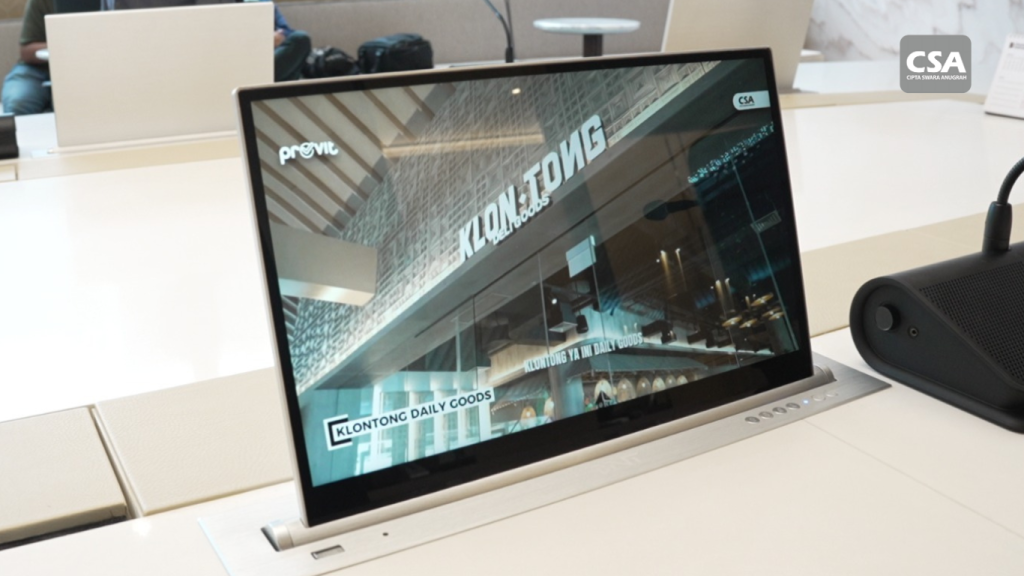
Read Also: Best Smart Meeting Room Vendor CSA Indonesia for Modern and Intelligent Meeting Solutions
Conclusion
A Meeting Room Sound System serves as the foundation of effective, productive, and professional communication. High-quality audio helps organizations improve collaboration, accelerate decision-making, and support successful hybrid work environments.
By selecting the right audio solution, optimizing room acoustics, and integrating modern technologies, businesses can create more efficient meeting experiences while supporting long-term organizational growth.
Working with an experienced partner such as CSA Indonesia also ensures that every audio-visual component performs optimally, maximizing the return on technology investments.
Frequently Asked Questions (FAQ)
What is a meeting room sound system?
A meeting room sound system is an audio solution specifically designed to support communication, presentations, and video conferencing in meeting spaces.
Why is audio quality more important than video quality?
Communication becomes ineffective when participants cannot hear clearly, even if video quality remains acceptable.
What is the role of a DSP in a meeting room audio system?
A DSP processes audio signals to improve clarity, reduce noise, and eliminate echo.
Do small meeting rooms require professional audio systems?
Yes. Clear communication remains essential regardless of room size.
What causes echo during video conferences?
Echo is typically caused by sound reflections within the room or improper audio system configuration.
What are the benefits of microphone array technology?
Microphone arrays capture voices from multiple directions, creating a more natural communication experience.
How do I choose the right speakers for a meeting room?
Speaker selection should be based on room size, participant capacity, usage requirements, and acoustic characteristics.
Can a meeting room sound system integrate with Microsoft Teams and Zoom?
Yes. Modern audio systems can seamlessly integrate with Microsoft Teams, Zoom, Google Meet, and Cisco Webex.
Why are room acoustics important?
Proper acoustics help reduce sound reflections and improve speech intelligibility during meetings.
Why should companies work with a system integrator like CSA Indonesia?
A professional integrator ensures that audio-visual technologies are properly designed, implemented, and optimized to meet business requirements and maximize performance.