
How Much Does Audio Visual Integration Cost for a Company? This is one of the most common questions businesses ask when planning to build a modern meeting room, boardroom, training center, command center, or collaborative workspace. Every company wants to invest wisely while ensuring that the technology they implement supports long-term productivity and business growth.
Unlike purchasing individual audio visual equipment, Audio Visual Integration does not have a fixed price. Every project is unique, with different room sizes, operational requirements, technologies, and integration levels. As a result, the investment required for one company may differ significantly from another.
Understanding the factors that influence the overall cost will help businesses create a realistic budget, avoid unnecessary expenses, and choose a solution that delivers long-term value.
Why Isn’t There a Standard Price for Every Project?
Many companies expect a straightforward answer when asking about the cost of Audio Visual Integration.
In reality, providing a single price is impossible because every project is designed according to specific business requirements.
Some organizations only require a small meeting room equipped for presentations and online meetings. Others need multiple conference rooms, executive boardrooms, training facilities, auditoriums, or command centers connected through one integrated system.
Business objectives also play a significant role.
A room intended for hybrid meetings requires different technologies than a space designed for executive presentations, large-scale conferences, or mission-critical operations.
This is why professional consultation and site assessment are essential before determining the overall project budget.
How Much Does Audio Visual Integration Cost for a Company? Key Factors That Affect the Investment
Read Also: Meeting Room Solution: The Key to Creating an Efficient and Professional Modern Meeting Space
Factor 1 – Room Size and Room Function
The size of the room is one of the most important factors affecting the total investment.
Larger spaces require additional equipment to ensure every participant experiences clear audio, excellent visibility, and reliable communication.
For example, a small meeting room may only require a display, conference camera, microphones, and speakers.
An auditorium, however, requires multiple loudspeakers, additional microphones, larger displays, signal distribution systems, and more sophisticated control technologies.
The room’s intended function also influences system complexity.
An executive boardroom demands different performance standards compared to a training room, collaboration space, or command center.
Factor 2 – Display Technology Selection
Display technology represents a significant portion of an Audio Visual Integration project.
The right solution depends on room size, viewing distance, presentation style, and collaboration requirements.
Common display options include:
- Interactive Flat Panel
- Commercial Display
- LED Display
- Video Wall
- Projector
Each technology offers different capabilities and investment levels.
Interactive Flat Panels are ideal for collaborative meetings and interactive presentations.
LED Displays are better suited for large venues that require exceptional brightness and seamless visual performance.
Selecting the most appropriate display helps maximize both presentation quality and return on investment.
Factor 3 – Professional Audio System
Clear communication is impossible without high-quality audio.
Professional audio systems are designed to ensure that every participant can hear and be heard clearly, regardless of room size.
Project costs are influenced by components such as:
- Professional Speakers
- Power Amplifiers
- Digital Signal Processors (DSP)
- Audio Mixers
- Conference Audio Systems
Larger or acoustically challenging rooms require more advanced system designs to eliminate echo, feedback, and uneven sound distribution.
Investing in a properly engineered audio system significantly improves meeting efficiency and communication quality.
Factor 4 – Video Conferencing Cameras
Hybrid meetings have become an essential part of modern business communication.
Consequently, conference cameras now play a critical role in every meeting room project.
Popular options include:
- USB Conference Cameras
- PTZ Cameras
- Auto-Tracking Cameras
Higher-end cameras provide better image quality, wider viewing angles, intelligent speaker tracking, and superior zoom capabilities.
The right camera should be selected based on room dimensions, participant capacity, and the company’s collaboration requirements.
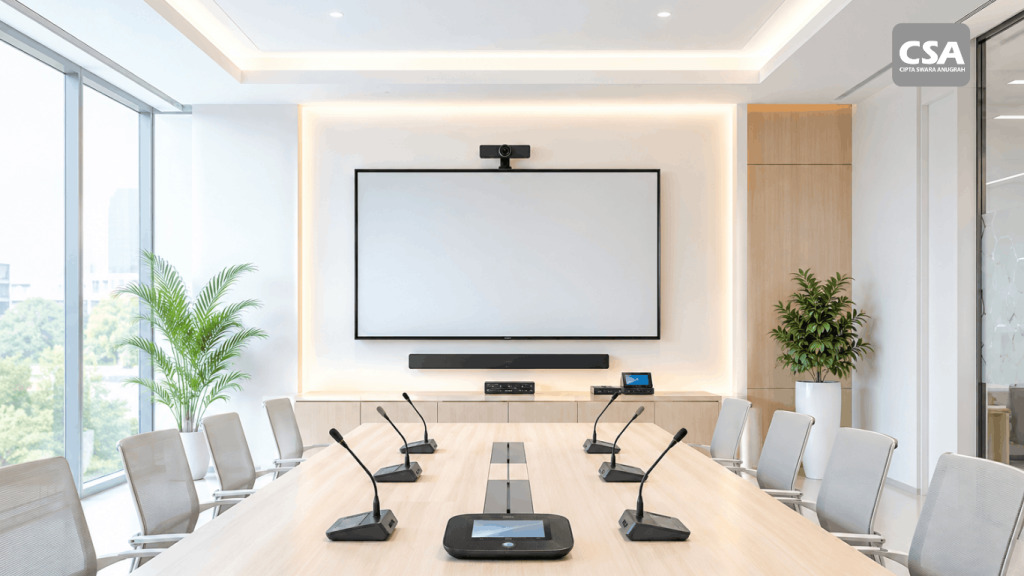
Factor 5 – System Integration and Automation
This is the factor that truly differentiates Audio Visual Integration from a conventional AV installation.
Instead of operating multiple devices independently, businesses invest in a unified system where every component communicates seamlessly.
For example, users simply press a “Start Meeting” button.
Instantly:
- The display powers on.
- The conference camera activates.
- Microphones become operational.
- Audio systems are ready.
- Lighting adjusts automatically.
- The video conferencing platform launches.
The higher the level of automation and integration, the greater the engineering, programming, configuration, and commissioning effort required.
Although this increases the initial investment, it delivers substantial long-term benefits through improved productivity, easier operation, and reduced technical support requirements.
Factor 6 – Wireless Presentation Systems
Modern meeting rooms are expected to provide a fast and seamless presentation experience.
Traditional HDMI cables often limit mobility, create clutter, and consume valuable meeting time whenever users need to switch presenters.
A Wireless Presentation System eliminates these challenges by allowing participants to share content directly from laptops, tablets, or smartphones without physical cables.
Although this technology increases the overall project investment, it significantly improves efficiency, simplifies collaboration, and creates a cleaner meeting environment.
For organizations that conduct presentations frequently, this feature often becomes a worthwhile long-term investment.
Factor 7 – Network Infrastructure
A reliable network infrastructure is the foundation of every successful Audio Visual Integration project.
Many businesses focus on purchasing premium AV equipment while overlooking the importance of the underlying network.
In reality, technologies such as AV over IP, centralized control systems, video conferencing platforms, and remote monitoring all depend on a stable and properly designed network.
Project costs may include:
- Structured network cabling
- Managed network switches
- Power over Ethernet (PoE)
- Fiber optic infrastructure
- Network configuration and optimization
A well-designed network not only improves system reliability but also supports future expansion without requiring major infrastructure changes.
Factor 8 – Number of Rooms to Be Integrated
The number of meeting spaces included in the project also has a direct impact on the total investment.
A company integrating a single meeting room will naturally require a different budget than an organization implementing technology across multiple meeting rooms, executive boardrooms, training centers, auditoriums, and command centers.
However, integrating several rooms within one project often provides greater consistency and simplifies long-term management.
It also allows centralized monitoring and standardized user experiences throughout the organization.
Factor 9 – Installation, Programming, and Commissioning
Installing AV equipment is only one part of a successful integration project.
Professional Audio Visual Integration also includes system programming, equipment configuration, testing, calibration, and commissioning.
Every device must communicate correctly with the others before the system is ready for daily operation.
Experienced integrators carefully test every function, ensuring displays, cameras, microphones, speakers, control systems, and conferencing platforms operate as one complete solution.
Proper commissioning minimizes technical issues after deployment and ensures users receive the best possible experience from day one.
Factor 10 – Maintenance and After-Sales Support
Technology requires ongoing maintenance to maintain optimal performance.
Routine inspections, firmware updates, preventive maintenance, and technical support help extend equipment lifespan while reducing unexpected downtime.
Companies that include maintenance services within their investment often experience lower operational risks and faster issue resolution.
Reliable after-sales support also protects the company’s investment over many years.
Common Mistakes That Increase Project Costs
Many businesses unintentionally increase their Audio Visual Integration budget because of poor planning.
Some of the most common mistakes include:
- Purchasing equipment without a complete system design.
- Mixing incompatible products from different manufacturers.
- Choosing solutions based solely on the lowest price.
- Ignoring future expansion requirements.
- Upgrading equipment gradually without a long-term strategy.
- Overlooking network readiness before installation.
These decisions frequently result in additional redesign costs, repeated installations, and unnecessary equipment replacements.
Proper planning at the beginning of the project is almost always more cost-effective than correcting mistakes later.
How to Optimize Your Audio Visual Integration Budget
Companies should focus on value rather than simply looking for the lowest quotation.
A successful project begins with understanding business objectives, room functions, collaboration requirements, and future growth plans.
Working with an experienced Audio Visual Integrator allows businesses to:
- Identify the most appropriate technologies.
- Eliminate unnecessary equipment.
- Design scalable systems.
- Improve operational efficiency.
- Reduce long-term maintenance costs.
- Maximize return on investment.
Instead of purchasing more equipment than necessary, businesses invest only in technologies that truly support their operations.
Partner with CSA Indonesia for Professional Audio Visual Integration
Determining the right investment requires more than comparing equipment prices.
It requires professional planning, accurate system design, and proper implementation.
As a trusted provider of Audio, Visual, Lighting, and Automation solutions, CSA Indonesia (Cipta Swara Anugrah) offers comprehensive Audio Visual Integration services for corporate offices, meeting rooms, auditoriums, command centers, educational institutions, healthcare facilities, hotels, and various commercial environments.
From consultation and site surveys to system design, installation, integration, commissioning, and maintenance, CSA Indonesia delivers complete solutions tailored to each client’s operational requirements and future business growth.
Conclusion
The cost of Audio Visual Integration varies because every company has different operational needs, room configurations, collaboration methods, and technology requirements.
Rather than asking for a fixed price, businesses should first understand the factors that influence the total investment, including room size, display technology, professional audio systems, conferencing cameras, automation, network infrastructure, installation, and long-term maintenance.
By carefully evaluating these factors and partnering with an experienced Audio Visual Integrator, companies can build a reliable, scalable, and future-ready AV ecosystem that enhances productivity while delivering long-term business value.
FAQ
How much does Audio Visual Integration cost for a company?
There is no standard price because every project has unique requirements. The total investment depends on room size, equipment selection, integration complexity, and business objectives.
What factors have the biggest impact on project cost?
The primary factors include room size, display technology, audio systems, conference cameras, automation, network infrastructure, installation, commissioning, and maintenance services.
Is Audio Visual Integration only suitable for large enterprises?
No. Businesses of all sizes can implement Audio Visual Integration. The system can be designed according to the company’s operational requirements and available budget.
Can an existing meeting room be upgraded instead of building a new one?
Yes. Many organizations upgrade their existing meeting rooms by integrating new technologies while utilizing compatible equipment already in place, reducing unnecessary investment.
Why should companies work with a professional Audio Visual Integrator?
A professional integrator ensures proper system design, equipment compatibility, reliable performance, and scalable solutions that support future business expansion.
How can companies obtain an accurate project estimate?
The best approach is to schedule a consultation and site survey with an experienced Audio Visual Integrator. This process helps identify business needs and provides an investment estimate tailored to the project requirements.