
What Devices Are Included in an Integrated Audio Visual System is one of the most important questions for companies planning to build smart meeting rooms and modern buildings that are efficient, connected, and ready for hybrid collaboration. An integrated audio visual system is not just a collection of devices installed in a room. It is a fully connected ecosystem where every component works together seamlessly to support clear communication and smooth collaboration.
In modern workplaces, communication is no longer simple. Meetings often involve both in-person and remote participants. Presentations must be clear, audio must be stable, and room controls must be easy to operate. All of this can only be achieved when audio visual devices are designed as one integrated system.
What Is an Integrated Audio Visual System?
An integrated audio visual system is a combination of audio, visual, control, and network technologies that are connected and managed as a single unified platform.
The main goal is to simplify user interaction while improving communication quality.
Instead of operating each device separately, users can control the entire system through a centralized interface.
This system is commonly used in:
- Smart meeting rooms
- Modern conference rooms
- Smart offices
- Corporate buildings
- Command centers
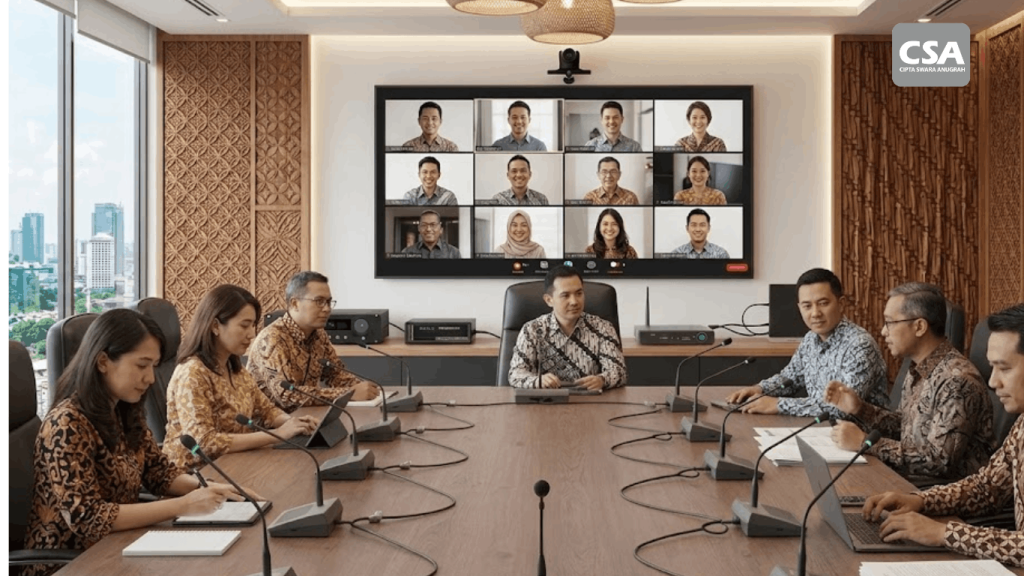
Audio Devices in an Integrated Audio Visual System
Audio is the foundation of any AV system. Without clear sound, communication becomes ineffective.
1. Meeting Room Microphones
Microphones capture speech from participants in the room.
Common types include:
- Ceiling microphones
- Table microphones
- Wireless microphones
Modern microphones often include noise reduction technology to ensure clearer sound.
2. Audio Processor (DSP)
A Digital Signal Processor (DSP) processes and optimizes audio signals.
Its main functions include:
- Reducing background noise
- Eliminating echo
- Balancing sound levels
3. Professional Speakers
Speakers distribute sound evenly throughout the room.
In an integrated system, speakers are designed to ensure consistent audio coverage across all seating positions.
Visual Devices in an Integrated Audio Visual System
Visual technology plays a key role in delivering presentations and data clearly.
1. Professional Displays
Displays are used for presentations, videos, and data visualization.
Common types include:
- LED displays
- LCD professional displays
- Large-format displays
2. Interactive Flat Panels
These allow users to interact directly with the screen.
Key features include:
- Touch interaction
- Digital annotation
- Real-time collaboration tools
3. Projector Systems
Projectors are still widely used in large rooms or auditoriums.
Their advantage lies in:
- Large image projection
- Flexible screen sizing
Video Conferencing Devices in Integrated Systems
Video conferencing connects in-room participants with remote attendees.
1. PTZ Cameras (Pan-Tilt-Zoom)
These cameras can move and zoom automatically to follow the speaker.
2. AI Tracking Cameras
AI-powered cameras automatically detect and track active speakers in the room.
3. Video Conferencing Codec
A codec connects the meeting room system to platforms such as Zoom, Microsoft Teams, or Google Meet.
Control System Devices in AV Integration
The control system acts as the central hub of the entire AV environment.
With a single interface, users can manage all devices simultaneously.
Its main functions include:
- Powering systems on and off
- Adjusting audio settings
- Controlling cameras
- Managing displays
- Selecting input sources
This simplifies the user experience significantly.

Read Also: What Is AV System Integration? A Complete Guide for Modern Businesses
Automation Devices in Smart Meeting Rooms
Automation enables systems to operate automatically without manual intervention.
Examples include:
- Lights turning on when a meeting starts
- Displays activating automatically
- Cameras adjusting to active speakers
- Systems shutting down when rooms are not in use
Automation improves efficiency and user comfort.
Network Devices in Integrated AV Systems
Network infrastructure is the backbone of modern AV systems.
1. Network Switches
They connect all devices within a unified network.
2. AV over IP Systems
This technology transmits audio and video over IP networks.
Advantages include:
- High scalability
- Flexible system expansion
- Easier infrastructure management
Supporting Devices in Integrated AV Systems
Additional devices enhance usability and functionality.
1. Wireless Presentation Systems
Allow users to share content without cables from laptops or mobile devices.
2. Digital Signage
Used to display information in buildings or public areas.
3. Room Scheduling Panels
Digital panels used to manage and book meeting rooms efficiently.
Why Must All Devices Be Integrated?
Without integration, devices operate independently, which creates inefficiencies.
Common issues include:
- Complicated operation
- Longer setup time
- Higher risk of technical errors
- Inconsistent user experience
With integration, all devices work as a single ecosystem.
Benefits of Integrated Audio Visual Systems
1. Clearer Communication
Audio and visual systems work together seamlessly.
2. Improved Operational Efficiency
All devices can be controlled from one system.
3. Professional Meeting Experience
Meeting rooms become more modern and user-friendly.
4. Increased Productivity
Less time is spent on technical setup.
5. Smart Building Enablement
AV systems become part of modern building infrastructure.
Challenges in AV System Implementation
Despite its benefits, implementation can be complex.
Common challenges include:
- Mixed vendor equipment
- Lack of system design planning
- Network infrastructure limitations
- Configuration errors
- Compatibility issues
This is why proper planning is essential from the beginning.
Role of an AV System Integrator
An AV System Integrator ensures all devices work together properly.
Their responsibilities include:
- System design and planning
- Device integration
- Configuration setup
- System testing
- User training
Without proper integration, even high-quality equipment may not perform optimally.

Conclusion
What Devices Are Included in an Integrated Audio Visual System covers a wide range of technologies, including audio systems, visual displays, video conferencing tools, control systems, automation, and networking infrastructure.
These devices do not function independently. Instead, they form a connected ecosystem designed to support smart meeting rooms and modern buildings.
With the right integration, organizations can achieve better communication, improved efficiency, and a more professional collaboration environment that is ready for the future of work.
FAQ
What is an integrated audio visual system?
It is a system that connects audio, visual, control, and network devices into one unified platform.
What are the main devices in an AV system?
Microphones, speakers, displays, cameras, control systems, and network devices.
Why is AV integration important?
It improves efficiency, communication quality, and user experience.
What does a control system do?
It manages all devices from a single interface.
What is AV over IP?
A technology that transmits audio and video over IP networks.
Are AV systems only for meeting rooms?
No, they are also used in auditoriums, offices, and smart buildings.
What are the benefits of integrated AV systems?
Better communication, efficiency, and professional meeting experiences.
Who installs AV systems?
Professional AV System Integrators.
Can AV systems be upgraded?
Yes, most systems are scalable and future-proof.
What is the biggest challenge in AV integration?
Ensuring compatibility and proper system design.