
The development of modern workplaces has changed the way companies conduct meetings and collaboration. Modern Smart Meeting Room Standards for Companies in 2026 are no longer limited to having a conference table, chairs, and a display screen. Today, companies require intelligent meeting spaces that support digital collaboration, hybrid communication, and seamless integration between multiple technologies.
The growth of hybrid work environments has accelerated the demand for advanced meeting solutions. Employees, clients, and business partners may participate from different locations, making it essential for companies to create meeting environments that deliver the same experience for both in-room and remote participants.
Building a professional meeting room requires careful planning. Companies must not only select high-quality devices but also ensure that every technology works together as an integrated system to improve productivity and communication efficiency.
The Evolution of Corporate Meeting Rooms in the Digital Era
Traditional meeting rooms often face several challenges, such as complicated device connections, unclear audio quality, and limited collaboration capabilities.
Modern businesses are now shifting toward intelligent meeting environments that prioritize flexibility, efficiency, and user-friendly experiences. Advanced technologies allow users to conduct presentations, share content, collaborate in real-time, and control room devices through a centralized system.
Smart meeting environments are no longer exclusive to technology companies. Industries such as banking, government institutions, education, hospitality, and manufacturing are increasingly adopting these solutions to improve communication and operational efficiency.
A professionally designed meeting room helps companies reduce technical barriers and create more productive discussions.
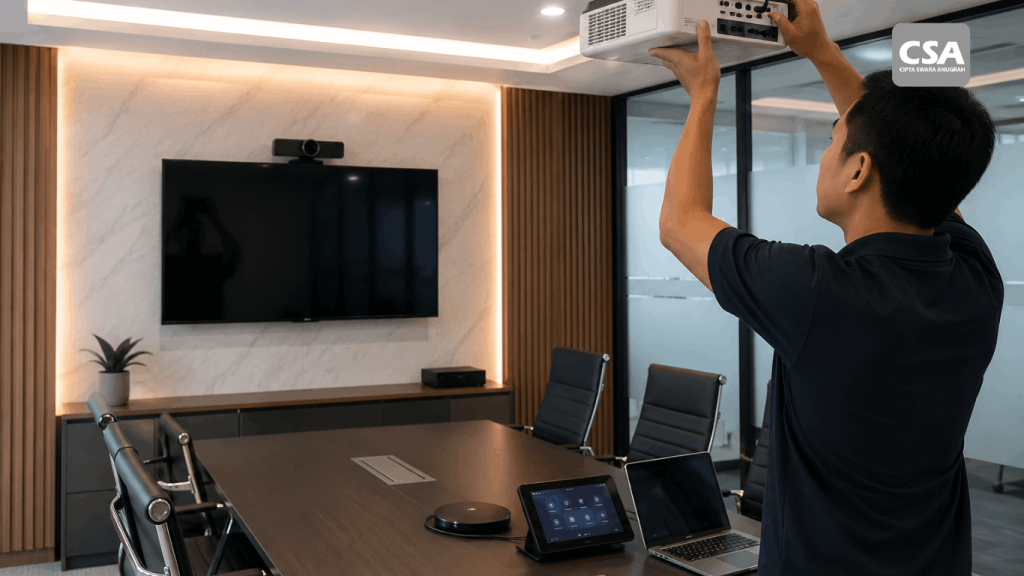
Read Also: Why Is Audio Visual Maintenance Important for Companies? Here Are the Benefits You Need to Know
8 Essential Technologies for Modern Smart Meeting Rooms
Creating an advanced meeting environment requires several interconnected technologies. Each component plays an important role in ensuring smooth communication and collaboration.
1. Interactive Displays and Professional Displays for Digital Collaboration
Display technology has become one of the most important components in modern meeting spaces. Companies are moving beyond conventional screens and adopting interactive displays that support direct engagement.
Interactive displays allow users to write notes, annotate documents, brainstorm ideas, and share information in real-time.
Key features include:
- High-resolution displays for clear visuals.
- Touchscreen capabilities for interactive collaboration.
- Wireless screen sharing from laptops and mobile devices.
- Compatibility with multiple operating systems.
- Real-time collaboration features.
This technology transforms meetings from passive presentations into interactive discussions where every participant can contribute.
2. High-Quality Video Conference Systems for Hybrid Meetings
Hybrid meetings have become a fundamental requirement for modern companies. Therefore, video conferencing technology plays a crucial role in creating an effective collaboration environment.
Professional video conference systems now include advanced features such as:
- Auto framing technology.
- Speaker tracking.
- Wide-angle camera coverage.
- High-resolution video quality.
- Integration with popular meeting platforms.
These features ensure remote participants can clearly see and interact with everyone inside the meeting room.
Without a reliable video conferencing system, communication quality can decrease due to poor visibility and limited interaction.
3. Professional Audio Systems with Clear Sound Quality
Audio quality is one of the most critical factors in any meeting environment. A high-quality visual experience cannot deliver maximum impact if participants cannot hear conversations clearly.
Modern meeting spaces require professional audio solutions that capture voices evenly throughout the room.
Common audio components include:
- Ceiling microphones.
- Wireless microphones.
- Professional speakers.
- Digital Signal Processors (DSP).
- Echo cancellation technology.
A properly designed audio system minimizes background noise and ensures every participant can communicate effectively.
Room acoustics also play an important role in maintaining optimal sound performance.
4. Wireless Presentation Systems for Faster Collaboration
One of the common challenges in meeting rooms is the time required to connect devices before starting a presentation.
Wireless presentation technology provides a solution by allowing users to share content from laptops or mobile devices without complicated cable connections.
The benefits include:
- Faster presentation setup.
- Reduced cable dependency.
- Support for multiple devices.
- More flexible collaboration.
This technology allows participants to focus on discussions rather than technical preparation.
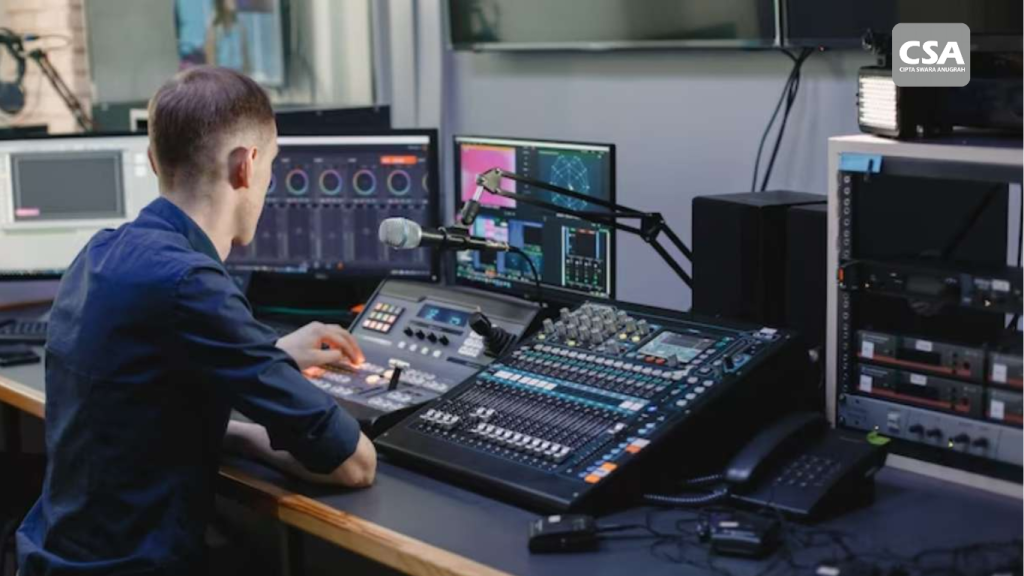
Read Also: Audio Visual Installation for Companies: Process, Benefits, and What You Need to Prepare
5. Room Automation Systems for Integrated Control
One of the key differences between traditional meeting rooms and modern meeting environments is automation capability.
Room automation systems allow companies to control multiple devices through a centralized interface.
Examples include:
- Display control.
- Audio system management.
- Lighting adjustment.
- Meeting device activation.
- Room environment customization.
This technology creates a simpler user experience because employees do not need to operate multiple systems separately.
For enterprise environments, automation also improves operational efficiency and consistency.
6. Room Booking Systems for Better Space Management
Large companies often face challenges managing multiple meeting spaces. A room booking system helps organizations optimize room usage and avoid scheduling conflicts.
This technology provides real-time room availability information and can integrate with digital calendars.
Key advantages include:
- Reducing double bookings.
- Improving room utilization.
- Providing real-time availability updates.
- Increasing employee productivity.
Room booking solutions have become an important element of modern smart office environments.
7. Reliable Network Infrastructure and Data Security
Smart meeting technologies depend heavily on stable network infrastructure.
Companies need to consider several factors, including:
- Network speed.
- Connection stability.
- Data security.
- System integration capabilities.
Video conferencing, wireless presentations, and room control systems require consistent connectivity to perform effectively.
Without proper network infrastructure, even the most advanced devices cannot deliver optimal performance.
8. Professional Room Design and Acoustic Planning
Technology alone does not determine the quality of a meeting environment. Room design and acoustic planning also influence user experience.
Professional meeting rooms must consider:
- Table and participant arrangement.
- Camera positioning.
- Speaker distribution.
- Lighting conditions.
- Acoustic treatment.
Proper planning ensures that every participant receives a comfortable and effective meeting experience.
Benefits of Implementing Smart Meeting Rooms for Companies
Investing in modern meeting technology provides significant advantages for businesses.
Improving Meeting Productivity
Integrated technology reduces preparation time and allows users to start meetings faster without complicated device configuration.
Supporting Hybrid Work Environments
Companies can connect employees, clients, and partners from different locations with better communication quality.
Enhancing Corporate Professionalism
A well-designed meeting environment creates a stronger impression for clients and business partners.
Simplifying Technology Management
Integrated systems allow companies to manage multiple devices more efficiently through centralized control.
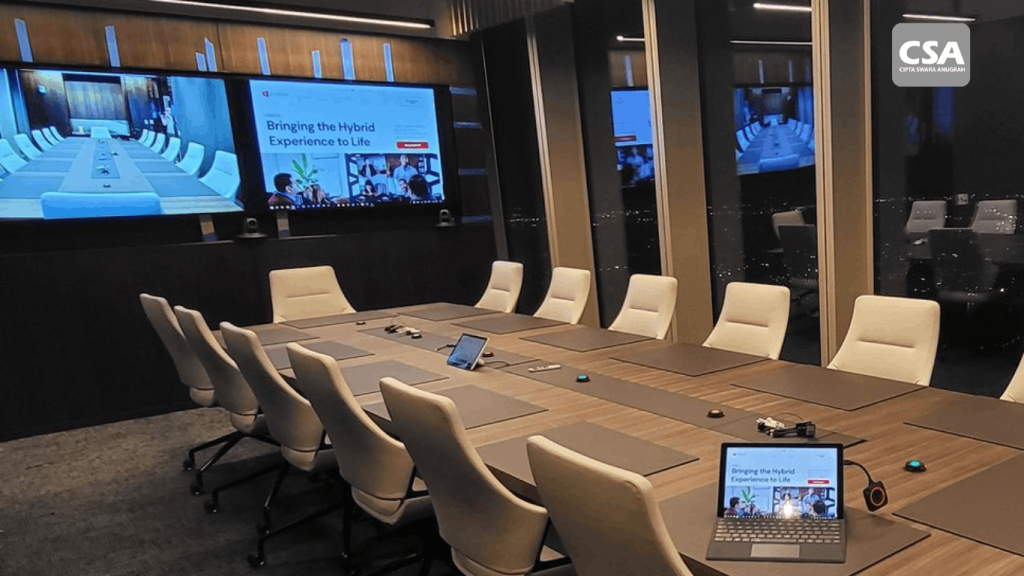
Read Also: How to Determine Audio Visual Requirements for Your Office to Maximize Investment Efficiency
Why Companies Need a Professional AV Integrator
Creating a modern meeting environment is not simply about purchasing advanced devices. Companies need proper system planning to ensure every component works effectively.
A professional AV integrator manages the entire process, including requirement analysis, system design, equipment selection, installation, integration, and maintenance.
CSA Indonesia provides professional audio visual solutions to help companies develop advanced meeting environments tailored to their business requirements.
With expertise in Audio Visual Integration, CSA Indonesia delivers solutions including Smart Meeting Rooms, video conferencing systems, room automation, and professional technology integration using industry-leading platforms such as Q-SYS, Crestron, and Extron.
CSA Indonesia focuses not only on installing equipment but also on creating reliable, scalable, and user-friendly systems that support long-term business operations.
Conclusion
Modern Smart Meeting Room Standards for Companies in 2026 reflect how meeting spaces have evolved into digital collaboration hubs that support business productivity and communication.
Companies now require more than basic displays and cameras. They need integrated solutions that are easy to operate, scalable, and ready to support future technological developments.
From interactive displays and video conferencing systems to professional audio solutions and automation technology, every component contributes to creating an efficient and effective meeting environment.
By partnering with a professional AV integrator such as CSA Indonesia, companies can build modern meeting spaces that improve collaboration, enhance productivity, and support the future of digital workplaces.
FAQ
1. What is a Smart Meeting Room?
A Smart Meeting Room is a technology-enabled meeting space that integrates digital solutions to support communication, collaboration, presentations, and room management.
2. What equipment is required for a modern meeting room?
A modern meeting room typically requires interactive displays, video conferencing systems, professional microphones, speakers, wireless presentation solutions, room control systems, and reliable network infrastructure.
3. Can Smart Meeting Rooms support hybrid meetings?
Yes. Smart Meeting Rooms are designed to support hybrid meetings by integrating cameras, microphones, speakers, and collaboration platforms.
4. How much does it cost to build a Smart Meeting Room?
The cost depends on several factors, including room size, technology requirements, equipment selection, and the level of system integration.
5. Why do companies need an AV integrator?
An AV integrator helps companies design, install, and optimize integrated technology systems to ensure reliable performance and ease of use.
6. What is the difference between a traditional meeting room and a Smart Meeting Room?
Traditional meeting rooms usually rely on basic equipment, while Smart Meeting Rooms combine multiple technologies to create a more efficient, flexible, and collaborative environment.