
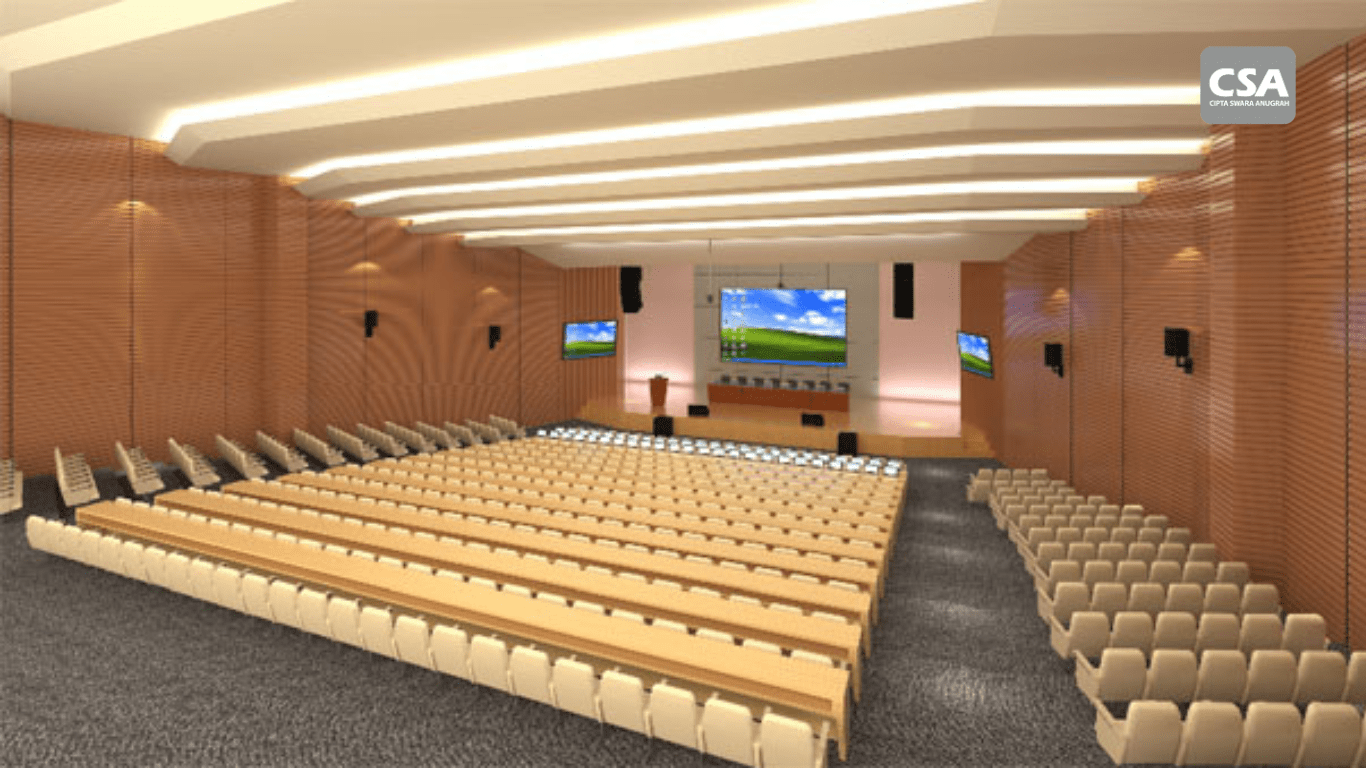
Audio Visual for Auditorium plays an important role in creating large-scale venues that can support seminars, conferences, presentations, training sessions, and professional events. An auditorium has different requirements from a standard meeting room. It accommodates larger audiences, involves greater viewing distances, and requires more complex audio and visual distribution.
A well-designed system should allow every participant to hear the speaker clearly. Presentation materials should also remain visible from different seating areas. At the same time, operators need a system that is easy to control throughout an event.
For this reason, an auditorium requires careful technology planning. Choosing the right equipment is only one part of the process. Every component needs to be positioned, configured, and integrated according to the characteristics of the room and the needs of its users.
What Is an Audio Visual System for an Auditorium?
An auditorium audio visual system combines audio, visual, control, and supporting technologies designed specifically for large-capacity spaces.
The system may include speakers, microphones, amplifiers, DSPs, mixers, projectors, LED walls, displays, video processors, video conferencing systems, and control systems.
Each component serves a different purpose. However, all components need to operate as one integrated system to ensure smooth event operations.
For example, a presenter can use a microphone to address the audience. The audio signal then passes through the audio processing system before reaching the speakers. At the same time, presentation content can be displayed through an LED wall or projector.
When the auditorium supports hybrid events, the system can also connect cameras, microphones, speakers, and conferencing platforms.

Read Also: Auditorium Sound System with CSA Indonesia: Professional Audio Solutions for Large Venues
Why Does an Auditorium Need an Integrated AV System?
Auditoriums generally have larger capacities and dimensions than standard meeting rooms. These conditions make audio and visual distribution more challenging.
A speaker that produces high volume does not necessarily provide a good listening experience. Sound must reach the audience evenly across the room.
The same principle applies to the visual system. A screen that is too small can make presentations difficult to see for participants sitting farther from the stage.
An integrated system addresses these requirements through a design based on the room and its intended activities.
Some of the key benefits include:
- More even sound distribution
- Clearer visual presentation
- Simpler equipment operation
- Integration of multiple audio and video sources
- Support for hybrid events
- More organized system management
With this approach, an auditorium does not simply contain multiple devices. Instead, it has a complete system designed to work together.
Key Components of an Auditorium Audio Visual System
Every auditorium has different requirements. However, several components commonly form an important part of its AV infrastructure.
1. Auditorium Sound System
The sound system is one of the most important elements.
An auditorium requires sound distribution that can reach the entire audience area. Different types of speakers may be used depending on the room size and layout.
Speaker selection should consider coverage, audience positioning, room characteristics, and event requirements.
Amplifiers must also match the speaker configuration. Meanwhile, DSPs can help manage audio processing and signal distribution.
The goal is not simply to produce high volume. The system should deliver clear and comfortable sound throughout the auditorium.
2. Microphone System
Microphones provide the primary connection between presenters and the audience.
The appropriate microphone type depends on the activity. An auditorium may use handheld wireless microphones, lapel microphones, podium microphones, or other microphone configurations.
Microphone selection should consider the presenter’s position and the type of event.
Proper configuration can also help reduce feedback and unwanted noise during presentations.
3. LED Walls, Projectors, and Displays
Visual systems play an important role in delivering information to the audience.
An auditorium may use LED walls, projectors, projection screens, or additional displays.
The appropriate technology depends on room size, viewing distance, lighting conditions, content type, and event requirements.
Large auditoriums may also require additional displays. Participants sitting farther from the stage or toward the sides should still be able to view presentation content clearly.
4. Video Processors and Video Distribution
Auditoriums often require more than one video source.
Presentation laptops, cameras, media players, and other devices may provide content during an event.
A video processor helps manage these sources. Meanwhile, video distribution systems can send signals to multiple displays.
This configuration allows operators to manage the content shown throughout the auditorium more efficiently.
5. Video Conferencing System
Modern auditoriums can also support hybrid events.
Cameras can capture presenters or activities on stage. Microphones capture speech, while speakers allow communication with remote participants.
This system allows the auditorium to host conferences and events involving participants from different locations.
6. Control System
The more devices an auditorium uses, the more complicated operation can become.
A control system helps simplify this process.
Operators can manage audio, visual, video, and supporting equipment through a centralized control interface.
Functions such as changing video sources, adjusting audio levels, and controlling displays can be handled more efficiently.
Read Also: Sound System for Hall Room with CSA Indonesia
Factors to Consider When Designing an Auditorium AV System
System design should begin with the auditorium’s physical characteristics and operational requirements. Every venue requires a different approach.
Audience Capacity
The number of participants affects the requirements of the audio and visual systems.
An auditorium designed for 100 people will have different requirements from a venue designed for 1,000 people.
Audience capacity can also influence the number of speakers, microphones, displays, and supporting devices required.
Room Size and Layout
Room dimensions affect system coverage.
The shape of the auditorium also influences speaker placement and visual positioning.
The design team needs to consider the stage, audience seating, aisles, operator area, and equipment locations.
Room Acoustics
Acoustics are a critical factor in auditorium audio design.
Excessive sound reflections can make speech difficult to understand. The audio system must therefore account for the acoustic characteristics of the room.
Speaker placement and DSP configuration should also reflect these conditions.
Viewing Distance
Participants sitting farther from the stage need displays that remain easy to see.
Screen size and display placement should correspond to audience viewing distances.
This consideration helps ensure that presentation content remains readable from different seating areas.
Event Type
The function of the auditorium also influences the system configuration.
Seminars may require microphones and presentation systems. Conferences may require video conferencing. Corporate events may require LED walls, recording, and streaming.
The system should therefore be designed around the activities that will take place in the venue.
Audio Visual Solutions for Different Auditorium Applications
Auditoriums can serve many types of organizations. Each environment has different technology requirements.
Corporate Auditoriums
Companies may use auditoriums for town halls, internal training, seminars, product presentations, and corporate events.
The system should support clear communication and effective presentation delivery.
University and Educational Auditoriums
Educational institutions may use auditoriums for public lectures, academic seminars, conferences, graduations, and institutional events.
Audio and visual systems need to support large audiences while maintaining clear communication.
Government Auditoriums
Government facilities may use auditoriums for meetings, conferences, public briefings, and official events.
These applications can involve microphone systems, presentation displays, recording, and centralized control.
Hotel and Convention Center Auditoriums
Hotels and convention centers require flexible systems.
The same venue may host a seminar in the morning and a corporate event later in the day.
The AV system should therefore be easy to configure for different event requirements.
MICE Auditoriums
MICE events require systems that can adapt quickly to changing event requirements.
A single event may involve multiple presenters, different video sources, live presentations, recording, and streaming.
An integrated system helps operators manage these requirements more efficiently.
Common Mistakes in Auditorium AV Design
Poor planning can directly affect system performance.
One common mistake is focusing only on equipment specifications. A company may choose high-specification speakers or displays without considering the actual requirements of the venue.
Ignoring room acoustics is another common problem.
Even expensive audio equipment can produce unclear sound when the acoustic characteristics of the room are not properly considered.
Visual placement can also create problems. Displays that are too small or positioned too far away can reduce the audience’s viewing comfort.
Some users also overlook the control system. As a result, operators may need to manage multiple devices separately during an event.
Proper planning can help minimize these issues before installation begins.
Why Does an Auditorium Need an AV Integrator?
An auditorium project involves multiple devices and technology systems. All components need to work together within the same environment.
An AV integrator helps connect user requirements with the appropriate technology solution.
The process may begin with needs analysis and system design, followed by equipment selection, installation, configuration, integration, testing, and commissioning.
This approach allows businesses to manage the project as one complete system instead of handling every component separately.
An integrator can also ensure that the system matches the physical characteristics of the venue. This is important because every auditorium has different dimensions, layouts, acoustic conditions, and operational requirements.
How to Choose an AV Vendor for an Auditorium
Choosing a vendor should not depend only on equipment prices.
Businesses should evaluate the vendor’s ability to manage the entire project.
Several factors can be considered, including:
- System design capabilities
- Experience with large-scale venues
- Audio and visual integration expertise
- DSP and control system knowledge
- Installation capabilities
- Testing and commissioning
- Technical support after project completion
- Experience with corporate, hospitality, or institutional projects
A vendor with end-to-end capabilities can help reduce the risk of implementation issues.
CSA Indonesia for Professional Auditorium AV Solutions
Building an auditorium with integrated AV technology requires a partner that understands the relationship between equipment, room characteristics, and user requirements.
CSA Indonesia provides AV integration solutions for professional environments, including projects that require integrated audio visual systems.
Its approach goes beyond equipment installation. The process can include system planning, equipment integration, configuration, and testing to ensure that the system performs according to the project’s requirements.
CSA Indonesia also has experience with audio visual requirements for meeting venues, MICE environments, hospitality facilities, and other professional spaces. Its project portfolio includes integrated AV systems for hotels and convention centers, as well as sound system solutions for meeting and event venues.
This experience is valuable when developing systems for auditoriums. Every venue requires a different solution based on capacity, function, acoustic conditions, visual requirements, and event activities.
CSA Indonesia also provides supporting services such as AV Integration, Sound System Installation, Smart Lighting Automation, LED Wall Rental, and Restaurant Audio Solutions.
Through an integrated approach, an auditorium can have a system that is easier to operate and better aligned with its operational requirements.
For companies, educational institutions, government facilities, hotels, and convention center operators, planning the system from the early stages can help determine the right technology solution.
The goal is not simply to install speakers or large displays.
The system should deliver clear audio, provide effective visual communication, support different types of events, and create a comfortable experience for the audience.
If you are planning to build or upgrade an auditorium AV system, CSA Indonesia can help design and integrate an audio visual solution based on your venue’s characteristics and operational requirements.
FAQ About Auditorium Audio Visual Systems
1. What equipment is needed for an auditorium AV system?
Equipment may include speakers, amplifiers, DSPs, mixers, microphones, LED walls, projectors, displays, video processors, video conferencing systems, and control systems. The final configuration depends on the auditorium’s capacity and intended use.
2. Does an auditorium have to use an LED wall?
Not necessarily. An auditorium can use an LED wall, projector, or a combination of multiple displays. The right choice depends on room size, viewing distance, lighting conditions, content, and event requirements.
3. Why is a DSP important for an auditorium?
A DSP manages and processes audio signals. Its configuration can support signal routing, equalization, and audio distribution according to the requirements of the venue.
4. Can an auditorium support hybrid meetings?
Yes. The system can integrate cameras, microphones, speakers, displays, and video conferencing platforms to support participants joining from different locations.
5. Can an auditorium AV system support different types of events?
Yes. The system can be designed to support seminars, conferences, training sessions, town halls, presentations, graduations, and MICE events.
6. How much does an auditorium AV system cost?
The cost depends on room capacity, equipment quantity, visual technology, audio configuration, control systems, installation requirements, and integration complexity. The project requirements should be assessed before establishing a budget.
7. Why does an auditorium need an AV integrator?
An AV integrator helps ensure that different devices operate as one integrated system. The scope may include design, installation, integration, configuration, testing, and commissioning.
8. Can CSA Indonesia handle auditorium AV projects?
CSA Indonesia provides audio visual integration solutions for professional environments. Its approach covers system planning and implementation based on the requirements and characteristics of each project.