
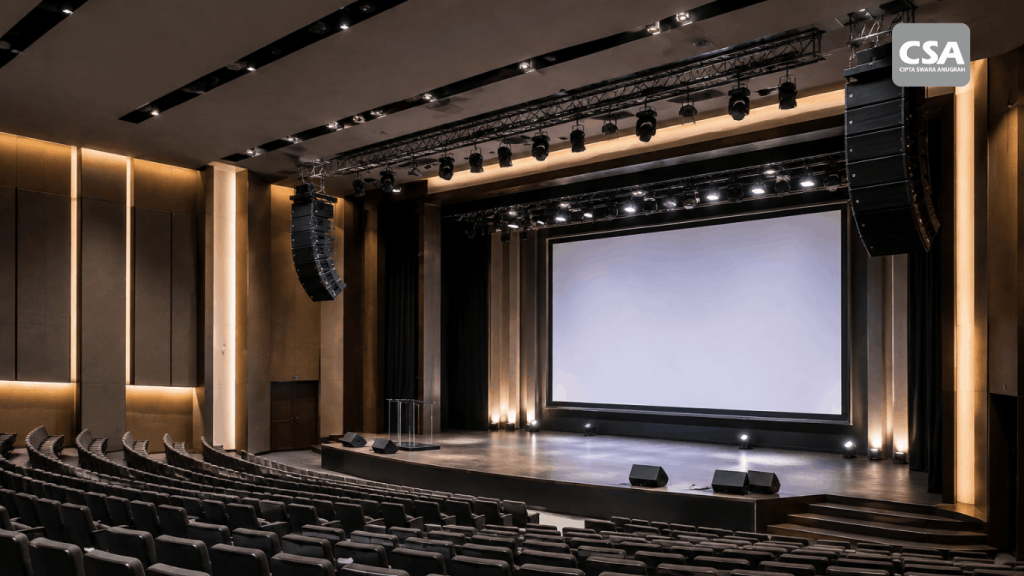
Lighting Systems for Auditoriums play an essential role in creating professional, functional, and comfortable venues. Lighting does more than illuminate the stage or audience area. A well-designed system can shape the atmosphere, direct audience attention, and support different types of events.
Modern auditoriums serve increasingly diverse purposes. The same venue may host seminars, conferences, graduations, performances, product launches, and corporate events. Each activity requires a different lighting approach.
For this reason, auditorium operators cannot rely on a few stage lights alone. They need a system that can adapt to different activities and operational requirements.
Professional lighting design must also consider the room layout, stage position, audience area, camera requirements, and integration with audio and visual systems.
Why Is Lighting Important for an Auditorium?
Lighting affects how audiences see and experience an event. Excessive brightness can reduce focus. Insufficient lighting can make it difficult for audiences to see speakers, performers, or important areas.
During presentations, audiences need clear visibility of the speaker. Presentation content must also remain visible without excessive light affecting the screen.
Performances require a more dynamic approach. Lighting can create atmosphere and direct attention toward specific areas of the stage.
Lighting also contributes to safety. Stairways, exits, corridors, and audience areas require appropriate illumination.
With proper planning, an auditorium lighting system can serve several purposes:
- Illuminate the stage
- Improve speaker visibility
- Support presentations
- Create the desired atmosphere
- Direct audience attention
- Support production requirements
- Improve audience comfort
- Support venue safety
Read Also: Audio Visual for Auditorium: Integrated AV Solutions for Large-Scale Venues
Types of Lighting Used in Auditoriums
Every auditorium has different requirements. However, several lighting categories commonly become part of a professional system.
Stage Lighting
Stage lighting focuses on the performance or presentation area. It helps ensure that speakers, performers, and important objects remain clearly visible.
Fixture placement should consider the speaker’s position and the audience’s viewing angle. Designers should also minimize unwanted shadows on performers’ faces.
For performances, stage lighting can incorporate different fixture types. Each fixture serves a specific purpose.
Front Lighting
Front lighting illuminates subjects from the front. It helps ensure that speakers and performers remain clearly visible.
A properly designed configuration can also improve camera performance. This becomes important when an auditorium supports recording or live streaming.
Back Lighting
Back lighting comes from behind the subject or performer. It can add visual depth and help separate the subject from the background.
In stage productions, back lighting can also create specific visual effects.
Wash Lighting
Wash lighting provides broader illumination. It can cover a stage or specific section of a venue more evenly.
This type of lighting works well when an event requires consistent illumination across a wider area.
Accent Lighting
Accent lighting highlights specific objects or areas.
Auditorium operators can use it to emphasize architectural features, stage decorations, branding elements, or selected areas within the venue.
Common Lighting Fixtures for Auditoriums
Understanding lighting functions is important, but fixture selection also affects the final result.
Profile or Ellipsoidal Fixtures
These fixtures produce focused beams. Operators can use them to highlight speakers, performers, or specific areas on stage.
Fresnel Fixtures
Fresnel fixtures produce softer illumination. They can support stage lighting where the venue requires smoother and more evenly distributed light.
PAR Fixtures
PAR fixtures can deliver strong illumination across selected areas. They work well for various stage and event applications.
Moving Head Fixtures
Moving heads provide greater flexibility through movement and directional control. They are particularly useful for performances and events that require dynamic lighting effects.
Follow Spot
Follow spots produce focused beams that can follow a specific subject. They are commonly useful for performances where the main performer needs to remain the visual focus.
Fixture selection should always follow the venue’s actual requirements. Not every auditorium needs the same configuration.
Audience Lighting for Seating Areas
The audience area also requires careful consideration.
Lighting should not focus entirely on the stage. Visitors need sufficient visibility when moving around, reading materials, finding seats, or leaving the venue.
Audience lighting helps maintain appropriate illumination across seating areas.
During a presentation, operators can reduce the intensity. After the event, they can increase the lighting again.
This flexibility improves the overall audience experience without compromising safety.
Architectural Lighting for Auditoriums
Lighting can also become part of an auditorium’s architectural design.
Architectural lighting can highlight walls, ceilings, stairs, corridors, and decorative elements.
This approach gives lighting both a functional and aesthetic role. It can also strengthen the visual identity of a venue.
Corporate auditoriums, hotels, universities, and convention centers may have completely different architectural concepts. Lighting should therefore complement the existing design.
Read Also: CSA Indonesia Delivers an Outdoor Audio Visual Solution for Sonada Beach Club in Bintan
Lighting Control Systems for Auditoriums
A large number of fixtures can make manual operation complicated. For this reason, professional auditoriums can benefit from a centralized lighting control system.
Operators can manage intensity, color, timing, and scenes through an appropriate control interface.
For example, an auditorium can have several predefined presets.
Presentation Mode
Stage lighting remains active while the audience area becomes dimmer. The visual presentation remains the main focus.
Conference Mode
The speaker receives appropriate illumination while the audience maintains a comfortable light level.
Performance Mode
Stage lighting becomes more dynamic. Fixtures can respond to the requirements of the performance.
Cleaning Mode
The entire auditorium becomes brighter. This setting makes post-event cleaning easier.
Presets like these help operators change room conditions quickly.
Smart Lighting Automation for Auditoriums
Smart lighting technology gives venue operators greater flexibility.
The system can use presets based on activities or scheduled events. Operators can also adjust different parameters through a dedicated interface.
Automation becomes particularly useful when an auditorium hosts frequent events.
Operators do not need to configure every fixture from the beginning for each event. They can simply select an existing scene.
The system can also work alongside other control technologies. This allows lighting to become part of a broader auditorium technology ecosystem.
Color Temperature and CRI in Auditorium Lighting
Lighting quality depends on more than brightness.
Color temperature affects the visual character of the light. The right setting can help create an appropriate atmosphere for each event.
CRI, or Color Rendering Index, relates to how naturally a light source reproduces colors.
This becomes increasingly important when an auditorium supports recording or live streaming. Speakers, performers, products, and stage elements should appear with natural colors.
For this reason, professional lighting design should consider both audience experience and camera requirements.
Lighting for Live Streaming and Video Conferencing
Modern auditoriums increasingly support hybrid events. This creates additional lighting requirements.
Cameras need consistent illumination. Uneven lighting can make faces appear too dark or create excessively bright areas.
Common problems include:
- Poorly illuminated faces
- Overexposed backgrounds
- Harsh facial shadows
- Unnatural skin tones
- Inconsistent camera exposure
- Poor stage visibility
Proper lighting design can help reduce these problems.
Fixture positions, intensity, beam direction, color temperature, and camera requirements should be considered together.
This approach strengthens the relationship between lighting and visual systems in modern auditoriums.
Considering Acoustics and Auditorium Layout
Lighting focuses on illumination, but its design should still consider the auditorium as a complete environment.
Speaker positions, cameras, projectors, LED walls, lighting fixtures, and rigging systems require coordinated planning.
Ceiling height also affects fixture placement. Designers need to position equipment to achieve the required coverage.
Installation routes and maintenance access should also receive attention. Difficult-to-reach equipment can create unnecessary maintenance challenges.
Lighting fixtures should not interfere with speakers or create excessive reflections on projection screens.
For this reason, coordination between audio, visual, lighting, interior, and architectural teams should begin during the early project stages.
Integrating Lighting with Audio and Visual Systems
This is one of the most important aspects of a modern auditorium.
Lighting does not have to operate independently. It can integrate with audio and visual systems to create a more consistent event experience.
For example, when a presentation begins, the system can activate a predefined scene.
The LED wall or projector displays the presentation. The audio system activates the required configuration. Lighting then adjusts the stage and audience illumination.
When properly designed, these systems can operate through a centralized control platform.
This approach simplifies venue operations. Operators do not need to control every device separately.
Factors to Consider When Designing Auditorium Lighting
Professional lighting design requires more than determining the number of fixtures.
Auditorium Size
Room dimensions influence fixture quantity, mounting positions, and coverage requirements.
A small auditorium requires a different approach from a large venue with thousands of seats.
Ceiling Height
Ceiling height affects fixture positioning. Designers should also consider access for future maintenance.
Stage Position
Stage position determines lighting angles and coverage.
Designers need to minimize dark areas that could reduce speaker or performer visibility.
Event Type
Seminars require a different lighting approach from concerts or theatrical performances.
A flexible system can accommodate multiple event scenarios.
Camera Integration
Auditoriums that support recording or live streaming require camera-friendly lighting.
Uneven illumination can affect image quality. Production requirements should therefore become part of the initial system design.
Ease of Operation
A professional system should not necessarily be difficult to operate.
Operators should be able to access essential functions quickly. A well-designed interface can simplify event preparation.
Common Auditorium Lighting Mistakes
Several mistakes can reduce system performance.
Focusing Only on the Number of Fixtures
More fixtures do not automatically produce better lighting.
Position, beam angle, fixture type, and control have a major influence on the final result.
Ignoring the Audience Area
Operators sometimes focus too heavily on the stage. However, audience areas also require comfortable and safe illumination.
Designing for Only One Event Type
A system designed for a single event format can limit the auditorium’s future use.
It is better to plan several lighting scenarios from the beginning.
Not Preparing a Control System
A large number of devices can make operation complicated.
A centralized control system helps operators manage lighting in a more structured way.
Ignoring Maintenance
Lighting fixtures require regular inspection and maintenance.
Designers should consider equipment access from the beginning of the project.
Auditorium Lighting for Different Types of Events
Modern auditoriums need to support different event formats.
Seminars and Conferences
Lighting should provide clear visibility for speakers while maintaining comfortable illumination for the audience.
Graduation Ceremonies
The stage becomes the primary focus. Lighting should support visibility and documentation throughout the ceremony.
Performances
Performances require greater flexibility. Color, intensity, movement, and scenes can follow the creative direction of the production.
Corporate Events
Lighting can create a professional visual environment. It can also support branding through specific colors and lighting scenes.
Product Launches
Lighting can direct audience attention toward a product. Timing can also follow important moments during the launch.
Why Do Auditoriums Need a Lighting Integrator?
As lighting systems become more complex, professional integration becomes increasingly important.
A lighting integrator does more than install fixtures. The integrator needs to understand how the system will operate and interact with other technologies.
The process can include needs analysis, site surveys, system design, equipment selection, installation, programming, integration, testing, and commissioning.
This approach helps ensure that the system matches the auditorium’s characteristics.
More importantly, lighting can integrate with other technologies. Audio, visual, automation, and control systems can work together within one ecosystem.
CSA Indonesia for Integrated Auditorium Lighting Solutions
An auditorium needs more than stage lights. Its lighting system should consider room functions, event requirements, operational convenience, and integration with other technologies.
CSA Indonesia operates as an AVL Integrator, providing Audio, Visual, and Lighting solutions for professional environments.
CSA Indonesia approaches lighting as part of a broader technology system rather than as an isolated component.
One relevant service is Smart Lighting Automation. This solution can support more flexible and controlled lighting environments.
For auditoriums, the concept can be implemented through different lighting scenes. Venue operators can adjust lighting according to the activity taking place.
For example, presentation mode can prioritize the speaker. Performance mode can provide greater flexibility for stage lighting. General mode can provide more even illumination throughout the room.
Integrating Lighting with Audio and Visual Systems
As an AVL Integrator, CSA Indonesia can approach lighting within a broader technology ecosystem.
An auditorium may require sound systems, microphones, LED walls, projectors, video conferencing, lighting, and control systems at the same time.
When each system operates independently, operators face more tasks during an event.
Integration creates a more structured operational workflow.
For example, a single event scene can control multiple functions. Lighting can adjust the stage illumination. The audio system can activate a specific preset. The visual system can display a selected content source.
This approach can improve operational efficiency and simplify event management.
CSA Indonesia for Professional Venues
Lighting requirements are not limited to auditoriums.
Hotels, convention centers, restaurants, corporate buildings, MICE venues, and commercial spaces can also require lighting designed around their specific functions.
CSA Indonesia’s service scope includes AV Integration, Smart Lighting Automation, Sound System Installation, LED Wall Rental, and Restaurant Audio Solutions.
CSA’s hospitality experience also includes projects such as HARRIS Hotel & Convention Serpong and MYZE Hotel Waingapu.
This experience becomes valuable when a project requires multiple technology systems to work together.
Auditoriums present their own challenges. The venue needs lighting that supports events without interfering with presentations or audience visibility.
The system should therefore reflect the venue’s physical conditions and operational requirements.
From Lighting to Complete AVL Integration
CSA Indonesia’s key strength lies in its integration approach.
Lighting can become part of a broader system alongside audio, visual, automation, and centralized control.
With this approach, auditorium operators receive more than individual lighting equipment. They receive a system designed around the operational needs of the venue.
If you are building or upgrading an auditorium, CSA Indonesia can help design an integrated Audio, Visual, and Lighting solution based on your venue’s requirements.
Conclusion
Auditorium lighting serves a much broader purpose than simply illuminating the stage.
The right system can improve visibility, create atmosphere, direct audience attention, support production, and simplify venue operations.
These requirements become more complex when an auditorium hosts different types of events. Seminars, conferences, graduations, performances, and corporate events all require different lighting characteristics.
Lighting should therefore be designed from the beginning with the room layout, event types, control system, camera requirements, and technology integration in mind.
CSA Indonesia can support this approach through its role as an AVL Integrator.
By bringing together Audio, Visual, Lighting, and automation, CSA Indonesia helps create more structured technology environments for auditoriums and other professional venues.
FAQ About Auditorium Lighting
1. What is the main function of auditorium lighting?
Lighting illuminates the stage and audience areas, improves visibility, creates atmosphere, and supports different types of events.
2. Does an auditorium need a lighting control system?
It is highly recommended, especially for auditoriums with many fixtures and multiple event formats. A control system allows operators to manage lighting more quickly and systematically.
3. Can auditorium lighting integrate with audio and visual systems?
Yes. Lighting can become part of an AVL system that connects audio, visual, lighting, and control technologies.
4. What is smart lighting automation?
Smart lighting automation allows users to manage lighting through presets, scenes, or automated configurations based on specific requirements.
5. Can auditorium lighting support different types of events?
Yes. The system can include different scenes for seminars, conferences, graduations, performances, corporate events, and other activities.
6. Does lighting affect live streaming quality?
Yes. Uneven lighting can affect camera image quality. Recording and live streaming requirements should therefore be considered during the design stage.
7. Why should an auditorium work with a lighting integrator?
A lighting integrator can design, install, configure, and integrate the lighting system according to the venue’s characteristics and operational requirements.
8. Does CSA Indonesia provide lighting solutions?
Yes. CSA Indonesia provides Smart Lighting Automation and positions itself as an AVL Integrator that combines Audio, Visual, and Lighting into integrated technology solutions.