
Choosing AV System Integrator Services for Companies is not simply about finding a provider that can supply speakers, displays, microphones, or cameras. Companies need a partner that can design these components as one system based on the needs of the space and its users.
This becomes increasingly important when a company has meeting rooms, boardrooms, training rooms, auditoriums, or conference spaces with multiple technologies. Without proper planning, individual devices may operate separately and force users to perform several manual steps.
An AV System Integrator helps connect these requirements. The scope can include consultation, requirements analysis, site surveys, system design, equipment selection, installation, configuration, integration, testing, commissioning, and post-installation support.
CSA Indonesia provides Audio, Visual, Lighting, and Automation solutions, with more than 30 years of experience in design, installation, and maintenance. Its project portfolio covers corporate, government, hospitality, entertainment, and other environments.
What Is an AV System Integrator?
An AV System Integrator is a company or specialist that designs and combines different audio visual technologies so they can operate as one coordinated system.
Devices such as displays, projectors, speakers, microphones, cameras, DSPs, video conferencing systems, and control systems each have their own functions. However, those functions need to work together according to how people actually use the room.
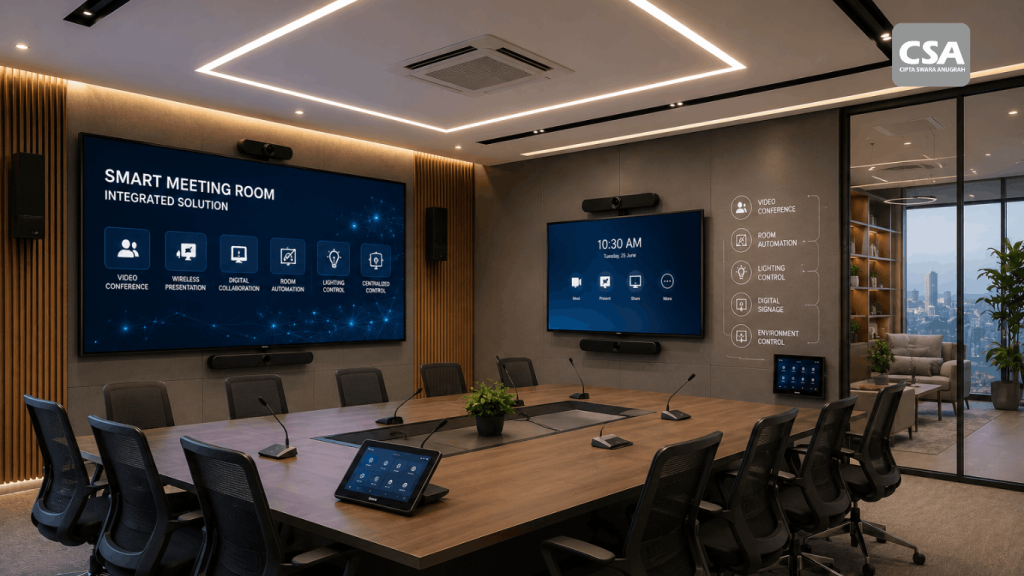
For example, an executive meeting room may require displays, cameras, microphones, speakers, video conferencing, wireless presentation, and centralized control. These components need to follow one logical workflow so meetings can run without unnecessary technical steps.
The integration approach also means companies do not have to select every device independently. The integrator first understands the requirements and then translates them into a system design.
For a deeper explanation of the role and process, see What Is an AV System Integrator? Understanding the Role and AV System Integration Process.
Read Also: Why Does a Smart Meeting Room Require a Professional AVL System Integrator?
When Does a Company Need an AV System Integrator?
Not every room requires a complex AV system. A small room with one display and a simple presentation setup may work with a standard configuration.
The requirements change when multiple devices need to work together.
A meeting room, for example, may include several microphones, speakers, cameras, displays, DSPs, video conferencing systems, and control panels. All of these components need to support the same meeting workflow.
Companies may benefit from an integrator when they have:
- Meeting rooms with hybrid meeting requirements
- Executive boardrooms
- Smart meeting rooms
- Training rooms
- Conference rooms
- Auditoriums
- Command centers
- Video conference rooms
- Corporate offices with multiple AV spaces
- Hospitality and event facilities
An integrator can also be useful when a company wants to upgrade an existing system. In that situation, the team needs to understand the current equipment and infrastructure before recommending new components.
What Does an AV System Integrator Do?
The scope of work varies from project to project. However, the process generally includes several connected stages.
Requirements Analysis
The first stage is understanding the purpose of the room.
The integrator needs to know the number of users, primary activities, presentation requirements, remote communication needs, video conferencing platforms, and expected user workflow.
A six-person meeting room has different requirements from an executive boardroom used by dozens of participants. An auditorium requires another approach because its audio and visual distribution is more complex.
Requirements analysis helps companies avoid selecting equipment that does not match actual usage.
Site Survey
A site survey provides an understanding of the physical conditions.
The team may inspect room dimensions, furniture layout, cable pathways, power availability, network infrastructure, ceiling conditions, mounting points, equipment rack locations, lighting, and acoustics.
These conditions can influence the system design.
For example, microphone placement should consider the table layout and participant positions. Camera placement should follow the desired viewing angle. Network-based AV devices may also require suitable network infrastructure.
A site survey helps identify these factors before installation begins.
System Design
After understanding the requirements and site conditions, the integrator develops the system design.
The design can include equipment locations, signal flow, connections, control methods, system architecture, and user workflows.
This stage provides the foundation for the rest of the project.
For corporate meeting rooms, CSA also discusses this process in How to Design an Audio Visual System for a Corporate Meeting Room.
Equipment Selection
Once the system design is established, the integrator selects suitable equipment.
Depending on the project, this may include:
- Professional displays
- Projectors
- PTZ cameras
- Microphones
- Speakers
- Amplifiers
- DSPs
- Video conferencing systems
- Wireless presentation systems
- Control processors
- Touch panels
- Signal distribution equipment
- Racks and connectivity systems
Equipment selection does not always mean choosing the highest specifications available.
The integrator needs to consider compatibility, room size, user requirements, existing infrastructure, system architecture, and future expansion.
Why Is Integration More Important Than Simply Buying Equipment?
Companies can purchase AV devices individually. However, high-quality equipment does not automatically create an effective AV system.
Imagine a meeting room with a display, camera, microphone, speaker, and video conferencing system. If users need to operate each device separately, the room can still feel complicated.
An integrated system takes a different approach.
Multiple devices are connected into a coordinated workflow. Users can start meetings, select presentation sources, manage audio, and control cameras through a simpler interface.
This becomes particularly valuable when the room is used by many employees with different levels of technical knowledge.
For a broader explanation of integrated AV design, see Why Should Audio Visual Be Designed as an Integrated System?.
AV Solutions for Different Types of Rooms
AV requirements cannot be standardized across every space. The function of the room is one of the main factors that determines the system.
Meeting Rooms
Meeting rooms commonly require displays, cameras, microphones, speakers, presentation systems, and video conferencing.
If the company frequently holds hybrid meetings, the AV system should support communication between participants inside and outside the room.
The system can also be designed so users can start meetings and share content through a simpler workflow.
Executive Boardrooms
Boardrooms often require more structured communication systems.
A typical solution may include multiple displays, conference cameras, microphones, speakers, wireless presentation, and centralized control.
Reliability and ease of use become particularly important because boardrooms may be used for strategic meetings and external presentations.
Training Rooms
Training rooms have different requirements from standard meeting rooms.
The system may need to support trainers, participants, presentation content, remote attendees, and different types of media.
A microphone for the trainer, display or projector, speakers, camera, and presentation connectivity may form part of the solution.
Auditoriums
Auditoriums require larger-scale AV systems.
The audio system needs to distribute sound across the audience area. The visual system must also provide clear content from different viewing positions.
Because these systems often contain more devices and signal paths, system design and integration become increasingly important.
Corporate Offices
Corporate offices may contain multiple spaces with different functions.
Meeting rooms, boardrooms, training rooms, collaboration areas, and presentation spaces do not necessarily need the same configuration.
CSA discusses these requirements in Audio Visual for Corporate Offices: What Systems Are Needed?.
The best approach is to design each space according to its function while maintaining a consistent technology strategy across the organization.
Smart Meeting Rooms Require Deeper Integration
A smart meeting room is not simply a room with a large display and camera.
It can combine audio, video, control, automation, wireless presentation, and video conferencing into one workflow.
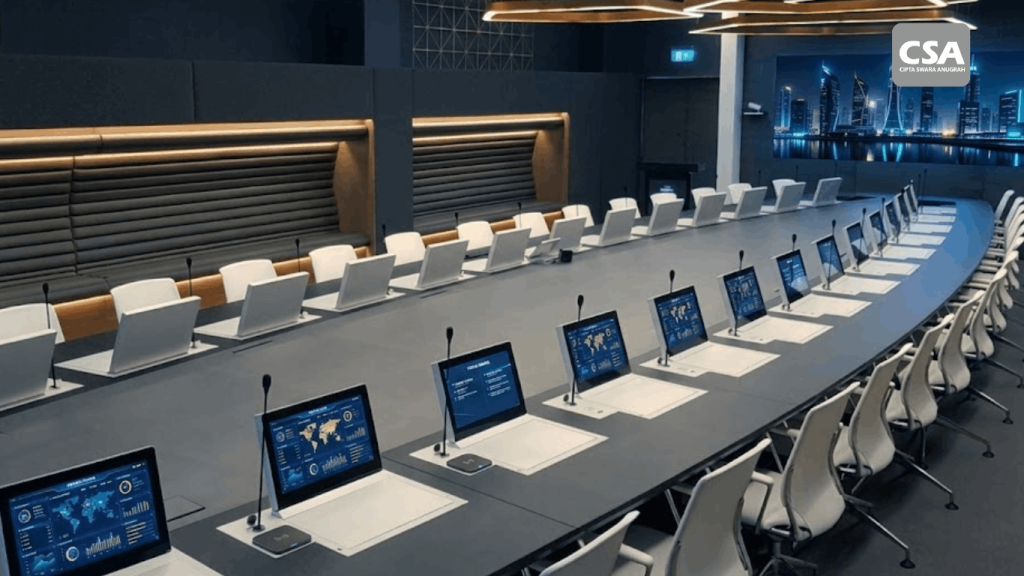
One example is CSA Indonesia’s project at Danantara Indonesia. The Nusantara Meeting Room was designed as an advanced hybrid meeting environment for executive-level discussions.
The system uses Crestron AV over IP infrastructure for audio and video distribution. The room also features AI auto-tracking cameras and a wireless delegate microphone system.
This type of integration allows technology to operate in the background while users focus on the discussion.
For corporate environments, this approach can be useful when the company wants a meeting room that supports hybrid communication without making the technology difficult to operate.
Examples of AV System Integration Projects by CSA Indonesia
Project experience is an important consideration when a company evaluates an integrator.
A portfolio can provide insight into the types of environments an integrator has handled, the complexity of previous projects, and the scope of its capabilities.
CSA Indonesia’s portfolio includes corporate, government, hospitality, entertainment, arena, and other business environments.
Danantara Indonesia – Nusantara Meeting Room
At Danantara Indonesia, CSA delivered an advanced hybrid meeting environment for the Nusantara Meeting Room.
The project uses Crestron AV over IP infrastructure for flexible audio and video distribution. It also includes AI auto-tracking cameras and a wireless delegate microphone system.
The project is a relevant example of a corporate environment where audio, visual, communication, and control technologies need to work together.
Ministry of Agriculture – Agriculture War Room
CSA also worked on the Agriculture War Room at Indonesia’s Ministry of Agriculture.
The project includes Audio, Visual, Lighting, and Automation services. A major component is a giant 3 × 12 meter video wall designed to support monitoring activities.
This project demonstrates that AV System Integration can extend beyond conventional meeting rooms.
A monitoring environment requires careful consideration of visual distribution, system control, infrastructure, and operational requirements.
Mövenpick Resort – Integrated AVL System
At Mövenpick Resort, CSA served as the System Integrator for an integrated audio, visual, and entertainment lighting system.
The scope covered system design, equipment selection, installation, integration, and commissioning. The project supported multiple areas of the resort, including event and entertainment spaces.
The audio system supports background music, live performances, DJ sessions, and special events. The visual system supports meetings, presentations, and entertainment content.
All systems are integrated through a unified control platform so resort staff can manage audio, visual, and lighting functions more efficiently.
This project illustrates how system integration can support environments with different operational requirements.
What Is the Typical AV Implementation Process?
Every project has a different scope. However, companies generally go through several key stages.
1. Consultation and Requirements Identification
The integrator understands the project’s objectives, room functions, users, technology requirements, and expected workflow.
2. Site Survey
The team reviews the physical conditions and existing infrastructure.
3. System Design
User requirements are translated into a technical design covering equipment, connections, signal distribution, and control.
4. Equipment Selection
The integrator selects equipment that matches the system design and project requirements.
5. Installation
The team installs devices, cabling, racks, connections, mounting systems, and supporting components.
6. Configuration and Programming
Each component is configured to work according to the intended workflow.
Complex projects may also require control system programming and automation.
7. Testing and Commissioning
The complete system is tested before handover.
Audio, video, cameras, connectivity, control, and workflow functions should be checked against the project requirements.
8. Handover
Once the system is completed, the company receives the system along with relevant documentation and, when required, user training.
This end-to-end approach can be seen in the Mövenpick Resort project, where CSA handled system design, equipment selection, installation, integration, and commissioning.
Why Are Testing and Commissioning Important?
An AV project should not be considered complete simply because all equipment has been installed.
The system needs to perform under actual usage conditions.
Microphones should be tested from different participant positions. Cameras should be checked for framing and coverage. Speakers should be evaluated across the intended listening area.
Video conferencing should also be tested with realistic two-way communication scenarios.
Testing helps identify problems before the system becomes part of daily operations.
Commissioning then verifies that the completed system meets the agreed design and functional requirements.
What Should Companies Consider When Choosing an Integrator?
Companies should look beyond the equipment brands an integrator offers.
Several other factors can help evaluate whether an integrator is suitable for a particular project.
Project Experience
A portfolio provides insight into the types of projects an integrator has handled.
Corporate office experience is relevant to companies planning meeting rooms. Hospitality experience may be more relevant to hotels and resorts.
Design Capability
An integrator should be able to explain why a particular system is appropriate.
A good design should start from user requirements and room conditions rather than from a list of available products.
Integration Capability
The more devices a project contains, the more important integration becomes.
Companies should determine whether the integrator can connect audio, visual, control, automation, and other technologies into a coordinated system.
Testing and Commissioning
Ask about the integrator’s testing process before handover.
A structured commissioning process can help identify issues before the system enters regular use.
Post-Installation Support
An AV system becomes part of the company’s operational infrastructure.
For this reason, support after implementation should also be considered.
For a more detailed checklist, companies can read 7 Things to Consider Before Choosing an AV System Integrator.
Why Is an End-to-End Approach Important?
An AV project consists of multiple connected stages.
A design decision can affect equipment selection. Equipment selection can affect installation. Installation can affect configuration and commissioning.
If each stage is handled by different parties without proper coordination, project complexity can increase.
An end-to-end approach creates a more coordinated workflow.
CSA applies this approach across a number of projects. At Mövenpick Resort, for example, CSA handled the project from system design through commissioning as the System Integrator.
This approach can also make future troubleshooting, maintenance, and system expansion easier because the integrator understands the system as a whole.
CSA Indonesia as an AV System Integration Partner
CSA Indonesia provides Audio, Visual, Lighting, and Automation solutions for different business environments.
Its scope can cover planning, system design, equipment selection, installation, integration, configuration, testing, and commissioning, depending on the project requirements. CSA’s portfolio includes corporate, government, hospitality, entertainment, and other sectors.
This project experience includes different types of requirements.
Danantara Indonesia required an advanced hybrid meeting environment. The Ministry of Agriculture required an Agriculture War Room with a large video wall. Mövenpick Resort required an integrated audio, visual, and entertainment lighting system.
These examples demonstrate why AV projects cannot use one standard formula for every company.
Each project needs to begin with its users, room conditions, operational requirements, and expected workflow. Technology can then be selected and integrated around those requirements.
For companies planning a new meeting room, upgrading an existing AV system, developing a conference space, or building a facility with more complex audio visual requirements, a system integration approach can help create a more coordinated technology environment.
Conclusion
AV System Integrator Services for Companies go beyond installing individual audio visual devices. The scope can include requirements analysis, site surveys, system design, equipment selection, installation, configuration, integration, testing, commissioning, and ongoing support.
These services can apply to meeting rooms, boardrooms, training rooms, auditoriums, command centers, corporate offices, hospitality venues, and other facilities.
Project experience is also an important consideration. CSA Indonesia’s projects at Danantara Indonesia, the Ministry of Agriculture, and Mövenpick Resort demonstrate different applications of integrated AV and AVL technology.
Ultimately, companies should evaluate an integrator based on its ability to understand requirements, design a suitable solution, integrate the technology, test the system, and support the implementation.
The objective is not simply to purchase more equipment. It is to create a technology system that supports the way the company actually operates.
FAQ
What are AV System Integrator services for companies?
AV System Integrator services help companies plan, design, supply, integrate, configure, install, test, and commission professional audio visual systems based on their operational requirements.
What services does an AV System Integrator usually provide?
Services may include consultation, site surveys, system design, equipment selection, installation, integration, programming, testing, commissioning, documentation, and post-installation support.
Does an AV System Integrator only work on meeting rooms?
No. Integrators can work on meeting rooms, boardrooms, training rooms, auditoriums, command centers, corporate offices, hospitality venues, and other facilities requiring integrated AV systems.
What is the difference between an AV System Integrator and an AV equipment vendor?
An equipment vendor generally focuses on supplying products. An AV System Integrator has a broader role that can include system design, installation, integration, configuration, and testing.
Why do companies need integrated AV systems?
Integration allows multiple devices to operate as one coordinated system. This can simplify the user workflow and reduce the need to operate each device separately.
Can an AV system be expanded after implementation?
Yes, depending on the original design, infrastructure, and equipment compatibility. Future scalability should therefore be considered during the initial planning stage.