
Why Is a Modern Meeting Room Not Enough with Just a TV and Speakers? This question has become increasingly relevant as companies use meeting rooms for presentations, video conferences, hybrid meetings, and collaboration across different locations.
A TV can display presentation materials. Speakers can deliver sound. However, these two devices only address part of what a modern meeting room needs.
As meeting activities become more diverse, companies may also need cameras, microphones, audio processors, wireless presentation systems, control systems, and other supporting technologies.
The goal is not to fill a room with as many devices as possible. What matters is how each component works together as part of an integrated system.
A TV and Speakers Only Cover Basic Requirements
A TV serves as a visual display, while speakers deliver audio. Both remain important components of a meeting room.
However, modern meetings require more than visual and audio output.
Participants may need to share content from their laptops. Teams may need to communicate with colleagues in another office. Presenters may need to switch between different content sources. Remote participants also need to see and hear people inside the meeting room clearly.
In these situations, two devices alone cannot support the entire meeting workflow.
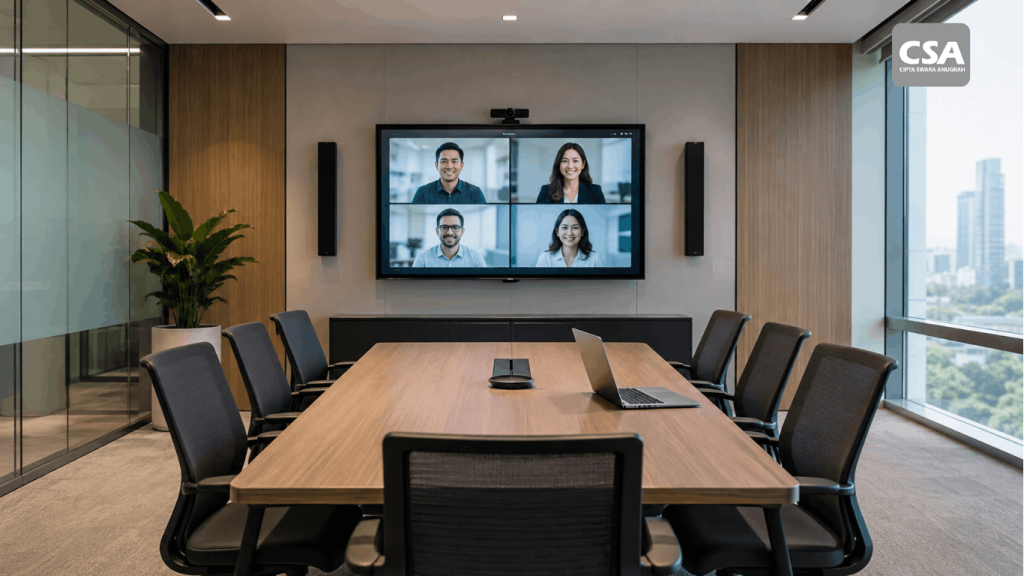
Consider a meeting with six people in the room and three participants joining remotely. One participant uses a personal laptop for a presentation. The presentation needs to appear on the display, the camera needs to capture the participants, and the microphone needs to pick up conversations.
At the same time, audio from remote participants needs to reach everyone in the room.
This is where a complete AV system becomes important.
Read Also: How to Design an Audio Visual System for a Corporate Meeting Room
Modern Meeting Rooms Need Integrated Systems
The key difference between a conventional meeting room and a modern one is integration.
Instead of operating independently, devices need to work together according to the way people actually use the room.
A system may include displays, cameras, microphones, speakers, DSP or audio processors, video conferencing systems, wireless presentation solutions, control systems, and supporting network infrastructure.
A broader overview of these components is available in the article What Devices Are Included in an Integrated Audio Visual System?.
The purpose is not simply to add more technology. The goal is to make meetings easier to run.
Cameras Are Essential for Remote Communication
Hybrid meetings are one of the main reasons companies need more than a TV and speakers.
When some participants join remotely, the system needs to capture what is happening inside the room.
A camera therefore becomes an important part of the setup.
However, simply installing a camera does not automatically solve the problem. Its viewing angle needs to match the room layout and participant positions.
A small meeting room has different requirements from a long boardroom or a U-shaped conference room.
The camera should capture participants from an appropriate angle so remote attendees can follow the discussion comfortably.
For frequently used meeting rooms, companies may also consider cameras with features such as auto framing or speaker tracking. The right choice still depends on the room configuration and meeting requirements.
Microphones Directly Affect Conversation Quality
Audio problems do not always come from speakers that are not powerful enough. In many cases, the microphone simply cannot capture voices properly.
Participants sitting far from the microphone may sound too quiet. Multiple speakers talking from different areas can also make conversations harder to follow.
Microphone design should therefore follow the participant layout.
Different microphone types may suit different table configurations, room sizes, participant numbers, and communication patterns.
A small meeting room may need a relatively simple setup. A larger boardroom may require several microphones with wider coverage.
The number of microphones alone is not enough. Their placement matters just as much.
Speaker Distribution Matters Too
Speakers are not only about volume.
Sound needs to reach participants evenly so people in different areas can hear the conversation comfortably.
Room acoustics also play a role. Increasing speaker volume does not always solve poor audio quality when excessive reflections are the actual problem.
Companies can also refer to the article Meeting Room Sound System: The Key to Effective Communication for a closer look at meeting room audio requirements.
Video Conferencing Cannot Operate in Isolation
Video conferencing is sometimes viewed as something that only requires a camera and meeting application.
In practice, the overall experience also depends on other components.
The camera needs to connect to the conferencing system. Microphones need to capture voices. Speakers need to reproduce remote participants. Displays need to show both video and presentation content.
All of these components need to work together.
If one part performs poorly, the entire meeting experience can suffer.
For example, a camera may provide excellent image quality, but if the microphone cannot capture participants at the far end of the table, remote attendees will still have a poor experience.
That is why video conferencing should be treated as part of the overall AV system.
For a more detailed discussion, see The Importance of Integrating Video Conferencing and Sound Systems in Meeting Rooms.
Wireless Presentation Makes Content Sharing Easier
Presentation requirements have also changed.
During a single meeting, several participants may want to present content from their own laptops. If every device needs a physical cable, switching between presenters can become inconvenient.
Wireless presentation systems can simplify this process.
Users can share content without constantly changing cables or looking for the correct adapter.
However, the system still needs to be planned around network requirements and device compatibility.
The goal is not simply to provide wireless connectivity. Users should also be able to operate the system without needing technical assistance every time they start a meeting.
Control Systems Bring Multiple Devices Together
The more devices a meeting room contains, the more complicated operation can become.
The display may have its own remote. The conferencing system may use another interface. Audio may have separate controls. The presentation system may require another method of operation.
This can make a technology-equipped meeting room feel unnecessarily complicated.
A room control system can simplify this experience.
Users can access multiple functions through a single interface. They may be able to turn on the display, select a content source, adjust the volume, or start a meeting from one control panel.
The level of automation should still match the actual requirements of the room.
For a broader look at this technology, see Room Automation System for Smart Meeting Rooms.
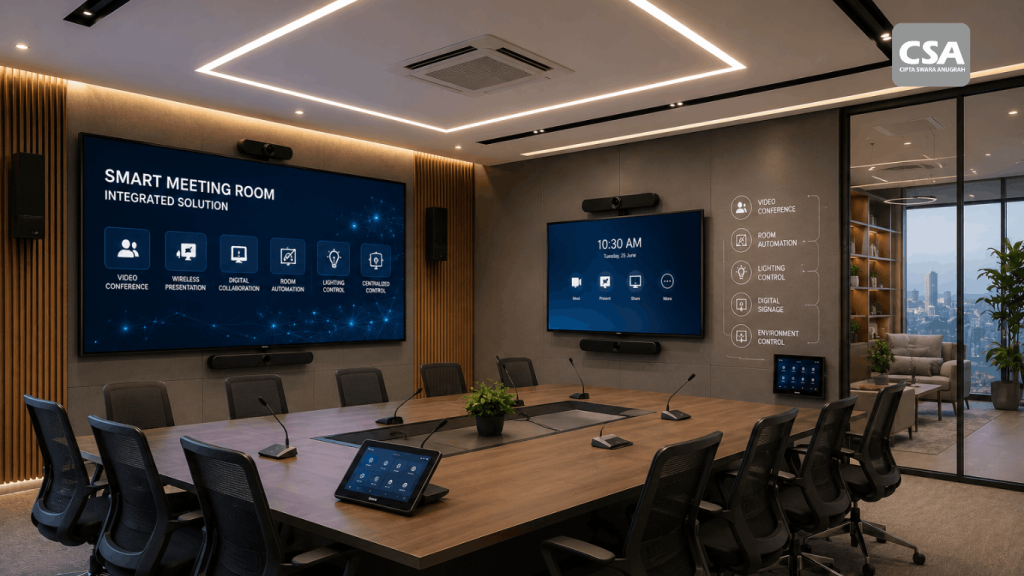
A Smart Meeting Room Is More Than a Collection of Devices
The term smart meeting room is sometimes interpreted as a room filled with advanced technology.
In reality, being smart is more about how technology supports users.
A room can contain many devices and still feel difficult to operate. Meanwhile, a simpler system can provide a better experience when its components are properly integrated.
For example, a user may select a meeting mode from a control panel. The display turns on, the camera becomes active, the audio system switches to the appropriate configuration, and the presentation source can be selected without operating several devices separately.
This is where system integration becomes valuable.
For a broader discussion, companies can read Audio Visual Systems for Meeting Rooms.
Room Layout Also Determines the AV System
Not every meeting room requires the same configuration.
Room size and layout have a direct impact on system design.
A small meeting room may only need one display, a camera, microphones, and speakers with a relatively simple configuration.
A large conference room, on the other hand, may require multiple microphones, more than one camera, several displays, audio processing, and a control system.
The position of the table also matters.
Microphones need to cover participant areas. Cameras need the right viewing angle. Displays need to remain visible. Speakers need to provide appropriate sound distribution.
This is why equipment selection should follow the room design rather than the other way around.
Room Acoustics Cannot Be Ignored
Audio performance is also influenced by the room itself.
Glass surfaces, hard walls, ceilings, flooring, and certain interior elements can create sound reflections.
Excessive reflections can make conversations difficult to understand.
In such situations, simply increasing speaker volume is not necessarily the answer.
Companies may need to consider speaker placement, microphone positioning, audio processing, and room acoustics together.
This is why audio design should be treated as part of the overall system instead of simply choosing speakers with higher power output.
Integration Creates a Simpler User Experience
One of the main reasons companies invest in modern meeting rooms is to improve efficiency.
However, technology can create new problems when the system becomes too complicated.
Imagine users having to turn on five different devices before a meeting. They may also need to select inputs manually, adjust audio, connect the camera, and make sure remote participants can hear everyone.
That process wastes time.
An integrated system is designed to reduce this complexity.
Users can follow a predefined workflow while the technology operates in the background.
This concept is one of the foundations of Smart Meeting Room Solutions for Businesses.
Why Is Equipment Selection Alone Not Enough?
Companies often focus heavily on specifications when purchasing AV equipment.
They compare camera resolution, display size, speaker power, and microphone features.
These factors are important.
However, equipment specifications are only one part of the equation.
Each device needs to fit the overall system.
A high-quality camera will not deliver its full potential if it is installed in the wrong position. A premium microphone cannot solve coverage problems if its placement does not match the room layout.
System design and integration therefore matter just as much as individual equipment specifications.
When Does a Company Need an AV System Integrator?
A simple meeting room may work with a relatively straightforward configuration.
However, requirements become more complex when a room supports hybrid meetings, presentations, collaboration across locations, and multiple content sources.
At that point, a company needs more than individual devices. It needs a system designed around its actual requirements.
An AV system integrator can help translate user requirements into a technical design.
The process may include site surveys, system design, equipment selection, installation, configuration, integration, testing, and commissioning.
This approach is important because an integrator looks at the equipment as one connected ecosystem.
Companies can learn more about this concept through What Is AV System Integration?.
CSA Indonesia and Integrated Audio Visual Solutions
A modern meeting room needs more than devices that display images and produce sound.
Cameras, microphones, speakers, displays, video conferencing systems, wireless presentation solutions, control systems, and supporting equipment need to be planned around the room’s actual requirements.
CSA Indonesia takes an integration-focused approach to professional audio visual solutions. The system is designed so different components can work together and support the way users conduct meetings.
This approach becomes increasingly important for companies that want a meeting room that is simple to operate while still supporting modern communication and collaboration needs.
For more complex projects, AV system integration can help companies avoid disconnected systems that are difficult to operate and maintain.
Conclusion
A TV and speakers remain important components of a meeting room. However, they only cover the basic requirements for visual and audio output.
Modern meetings involve two-way communication, presentations, video conferencing, collaboration, and convenient system operation. Cameras, microphones, audio processing, wireless presentation, control systems, and other technologies may therefore become necessary.
What matters most is not the number of devices installed. The quality of a meeting depends on how well those components are designed and integrated around the needs of the room and its users.
FAQ
Does every meeting room need a smart meeting room system?
Not necessarily. The required system depends on the room size, number of participants, meeting activities, and collaboration requirements.
Can a TV still be used in a modern meeting room?
Yes. A TV can remain an effective display solution for certain rooms. However, companies should consider how it will work with the rest of the AV system.
What equipment is important besides a TV and speakers?
Cameras and microphones become especially important when the room supports video conferencing. Other equipment depends on the project’s requirements.
Why are microphones important in meeting rooms?
Microphones ensure that participants’ voices are captured clearly, particularly when meetings involve remote participants.
What are the benefits of working with an AV system integrator?
An integrator can help design, integrate, configure, and test different components so they operate as one coordinated system.
Does every meeting room require the same AV configuration?
No. The configuration should reflect the room’s size, layout, number of participants, functions, and communication requirements.