
A professional field sound system requires more than powerful speakers. Outdoor areas create unique audio challenges because there are no walls or ceilings to naturally contain sound. Wind, ambient noise, large audience distances, weather exposure, and wide coverage areas can all affect the final listening experience.
A well-designed outdoor audio system must deliver clear and consistent sound across the entire field. Whether the venue is used for sports competitions, school events, community gatherings, outdoor ceremonies, or commercial events, every audience area should receive sufficient audio without creating excessive volume in certain locations.
The design process should therefore begin with the venue itself. Area size, audience positioning, event requirements, speaker locations, power infrastructure, weather conditions, and future operational needs all need to be considered before equipment is selected.
conditions all need to be considered before selecting the system.
Why Outdoor Fields Need a Different Audio Approach
Indoor rooms naturally create boundaries that affect how sound travels. Outdoor fields do not have the same physical limitations. Sound can spread freely, which makes coverage more difficult to control.
Ambient noise can also change throughout the day. Traffic, spectators, nearby facilities, sporting activities, and other environmental sources may compete with announcements or music.
Simply increasing the volume is not always the right answer. Excessive volume can make the system uncomfortable while failing to improve clarity in distant areas.
A better approach focuses on controlled coverage and proper distribution.
Several factors should be evaluated before installation:
- Total area requiring audio coverage
- Distance between speakers and listeners
- Expected audience capacity
- Type of activity
- Ambient noise around the venue
- Weather exposure
- Available electrical infrastructure
- Speaker mounting locations
- Microphone and announcement requirements
- Possibility of future system expansion
With this approach, the audio system becomes part of the venue infrastructure rather than simply a collection of speakers and amplifiers.
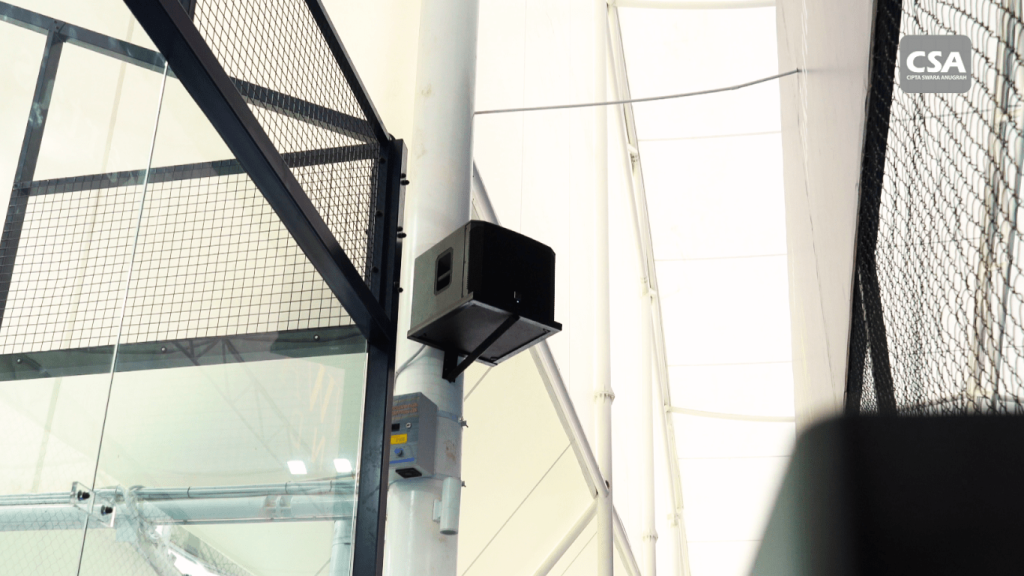
Read Also: Outdoor Sound System Installation by CSA Indonesia
Understanding the Intended Use of the Field
The right configuration depends heavily on how the field will be used. A sports venue has different requirements from a school field or an outdoor event space.
Sports Fields
Sports facilities commonly use audio for announcements, background music, match commentary, communication, and audience engagement.
Speech intelligibility is particularly important. Spectators need to understand announcements even when the venue becomes crowded and noisy.
The system can also be divided into multiple zones. This allows different areas to receive appropriate sound levels instead of forcing the entire venue to operate at the same volume.
For a broader reference, CSA Indonesia discusses the design of Sound System for Sports Arenas, including considerations for sports venues and their different listening areas.
Schools and Campuses
Outdoor fields at schools and universities may accommodate ceremonies, sports activities, student events, performances, and community gatherings.
Flexibility becomes important in these environments. A system used for a simple announcement should not require the same setup as a large event.
The control interface should also remain practical. Staff should be able to operate basic functions without complicated technical procedures.
Event and Community Areas
Outdoor event venues can have a wider range of audio sources. Wireless microphones, music playback, stage monitors, announcements, and other sources may need to work together.
Portable equipment can provide flexibility for temporary events. Permanent venues, meanwhile, may benefit from fixed speakers, organized cabling, predefined zones, and centralized control.
Mapping Audio Coverage Before Installation
Coverage planning is one of the most important stages in an outdoor audio project.
The number of speakers should not be determined solely by the size of the field. The shape of the venue, audience position, speaker height, listening distance, and required sound level all affect the design.
A coverage plan can help identify:
- Main speaker positions
- Secondary speaker locations
- Areas requiring additional coverage
- Potential dead zones
- Areas that may receive excessive sound
- Speaker overlap
- Required delay between different zones
The goal is to create consistent coverage throughout the listening area.
For example, a sports facility may require separate coverage for the playing area, spectator seating, entrance, café, and other supporting spaces. Each zone can have its own audio requirements.
CSA Indonesia’s experience with Sound System for Sports Arenas provides an example of how audio distribution can be planned across different areas within a sports facility.
Choosing the Right Speakers for Outdoor Areas
Speaker selection should go beyond output power. Coverage pattern, installation position, environmental protection, and intended use all influence whether a speaker is suitable for a particular venue.
Directional speakers can help focus sound toward the audience. This can reduce unnecessary energy directed toward surrounding areas.
Permanent outdoor installations also require attention to environmental exposure. Rain, humidity, heat, dust, and direct sunlight can affect equipment when the installation does not provide sufficient protection.
Mounting hardware deserves equal consideration. Speakers installed on poles, structures, or elevated platforms must remain stable during regular operation.
The objective is to create a system that delivers the required coverage while remaining appropriate for the physical conditions of the venue.
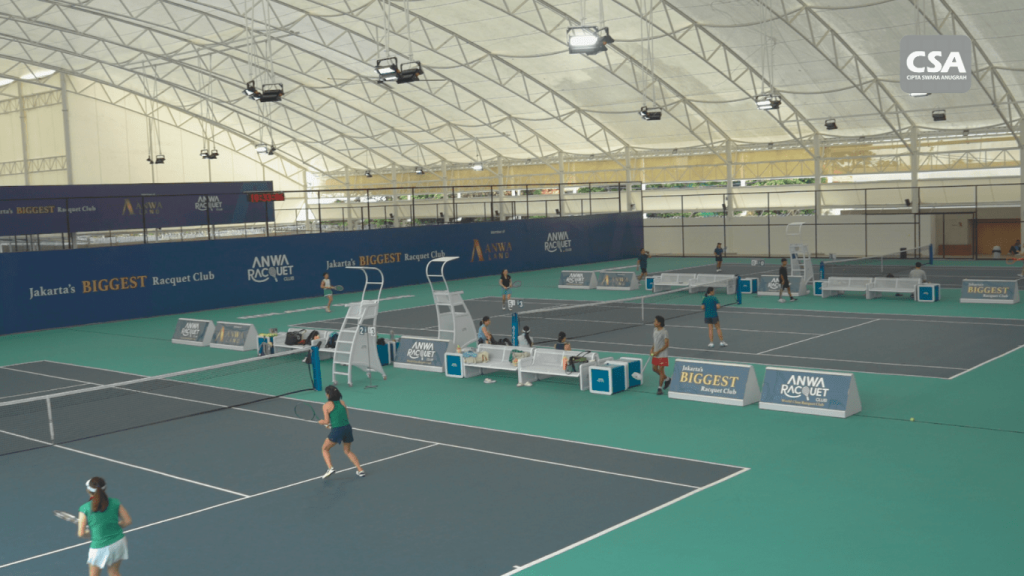
Read Also: The Advantages of CSA Indonesia’s Audio System in Sports Activities
Speaker Placement and Sound Direction
Even high-quality speakers can perform poorly when installed in unsuitable positions.
Speaker height, distance, angle, and orientation all influence how sound reaches listeners. The system should direct acoustic energy toward the intended audience rather than unnecessarily toward surrounding structures.
Large fields may require several speakers or separate audio zones. However, simply adding more speakers does not automatically improve the system.
Multiple sources can interact with each other. If their levels and timing are not controlled properly, listeners may experience inconsistent sound or noticeable echoes.
Speaker placement should therefore be considered as part of the overall system design.
This principle also appears in CSA Indonesia’s sports audio work, where speaker positioning and coverage planning are considered alongside the venue’s physical layout.
Managing Delay in Large Outdoor Areas
Large fields can have considerable distances between the main sound source and remote listening areas.
Additional speakers may be necessary to maintain adequate coverage. When these speakers are positioned farther from the main system, time alignment becomes increasingly important.
Without proper delay settings, listeners may hear the same audio signal at different times. The result can sound like an echo and reduce speech intelligibility.
DSP allows technicians to adjust delay parameters for individual zones. The settings should then be tested from several listening positions to ensure the system remains coherent.
This becomes especially useful for venues with long spectator areas, multiple courts, or separated event zones.
The Role of DSP in Outdoor Audio
Digital Signal Processing, or DSP, provides greater control over how an audio system operates.
A DSP can handle functions such as equalization, crossover, routing, delay, limiting, and other signal processing tasks.
This flexibility becomes useful when several zones require different settings.
For example, a spectator area may need a different level from a café, entrance, or VIP area. Each zone can be controlled independently while remaining part of the same audio infrastructure.
DSP can also support system protection through functions such as limiting and signal management.
Controlling Ambient Noise
Outdoor venues often have unpredictable background noise.
Vehicles, spectators, nearby businesses, sporting activities, and mechanical equipment can all affect perceived audio quality.
Increasing the volume is not always the best solution. A louder system may become uncomfortable while still failing to improve speech clarity.
The design should instead focus on controlled coverage, appropriate speaker direction, sufficient system headroom, and suitable signal processing.
Dividing the venue into audio zones can also improve control. Operators can increase the level in a noisy area without unnecessarily increasing the volume throughout the entire facility.
CSA Indonesia highlights the importance of controlled audio distribution in sports environments through its discussion of the advantages of professional audio systems in sports activities.
Protecting Equipment from Outdoor Conditions
Weather is one of the most important considerations for permanent outdoor installations.
Speakers and related equipment may face rain, humidity, heat, dust, and direct sunlight. The level of exposure depends on the venue and installation position.
Weather-resistant equipment can help protect the system from environmental conditions. However, protection should not stop at the speaker enclosure.
Cable routes, connectors, mounting hardware, equipment enclosures, and other installation components should also be considered.
A well-planned installation can reduce the risk of environmental damage and support more reliable long-term operation.
Designing the Electrical Infrastructure
A large outdoor audio system can include several amplifiers, processors, mixers, wireless microphone systems, and other supporting devices.
The electrical infrastructure must therefore accommodate the total system requirements.
For temporary events, power distribution and cable routing should also consider audience movement and environmental exposure. Cables need to be organized and protected to reduce safety risks.
For permanent installations, power requirements should be considered during the initial design stage. Coordinating audio, electrical, and structural requirements can make the final installation safer and easier to maintain.
Testing and Tuning the System
Installation does not end when every speaker has been connected.
The system should be tested from different positions across the field. Technicians need to evaluate both areas close to the main speakers and distant listening positions.
Testing can include:
- Overall sound level
- Speech intelligibility
- Frequency response
- Speaker delay
- Zone balance
- Feedback potential
- Background noise
- Amplifier performance
- Microphone clarity
Tuning allows the system to be adjusted according to actual site conditions. This is important because the real environment may behave differently from an initial simulation or design assumption.
The same principle applies to sports venues. Proper testing helps ensure that the final system supports actual activities rather than only performing well during installation.
Audio Zoning for Multi-Area Sports Venues
Modern sports facilities often contain more than one listening area.
A venue may include courts, spectator areas, cafés, entrances, lounges, changing rooms, and other supporting facilities.
An audio distribution system can divide these areas into separate zones while keeping them connected to the same infrastructure.
A relevant example can be found in CSA Indonesia’s work with Sound System for Sports Arenas, where audio requirements can extend beyond the main playing area.
Different zones can receive different content and volume levels. Background music can operate in one area while announcements remain focused on another.
This approach provides greater operational flexibility and avoids unnecessary sound spill between areas.
What Padel Venues Can Teach Us About Outdoor Sports Audio
Padel facilities provide an interesting example of specialized sports audio requirements.
Glass walls can create strong reflections, while semi-open layouts can introduce additional environmental noise. Speaker placement therefore needs to consider both the playing area and surrounding spaces.
CSA Indonesia has a dedicated article covering Professional Padel Sound System, discussing the role of speaker selection, DSP, wireless microphones, and controlled audio distribution in modern padel facilities.
The approach can also be seen in the Audio Visual Padel Court installation by CSA Indonesia, which demonstrates how audio and AV technology can support the experience of players and visitors.
CSA Indonesia has also carried out the House Of Mayor Padel sound system installation project, providing a practical example of how audio requirements can be addressed within a modern sports venue.
These projects illustrate an important principle: outdoor sports audio should be designed around the venue’s actual operational requirements rather than based solely on speaker specifications.
Permanent or Portable: Which System Is Better?
The choice between permanent and portable equipment depends on how the field will be used.
Portable systems are suitable for venues where event requirements change frequently. Equipment can be moved according to the needs of each activity.
Permanent systems are more appropriate when a field requires consistent audio performance. Sports facilities, schools, campuses, and commercial venues may benefit from fixed installations.
Permanent systems can also simplify daily operation. Speakers remain in predefined positions, cabling is organized, and audio zones can be configured in advance.
Portable systems offer greater flexibility for temporary events. The right choice should consider usage frequency, venue layout, budget, maintenance requirements, and future expansion.
Why Professional System Integration Matters
Outdoor audio installation may appear straightforward, but achieving consistent results requires careful technical planning.
A professional system integrator can evaluate the site, determine coverage requirements, select suitable equipment, design speaker placement, configure DSP, integrate audio zones, perform installation, and complete system testing.
This becomes increasingly important for large or permanent venues.
CSA Indonesia’s Project Visit Princess Padel Karawang demonstrates the importance of checking system performance and operational readiness at an actual sports venue.
System integration can also extend beyond audio. Modern sports facilities may connect audio with lighting, LED displays, centralized control, and other AV technologies.
The result is not simply a collection of independent devices. Instead, the systems work together according to the venue’s operational requirements.
Building an Audio System That Can Grow with the Venue
Outdoor facilities can change over time.
A field may initially support basic announcements but later host tournaments, larger sporting events, concerts, or commercial activities.
The audio infrastructure should therefore consider scalability from the beginning.
A modular approach can make it easier to add zones, speakers, microphones, processing, or control features when requirements increase.
This can be particularly useful for sports facilities that develop into larger lifestyle destinations. Audio may eventually serve the field as well as cafés, lounges, entrances, spectator areas, and event spaces.
The objective is not to install the largest possible system from day one. Instead, the system should meet current requirements while providing a practical path for future expansion.
Conclusion
A professional field sound system should be designed around coverage, clarity, environmental conditions, and the actual requirements of the venue. Simply increasing speaker power cannot solve every outdoor audio challenge.
The process should begin with site analysis and coverage planning. Speaker selection, placement, zoning, DSP configuration, delay, weather protection, electrical planning, and final tuning then work together to create consistent performance.
For sports facilities and outdoor venues, a properly integrated audio system can support announcements, background music, competitions, events, and everyday operations without becoming a distraction.
The right approach is to treat audio as part of the venue infrastructure. With professional planning and system integration, outdoor spaces can achieve clear, reliable, and scalable sound performance.
FAQ
What is a professional field sound system?
A professional field sound system is an outdoor audio system designed to provide clear and consistent sound across large open areas while considering coverage, environmental conditions, zoning, amplification, and operational requirements.
Why is outdoor audio more difficult than indoor audio?
Outdoor spaces lack walls and ceilings that help contain sound. Wind, ambient noise, long listening distances, and weather exposure can also affect audio performance.
How can sound be distributed evenly across a field?
Start with coverage planning and appropriate speaker placement. Directional speakers, multiple zones, DSP processing, and delay settings can help maintain consistent audio across different areas.
Do outdoor speakers need weather protection?
For permanent installations exposed to outdoor conditions, weather-resistant equipment is recommended. Cabling, connectors, mounting hardware, and other installation components should also receive appropriate protection.
Can one sound system cover multiple areas?
Yes. A zoned audio system can distribute sound to courts, spectator areas, cafés, entrances, and other spaces while allowing each area to have independent volume or audio control.
Should a field use a permanent or portable sound system?
It depends on the venue’s usage. Permanent systems suit facilities with regular audio requirements, while portable systems provide greater flexibility for temporary or changing events.