
A sound system for worship spaces plays an important role in delivering sermons, prayers, scripture readings, worship music, and announcements to the congregation. A good system is not simply about producing high volume. It should deliver clear, balanced, and comfortable audio across the entire listening area.
Every worship space has different characteristics. Room dimensions, ceiling height, wall materials, seating layout, stage position, and the number of worshippers can all influence audio performance. Because of this, equipment selection should follow the requirements of the space rather than relying only on speaker power or brand names.
The right approach begins with system design. Every component needs to work together, from microphones and mixers to DSP, amplifiers, loudspeakers, and supporting infrastructure. The goal is simple: every person should be able to hear the message clearly without excessive volume or distracting technical problems.
Why Audio Quality Matters in Worship Spaces
Sound carries much of the message during a worship service. A sermon needs to remain intelligible from the front row to the back of the room. Worship vocals should sound natural, while musical instruments need to remain balanced with the main vocal sources.
Poor audio distribution can create an uncomfortable listening experience. People sitting close to the stage may hear excessive volume, while those farther away struggle to understand the speaker.
This is one reason professional church sound system design starts with the characteristics of the room. Acoustic conditions, speaker placement, coverage, and signal processing need to work together rather than being treated as separate decisions. CSA Indonesia
Reverberation presents another challenge. Hard surfaces such as concrete, glass, marble, and large architectural elements can reflect sound and reduce speech intelligibility.
Simply increasing the volume does not necessarily solve the problem. In some situations, excessive volume can make reflections even more noticeable.

Read Also: Professional Church Sound System: Clear, Powerful, and Spiritually Engaging
Common Audio Challenges in Worship Spaces
Before selecting equipment, the technical team should understand the challenges presented by the building. These challenges can vary significantly between different worship venues.
Room Shape and Size
Some worship spaces have long rectangular layouts. Others feature wide seating areas, balconies, high ceilings, or multiple levels.
The shape of the room influences the distance between loudspeakers and listeners. A long room may require additional coverage points, while a balcony may need dedicated delay speakers.
The objective is to distribute sound consistently rather than relying on a single loudspeaker position.
Reflections and Reverberation
Worship buildings often contain reflective materials. Stone, concrete, glass, tile, and other hard surfaces can cause sound to bounce around the room.
Excessive reflections can make speech sound unclear. They can also make music feel less controlled.
For this reason, the audio system should be designed alongside the acoustic characteristics of the room. In some projects, acoustic treatment may also become part of the overall solution.
Uneven Sound Distribution
A large room can contain significant differences in listening levels between areas. The front seats may receive strong direct sound, while the rear section receives a combination of direct and reflected sound.
A properly designed system considers these differences from the beginning. Coverage mapping and speaker aiming can help the design team determine how loudspeakers should serve each area.
Microphone Feedback
Feedback occurs when sound from a loudspeaker returns to a microphone and creates a feedback loop. The result can be a high-pitched ringing sound.
Speaker placement, microphone position, gain structure, equalization, and room acoustics all influence feedback risk.
A professional church sound system setup therefore requires more than connecting equipment. It also involves testing different listening zones and configuring the system according to the room. CSA Indonesia
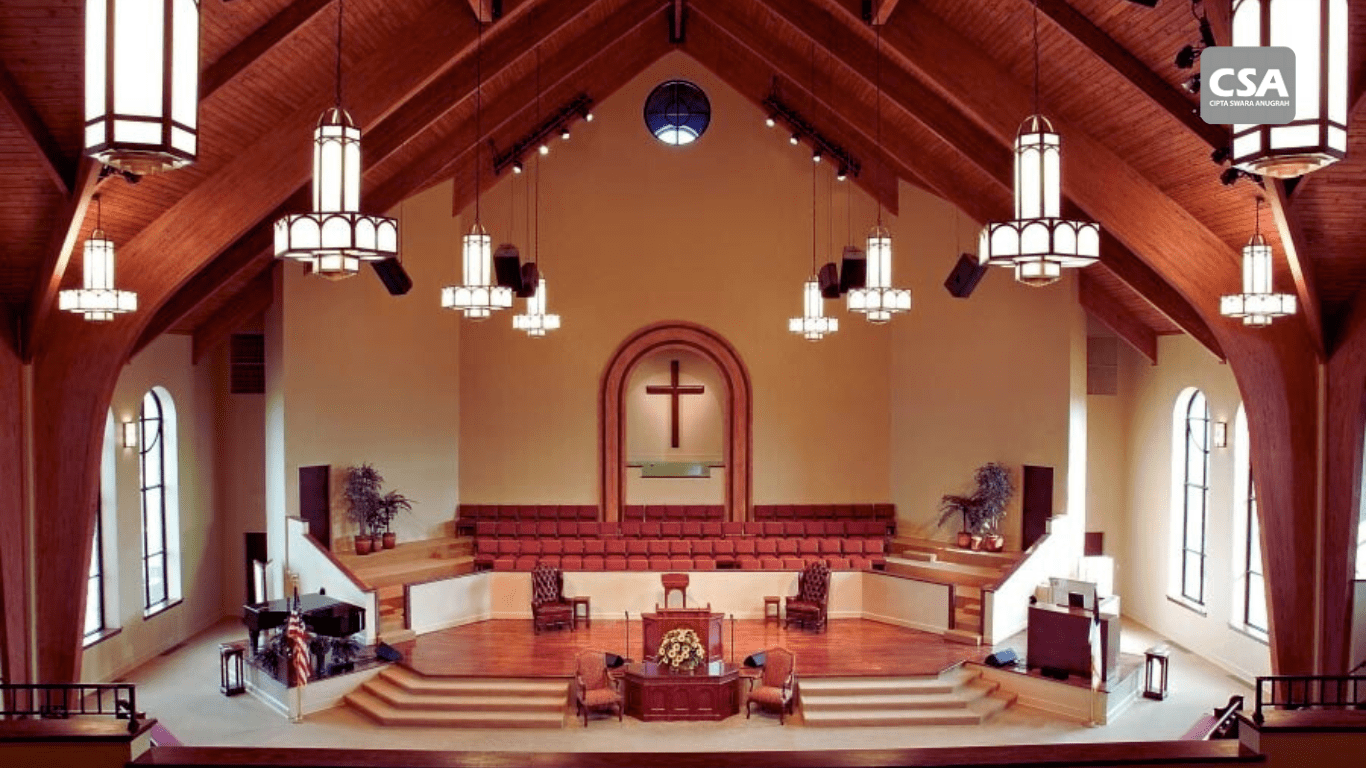
Read Also: Church Lighting Solutions Professional : Create a Sacred Worship Atmosphere with CSA Indonesia
How to Design an Audio System for a Worship Space
System design should begin with the needs of the venue. Equipment selection should follow after those requirements have been identified.
1. Conduct a Site Survey
A site survey gives the technical team a better understanding of the actual environment.
The survey can examine room dimensions, seating arrangements, stage position, balconies, ceiling height, cable routes, power availability, and equipment locations.
The team can also identify potential installation problems before construction or renovation begins.
For a professional project, acoustic measurements can provide additional information about reverberation, sound pressure levels, and areas that may require special attention.
2. Understand the Worship Activities
A worship space may support more than a weekly service.
The same room may host sermons, worship bands, choirs, prayer meetings, seminars, community events, and special celebrations.
Each activity can require different audio sources and configurations. A preacher may need a wireless lavalier microphone, while a worship band may require multiple vocal and instrument channels.
Understanding these activities helps determine the appropriate mixer capacity, microphone system, speaker configuration, and signal routing.
3. Map the Required Coverage
Coverage describes how the loudspeaker system serves the intended listening areas.
The design should account for seating positions, viewing distances, balconies, aisles, and other architectural features.
A professional design may use acoustic simulation to evaluate speaker angles, throw distances, and sound pressure distribution before installation.
This approach is more reliable than placing speakers based solely on visual symmetry.
Selecting and Positioning Loudspeakers
Loudspeakers are one of the most important components in any worship audio system. However, choosing them based only on wattage or physical size can lead to poor results.
Match the Speaker to the Space
The loudspeaker should match the size and function of the room.
The design team may need to consider coverage pattern, output capability, frequency response, listening distance, mounting position, and the intended use of the space.
A large worship venue may require a combination of main speakers and delay speakers. A smaller chapel may need a simpler configuration.
The objective remains the same: provide consistent and intelligible sound without unnecessary acoustic energy reaching reflective surfaces.
Consider Speaker Aiming
Speaker aiming has a major effect on coverage.
If a loudspeaker is pointed toward the wrong surface, a significant amount of acoustic energy may contribute to unwanted reflections.
The installation should therefore follow the technical design. Mounting height and speaker angle should support the intended coverage area.
Consider Different Audio Zones
Large worship facilities may contain more than one listening area.
These could include the main sanctuary, balcony, lobby, classrooms, children’s rooms, or other supporting spaces.
A multi-zone system can allow different areas to receive appropriate audio sources and volume levels.
This becomes especially useful when the worship space operates several activities simultaneously.
The Role of Microphones in Worship Audio
Microphones provide the starting point for many audio signals. Their selection and placement can significantly influence speech intelligibility and overall sound quality.
A microphone for a pastor or speaker has different requirements from a vocal microphone used by a worship leader.
Wireless microphones provide mobility for speakers who move across a stage. Fixed positions may benefit from wired microphones.
Choirs and musical groups can also require dedicated microphone configurations.
The microphone pattern matters as well. Directional microphones can help reduce unwanted pickup from the sides and rear when positioned correctly.
However, microphone selection alone does not eliminate feedback. The complete relationship between microphone position, loudspeaker coverage, gain, and room acoustics still needs to be considered.
Digital Mixers and DSP
As the number of audio sources increases, signal management becomes more complex.
A digital mixer can provide control over input levels, equalization, routing, dynamics, effects, and multiple output mixes.
DSP, or Digital Signal Processing, adds another layer of system control. Depending on the design, DSP can manage equalization, crossover processing, delay, routing, and output optimization.
This becomes particularly useful when a worship space contains several loudspeaker zones.
For example, the main sanctuary may require one processing configuration, while delay speakers at the rear require different timing parameters.
The design should also maintain an appropriate gain structure. Operators should avoid compensating for poor input levels by making excessive adjustments elsewhere in the signal chain.
Acoustic Planning Should Come Before Installation
Audio equipment cannot be separated from room acoustics.
A high-quality loudspeaker can still produce poor intelligibility when the room creates excessive reflections.
This is why acoustic assessment should form part of the planning process. The team can examine surfaces, room geometry, reverberation, ambient noise, and potential reflection paths.
In some cases, acoustic treatment may help control unwanted energy. Options can include absorptive materials, diffusers, carpeting, curtains, or architectural treatments, depending on the room.
The goal is not necessarily to eliminate every reflection. Instead, the objective is to create an acoustic environment that supports clear communication and appropriate musical reproduction.
Integrating Audio with Modern Worship Technology
Worship spaces increasingly use multiple technology systems together.
Audio may operate alongside projection, LED displays, cameras, lighting, streaming equipment, and centralized control systems.
A properly integrated system allows these technologies to support each other.
For example, the audio system can provide a dedicated feed for livestreaming while maintaining a separate mix for the congregation inside the worship space.
This distinction is important because the best mix for people inside a room may not be identical to the mix required for an online audience.
CSA Indonesia’s Professional Church Audio Visual Solutions article also highlights the role of integrated audio, visual, and lighting systems in modern worship environments. CSA Indonesia
The broader concept can also be seen in CSA’s integrated AV system for offices, churches, and meeting rooms, where audio, video, control, and networking form part of one coordinated system. CSA Indonesia
Designing Audio for Live Streaming
Live streaming creates an additional requirement for the audio system.
The sound that works well inside the worship space may not automatically translate well to an online audience.
A dedicated streaming mix can provide greater control over speech, vocals, music, and ambient sound.
The system may also need appropriate audio interfaces or networked audio infrastructure depending on the project.
This means the streaming requirement should be considered during system design rather than added after the installation is complete.
The existing Church Sound System Design guidance from CSA also discusses separate feeds for in-house audio and streaming as part of an integrated worship audio design. CSA Indonesia
System Tuning Determines the Final Result
Installation is not the final stage of an audio project.
After the equipment is installed, technicians need to configure and tune the system according to the design.
The process can include checking:
- Output levels
- Equalization
- Delay settings
- Signal routing
- Microphone gain
- Loudspeaker coverage
- Zone consistency
- Feedback behavior
Testing should take place from different listening positions.
The technical team should listen from the front, center, rear, balcony, and other important areas.
The purpose is not simply to make the system louder. The objective is to achieve consistent intelligibility and a balanced listening experience.
A properly completed church sound system setup includes multi-zone testing and delay calibration to ensure that supplemental speakers remain synchronized with the main system. CSA Indonesia
Common Mistakes to Avoid
Several mistakes can reduce audio performance even when the equipment itself is capable of producing professional results.
Focusing Only on Speaker Power
A larger speaker does not automatically create a better system.
Coverage, placement, acoustics, amplification, processing, and signal routing all influence the final result.
Assuming Louder Means Better
Increasing volume may make speech easier to hear in some areas, but excessive volume can create new problems.
A properly designed system aims for clarity and consistency rather than maximum loudness.
Ignoring Room Acoustics
A room with excessive reverberation can make speech difficult to understand.
Replacing speakers without addressing the underlying acoustic or system-design issue may not solve the problem.
Installing All Speakers in One Location
Large worship spaces often need distributed coverage.
Placing every speaker near the stage can create significant differences between front and rear listening areas.
Changing DSP or Mixer Settings Without Documentation
Uncontrolled changes can move the system away from its calibrated configuration.
Important settings should be documented, and operators should understand which parameters they can adjust during normal operation.
Neglecting Maintenance
Audio systems require ongoing inspection.
Cables, connectors, microphones, amplifiers, DSP units, and loudspeakers can all experience wear or operational issues over time.
Regular maintenance can help identify problems before they disrupt a worship service.
Choosing the Right System Approach for Different Worship Spaces
Not every worship venue needs the same configuration.
A small chapel may require a relatively simple system with a few microphones, a compact mixer, and a pair of loudspeakers.
A medium-sized church may need multiple vocal microphones, instrument inputs, main loudspeakers, subwoofers, and digital processing.
A large worship facility can require more extensive coverage, delay speakers, multiple zones, digital networking, dedicated streaming feeds, and centralized control.
This is why a sound system for houses of worship should be designed around the actual function and physical characteristics of the venue rather than copied from another building. CSA’s existing guide also distinguishes system requirements according to different worship environments. CSA Indonesia
When Does a Worship Space Need a Professional Integrator?
A basic audio system may be manageable by an internal team. However, the design becomes more complex when the venue has a large congregation area, balconies, multiple audio zones, numerous input sources, live streaming, or integration with visual and lighting systems.
An AV System Integrator can become involved during the early planning stage.
The process may include:
- Site survey
- Requirement analysis
- Acoustic assessment
- System design
- Equipment selection
- Installation
- Configuration
- System tuning
- Testing
- Operator training
This approach helps ensure that the equipment works as one system.
It can also reduce the risk of purchasing devices that do not match the actual requirements of the building.
CSA Indonesia approaches worship projects from an integration perspective, combining Audio, Visual, Lighting, and Automation according to the needs of each project.
Maintaining Performance After Installation
A well-designed system still requires proper operation and maintenance.
Operators should understand the role of each device and avoid making unnecessary changes to system configuration.
Routine inspections can cover loudspeakers, amplifiers, mixers, DSP units, microphones, cables, connectors, and other supporting equipment.
Changes to the worship space should also trigger a system review.
For example, moving the stage, changing the seating layout, adding a balcony, or renovating the interior can affect the acoustic environment and speaker coverage.
Documentation is therefore an important part of system management.
The original design, signal flow, DSP configuration, equipment list, and control procedures should remain accessible to the technical team.
CSA also has dedicated content covering sound system maintenance and the importance of maintaining consistent audio performance after installation.
Conclusion
Designing a sound system for a worship space involves much more than selecting speakers and amplifiers.
The process needs to consider room acoustics, seating layout, coverage, microphones, signal processing, DSP, system integration, live streaming, and final tuning.
A system works best when all components are designed as one complete solution.
For worship spaces, clarity should always take priority over excessive volume. With proper planning and professional integration, the audio system can deliver consistent sound across the congregation while supporting the changing needs of modern worship.
FAQ
What is a sound system for a worship space?
A sound system for a worship space is a combination of microphones, mixers, processors, amplifiers, loudspeakers, and supporting equipment designed to deliver clear audio throughout a worship venue.
Why does a worship space often have excessive reverberation?
Large worship spaces often contain reflective surfaces and high ceilings. These conditions can cause sound to remain in the room longer and reduce speech intelligibility.
Are larger speakers always better for worship spaces?
No. Loudspeaker selection should depend on room size, coverage requirements, listening distance, acoustic conditions, and the intended application.
What does DSP do in a worship audio system?
DSP can process and route audio signals while managing functions such as equalization, crossover, delay, and output optimization.
Can the same audio system support live streaming?
Yes. A properly designed system can provide separate audio feeds for the congregation and online audiences, depending on the system architecture.
When should a church work with an AV System Integrator?
Professional integration becomes particularly useful when the venue has multiple audio zones, a large congregation area, complex acoustics, live streaming, or integration with visual, lighting, and control systems.