
Hotel digital signage provides hospitality businesses with a flexible way to communicate information, promote facilities, and support guest experiences through digital displays. These screens can serve different purposes across hotel lobbies, restaurants, ballrooms, conference rooms, and public areas. However, an effective implementation involves more than selecting the right display. Hotels must also consider content management, signal distribution, network infrastructure, and integration with existing technology systems.
Each hotel area has different visual communication requirements. A lobby display may introduce hotel facilities and share important announcements, while screens in a ballroom may support presentations, conferences, and corporate events. To ensure these applications work reliably, hotels need a coordinated system design that considers both immediate requirements and future operational needs.
This is where an Audio Visual (AV) System Integrator becomes relevant. An integrator helps connect display devices, content sources, distribution infrastructure, and control systems into a coordinated solution. With proper planning, hotels can establish a visual communication system that is easier to operate, maintain, and expand.
Understanding Digital Signage in the Hospitality Industry
Digital signage is a communication system that uses electronic displays to present digital content. Depending on the application, this content may include text, images, videos, event schedules, directional information, and promotional materials.
Unlike printed signage, digital displays allow authorized staff to update information without physically replacing signs throughout the property. When supported by an appropriate content management platform, hotel teams can schedule content and distribute updates across selected screens.
In hospitality environments, this technology can support communication at different stages of a guest’s journey. Visitors may encounter informational displays when entering the lobby, checking event details, visiting restaurants, or looking for hotel facilities.
However, every installation requires a site-specific approach. The number of displays, screen dimensions, viewing distance, ambient lighting, mounting conditions, and content management requirements should all influence the system design.
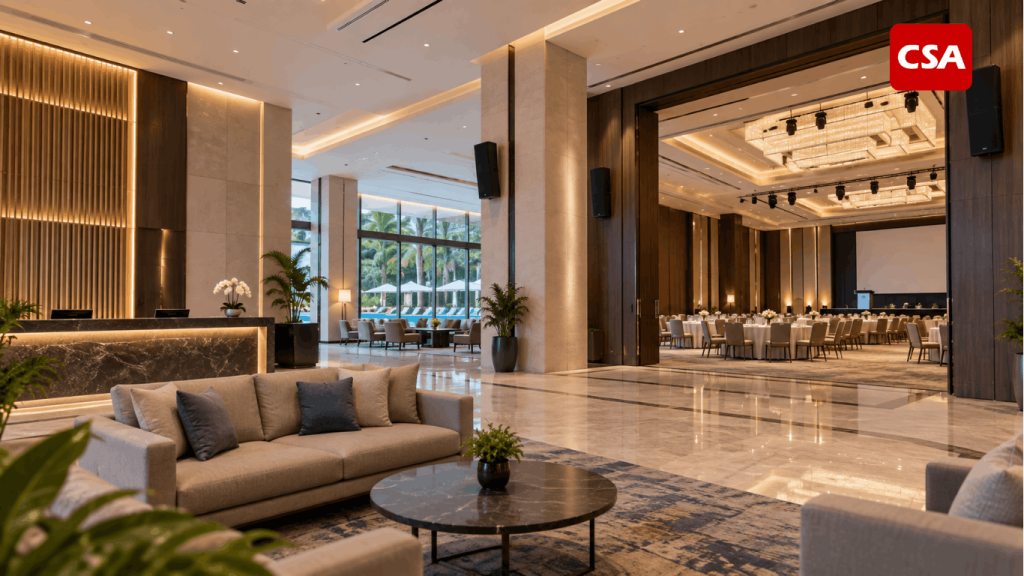
Applications of Digital Displays Across Hotel Facilities
A successful visual communication system should reflect how guests and staff use each area. Display placement, screen specifications, and content requirements should therefore follow the function of each space.
1. Lobby and Reception Areas
The lobby is often the first point of contact between a hotel and its guests. Digital displays can introduce hotel facilities, announce activities, promote dining options, and share relevant guest information.
Placement is particularly important in this area. Screens should remain visible without obstructing reception activities or pedestrian movement. Viewing distance, ambient lighting, and the direction of guest traffic should guide the installation design.
2. Ballrooms and Conference Facilities
Ballrooms and conference rooms support a wide range of activities, including corporate meetings, seminars, exhibitions, and social events. Their visual requirements may change significantly from one event to another.
Displays can present event schedules, presentation materials, sponsor content, and announcements. Depending on the venue, the installation may require professional displays, large-format LED screens, or multiple screens connected through a distribution system.
The design should account for content sources, signal routing, resolution, and connectivity. These considerations become especially important when event organizers bring their own computers or other presentation equipment.
Hotels with large event facilities can look at CSA Indonesia’s HARRIS Hotel & Convention Serpong project for an example of integrated AV infrastructure in a hospitality environment. The project covers the ballroom, meeting rooms, breakout areas, and public spaces.
3. Restaurants and Dining Areas
Restaurants can use digital displays to communicate menus, dining promotions, service information, and special offers. Content can be scheduled according to meal periods or promotional campaigns.
For example, a restaurant may display breakfast information in the morning and highlight its dining offers later in the day. A centralized content workflow can simplify these updates when the chosen platform supports scheduling.
The installation should also account for the restaurant’s lighting conditions, viewing angles, and operating environment. Display specifications should match the intended location rather than relying on a single configuration for every area.
4. Corridors and Public Facilities
Corridors, elevator lobbies, fitness centers, and other public spaces may benefit from displays that provide directions, facility information, or operational announcements.
In larger properties, consistent visual communication can help guests navigate unfamiliar spaces. However, not every corridor needs a screen. Hotels should identify locations where digital information provides a clear practical benefit.
5. Meeting Rooms and Business Centers
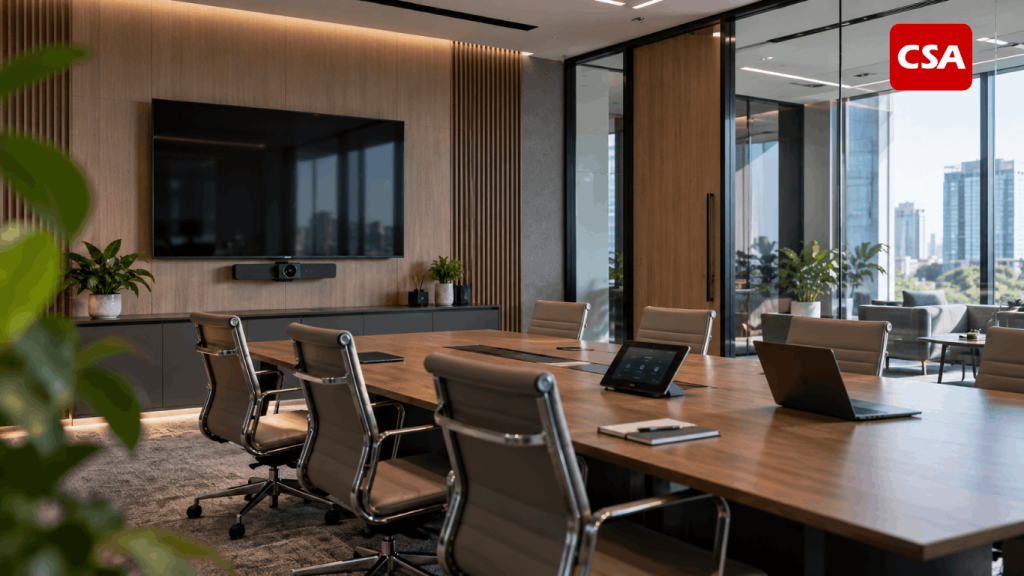
Hotels serving corporate clients often need technology that supports presentations and professional meetings. Displays can show room names, meeting schedules, event information, and presentation content.
Where meeting rooms also support video conferencing, the visual system may need to work alongside cameras, microphones, audio equipment, and room control systems.
These requirements should be considered together rather than handled as separate equipment purchases. CSA Indonesia explains the planning process in its English article on designing an audio visual system for a corporate meeting room .
Key Components of a Hotel Display System
A digital display is only one part of the complete installation. Several components work together to deliver content reliably across the property.
Professional Displays
Displays present the visual content to guests and staff. Selection should consider screen size, resolution, brightness, operating hours, mounting conditions, and the environment in which each screen will operate.
A brightly lit lobby may require different specifications from a dimly lit corridor. A ballroom may need a larger display or a different visual configuration to accommodate guests viewing content from a greater distance.
Hotels should also consider commercial operating requirements. A display intended for extended daily use may have different capabilities and support arrangements from a consumer television.
Media Players and Content Sources
Media players deliver content to displays, depending on the system architecture. They may take the form of dedicated playback devices, computers, or other compatible equipment.
The selected solution should support the required content formats and provide a reliable operating workflow. Hotels with multiple displays should also consider how playback devices will be managed and maintained.
For larger installations, the integrator can assess whether individual players, centralized sources, or a combination of approaches best suits the project.
Content Management System
A Content Management System (CMS) allows authorized users to manage the material displayed on compatible screens. Depending on the platform, it may support scheduling, screen grouping, content updates, and remote monitoring.
A hotel could use different content schedules for its lobby, restaurant, and conference facilities. This helps ensure that information remains relevant to each location.
Before selecting a platform, the hotel should evaluate user permissions, scheduling capabilities, device monitoring, licensing requirements, and technical support.
Network and Signal Distribution
The connection between content sources and displays must match the project’s technical requirements. A small installation may use direct connections, while a larger property may need a more extensive signal distribution infrastructure.
The system design should consider cable distances, connection types, bandwidth, and available network resources. These factors influence how content reaches each screen and how the installation can be expanded.
Hotels should also coordinate with their IT teams on network access and security policies. Where appropriate, network segmentation and access controls should follow the property’s existing IT requirements.
Control and Monitoring Systems
Some installations benefit from centralized control or device monitoring. Depending on the selected equipment, authorized staff may be able to manage supported functions through a common interface.
Monitoring features can help technical teams identify device problems and respond to interruptions. Their availability depends on the display hardware, software platform, and overall system design.
Read Also: AV System Integrator Services for Companies: Solutions, Services, and Project Experience
Why System Integration Matters More Than Display Selection Alone
Selecting suitable displays is important, but individual devices cannot guarantee a well-functioning installation. The connections between components and the way staff manage the system also influence its effectiveness.
Problems can occur when content formats are incompatible, signal distribution is poorly planned, or each screen requires a different management process. These issues can create additional work for hotel staff and complicate maintenance.
An integrated approach considers the complete system from the beginning. The integrator evaluates user requirements, site conditions, existing infrastructure, and potential expansion before recommending a design.
Consistent Visual Communication
Hotels may operate many screens across different departments. Without a clear design, those screens can end up using inconsistent configurations and management methods.
A coordinated system establishes suitable standards for equipment, connectivity, and content management. This can simplify documentation and make future maintenance more predictable.
More Structured Content Management
An appropriate system allows hotel teams to organize content according to location and schedule. Staff can determine which information appears on particular displays rather than treating every screen as an independent device.
The hotel should also establish clear content responsibilities. Marketing, operations, and IT teams may need different access permissions based on internal policies.
Easier Future Expansion
Hotel facilities and communication requirements can change over time. New restaurants, renovated public spaces, or additional event facilities may introduce new display requirements.
Planning for expansion allows the project team to evaluate network capacity, equipment compatibility, and infrastructure needs before additional screens are installed. This can reduce the risk of major redesigns later.
For a broader explanation of the integration process, see CSA Indonesia’s article on the role of an AV System Integrator and how AV system integration works .
What to Consider Before Implementation
A successful installation starts with a clear understanding of the property’s requirements. Evaluating the following factors helps align the technical design with operational needs.
Define the Purpose of Each Display
Hotels should identify the intended function of every screen before selecting equipment. Is it for guest information, promotional content, wayfinding, or event presentations?
The answer affects screen size, placement, content requirements, and supporting equipment. One configuration may not suit every area.
Assess Site Conditions
The project team should inspect lighting, viewing distances, power availability, cable routes, mounting surfaces, and installation constraints.
Physical conditions can influence both equipment selection and installation methods. High-traffic areas also require careful consideration of guest safety and unobstructed movement.
Verify Compatibility
If the hotel already operates network infrastructure, control systems, or AV equipment, the integrator should evaluate compatibility with the proposed solution.
This assessment can identify additional requirements before installation begins. It also helps the hotel understand which existing components can remain in service.
Evaluate the Total Project Cost
The project budget should cover more than the displays themselves. Depending on the design, costs may include media players, signal distribution equipment, software licences, mounting hardware, installation, configuration, and testing.
Hotels should also consider ongoing operating expenses, software subscriptions, maintenance, and eventual equipment replacement. Comparing proposals with equivalent scopes makes budget evaluation more meaningful.
Plan for Maintenance and Daily Operation
Installed systems require ongoing management. Hotels should determine who will update content, monitor devices, and respond to technical issues.
Documentation and clear operating procedures help internal teams manage the installation consistently. The hotel can also discuss technical support and maintenance arrangements with the integrator.
The Role of an AV System Integrator in Hotel Projects
An AV System Integrator helps align visual equipment, supporting infrastructure, and control systems with the requirements of a hospitality property. The work begins before installation.
The initial stages typically involve requirement discussions, site surveys, technical assessments, and system design. The team then determines suitable equipment, connectivity methods, and integration requirements.
Once the design is approved, implementation can proceed through equipment supply, installation, configuration, and testing. The commissioning process checks whether the system performs according to the agreed design.
Handover is another important stage. Hotel staff should receive relevant system documentation and guidance on operating the installation. Support arrangements can also be established according to the project’s scope.
CSA Indonesia provides integrated Audio, Visual, Lighting, and Automation solutions for commercial projects. In hospitality environments, this approach can help align technology with the functions of each space and the property’s operational requirements. The precise scope depends on the individual project.
How to Evaluate the Success of an Installation
The success of a display system should not be measured only by the number of screens installed. Hotels should evaluate whether the system supports their communication and operational objectives.
One useful consideration is the ease of updating content. If authorized staff can publish scheduled information without unnecessary manual work, the system may simplify everyday operations.
Hotels can also review display consistency, device downtime, response times, and the relevance of content to each location. For promotional displays, teams may assess engagement or audience responses when suitable measurement methods are available.
Regular reviews help identify areas for improvement. The solution may not always require additional equipment. In some cases, refining content workflows, device configuration, or operating procedures may better address the problem.
Conclusion
Hotel digital signage requires more than selecting suitable screens. Hotels need to coordinate displays, content sources, networks, management software, and supporting control systems according to the requirements of each space.
A well-planned integration can support guest communication, promotional activities, and event operations while making the system easier to manage. Involving an AV System Integrator during the design stage helps align the solution with site conditions, operational needs, and future expansion plans.
FAQ
What is digital signage in a hotel?
It is a digital display system used to present information, promotions, event schedules, directions, and other visual content throughout a hotel.
Where can hotels install digital displays?
Common locations include lobbies, reception areas, restaurants, ballrooms, conference rooms, corridors, and public facilities.
What is the difference between a digital display and an integrated signage system?
A display is the device that presents content. An integrated system connects the display with content sources, management software, network infrastructure, and other supporting components.
Do all hotel displays need to use the same CMS?
Not necessarily. The choice depends on project requirements, device compatibility, and the system architecture. A centralized platform can simplify management when it suits the installation.
Why should hotels work with an AV System Integrator?
An integrator helps plan equipment, infrastructure, connectivity, and control so the complete system meets operational requirements. The scope may also include installation, configuration, testing, and documentation.
What costs should hotels consider when implementing digital signage?
Costs may include displays, media players, signal distribution, software licences, installation, configuration, testing, and maintenance. The total depends on the project’s size and complexity.