
Hospitality TV Systems are changing the role of television in modern hotel rooms. Instead of serving only as a screen for traditional broadcasts, hotel televisions can become part of a connected guest experience. By combining hotel IPTV, guest casting, in-room entertainment, Property Management System (PMS) integration, and centralized content management, hotels can connect entertainment with useful information and selected guest services through one familiar interface.
This approach requires more than choosing the right television. Hotels need to consider network infrastructure, content distribution, device compatibility, platform management, and data privacy. Each component must work together to provide a reliable experience for guests while remaining practical for hotel teams to operate.
From Hotel Television to a Connected Guest Room Experience
Guests use their rooms for different activities. Some prefer watching live television, while others want to continue streaming content from their personal devices. They may also need information about restaurants, spa facilities, room service, or hotel activities.
A connected television platform can bring these functions together. The screen becomes a convenient access point for entertainment and selected hotel information without requiring guests to navigate multiple channels.
More Than a Traditional Television
A conventional television primarily receives and displays broadcast content. A hospitality-focused solution can support additional functions, depending on the hardware and software platform.
These functions may include:
- Entertainment: Access to supported television channels and streaming services.
- Hotel information: Details about restaurants, facilities, operating hours, and property services.
- Guest communication: Welcome messages, announcements, and relevant hotel information.
- Personalization: Language preferences or customized welcome screens when supported.
- Service access: Shortcuts to room service information and other digital services.
The interface should remain simple. Too many menus can make the experience confusing, particularly for guests who are unfamiliar with the hotel’s technology.
Hotels should prioritize frequently used functions and organize information around the guest journey.
Understanding the IPTV Architecture for Hotels
Internet Protocol Television (IPTV) delivers television content through an IP-based network. In a hotel environment, this technology can distribute channels and selected video content to televisions across multiple guest rooms.
However, IPTV involves more than replacing traditional television cables with Ethernet connections. The system requires a suitable distribution architecture, content management platform, network infrastructure, and compatible receiving devices.
How Does Hotel IPTV Distribution Work?
The architecture varies according to the project. A typical implementation may involve the following components.
1. Content Sources
The system receives content from authorized sources. These may include broadcast television, satellite services, or internally produced hotel video content.
Hotels must confirm the distribution rights and licensing requirements for the content they intend to provide.
2. Headend and Encoders
The headend receives and manages incoming television sources. Encoders convert supported sources into digital streams suitable for IP distribution.
The required equipment depends on the source formats, distribution method, and receiving devices. Not every installation requires the same encoder configuration.
3. IPTV Middleware
Middleware connects content services with the television interface. It can manage channel lists, program information, menus, and interactive functions supported by the platform.
It also helps coordinate the relationship between content sources and guest-facing services.
4. Network Infrastructure
The network carries content from the distribution equipment to guest room devices. Switches, routers, backbone connections, and network configurations must support the expected traffic.
Hotels should assess network capacity based on the number of devices and the expected simultaneous usage.
5. Hospitality TVs and Set-Top Boxes
The receiving device displays the content to guests. Hotels may use televisions that support the selected platform directly or install compatible set-top boxes when additional functionality is required.
Device compatibility should be confirmed before procurement. Differences in software, supported protocols, and hardware capabilities can affect the final system design.
Why Network Design Matters
Video distribution places specific demands on network infrastructure. When many rooms access content simultaneously, the network must handle the traffic without affecting other hotel services.
The technical design may need to address bandwidth, multicast configuration, VLAN segmentation, and Quality of Service (QoS). These settings depend on the chosen distribution architecture.
Hotels should also consider separating IPTV traffic from guest Wi-Fi and operational networks where appropriate. This helps establish clearer security boundaries and makes network management more structured.
A network assessment should include current capacity and future expansion requirements. Designing only for the initial number of rooms may create limitations when the property adds devices or services.
Guest Casting and Personal Streaming in Hotel Rooms
Guests do not always rely on traditional television channels. Many prefer watching content through applications on their smartphones, tablets, or laptops.
Guest casting allows them to send supported content from a personal device to the television in their room. This creates a more familiar entertainment experience without requiring the hotel to provide every service directly.
How Does Guest Casting Work?
The connection process depends on the selected platform. Some systems display a QR code on the television. Guests scan the code and follow the instructions to connect their personal device.
Other solutions use different pairing methods. Supported technologies may include Google Cast, Apple AirPlay, or proprietary casting platforms.
After connecting, guests select compatible content on their devices. The television then displays the content according to the capabilities of the platform and application.
Hotels should test the complete process before deployment. Support for one casting technology does not automatically guarantee compatibility with every streaming application.
IPTV, OTT, and Guest Casting: What Is the Difference?
These terms often appear together in hotel entertainment projects, but they describe different functions.
| Technology | Main Function |
|---|---|
| IPTV | Distributes television content through an IP network |
| OTT | Delivers content over the internet through a service provider |
| Guest casting | Sends supported content from a personal device to a television |
The technologies can complement each other. IPTV may provide hotel television channels, OTT services may provide streaming content, and casting gives guests another way to use their personal devices.
Hotels must check service licensing, platform compatibility, and usage conditions. Availability depends on the selected hardware, software, and service agreements.
Protecting Guest Privacy and Network Security
Guest casting introduces additional security responsibilities. The system must prevent one guest from accessing another room’s television or finding a previous guest’s active session.
Important considerations include:
- Room-level isolation: Guests should only connect to the television assigned to their room.
- Connection authentication: The platform should verify the pairing process through an appropriate mechanism.
- Session management: The system should track active casting sessions.
- Session clearing: Access credentials and active connections should be cleared after check-out.
- Network segmentation: Network configuration should restrict unnecessary communication between devices.
Hotels also need procedures for room changes and extended stays. These situations can affect device assignments and guest access.
Privacy protection should extend beyond the television interface. IT teams should review how the platform handles credentials, session information, and personal data. Regular testing helps confirm that the security configuration continues to work as intended.
Integrating Hotel TV with a Property Management System
A Property Management System (PMS) supports hotel operations such as reservations, check-in, check-out, room status, and guest information.
When the television platform supports PMS integration, selected operational data can help personalize the in-room experience. This allows the hotel to display relevant information based on configured rules and available data.
Personalizing the Guest Welcome Screen
A common application is a welcome message. When a guest enters the room, the television can display a greeting based on the hotel’s configuration.
Some platforms also support language preferences and selected guest information. The screen may provide restaurant details, facility guides, and service information during the stay.
Personalization must respect privacy. Hotels should only display information that is appropriate and permitted under their policies. Showing unnecessary personal details can create privacy concerns rather than improve the guest experience.
Connecting Television Services with Room Status
PMS integration may also connect room status changes with television functions.
A simplified workflow can operate as follows:
- The PMS updates a reservation or room status.
- The integration platform receives the required information.
- The television system applies the configured content or access rules.
- After check-out, the system ends the guest session and clears personal access according to the platform’s capabilities.
The actual workflow depends on the PMS, available APIs, middleware, and integration configuration. Hotels should confirm technical compatibility with each provider before finalizing the design.
Additional functions may include service requests, billing information, or express check-out. These features require specific platform support and should not be assumed to exist on every hospitality television.
Centralized Content Management Across Hotel Rooms
Hotels with many guest rooms need an efficient way to manage television content. Updating information individually on every device can consume significant staff time.
A Content Management System (CMS) provides a centralized platform for managing supported content. Authorized staff can update hotel information, promotional material, announcements, and interface elements through a single management environment.
What Content Can Hotels Manage?
The content should serve a clear purpose and provide useful information to guests. Common examples include:
- Welcome messages and television instructions.
- Restaurant, spa, gym, and facility information.
- Operating hours and facility locations.
- Room service information.
- Hotel promotions and available packages.
- Activity schedules and special announcements.
- Instructions for accessing supported digital services.
Content also needs a clear update process. Outdated restaurant hours or expired promotions can create confusion if they remain visible.
Managing Different Room Types
Not every room needs the same content configuration. Hotels may want different information for standard rooms, suites, executive rooms, or exclusive accommodation areas.
Platforms with device grouping capabilities can help administrators apply different settings. Access permissions can also ensure that only authorized staff members modify content.
Centralized management should include device monitoring where supported. This helps hotel teams identify technical issues and coordinate follow-up actions.
Adapting the System to Different Hospitality Properties
A business hotel has different priorities from a resort or serviced apartment. The design should reflect the property’s guest profile, facilities, and operating model.
Business Hotels
Business travelers often value convenient access to information and entertainment. The television interface can provide restaurant details, meeting facility information, service hours, and supported casting features.
A simple interface is particularly useful. Guests should be able to find essential functions without navigating complicated menus.
Resorts and Leisure Hotels
Resorts can use guest room televisions to introduce facilities and activities. Information about restaurants, spas, swimming pools, recreation, and property services can be organized into accessible sections.
Hotels may also update content based on current activities or available packages. The information must remain accurate and reflect actual service availability.
For a broader view of visual communication across hotel facilities, read Hotel Digital Signage: Integrated Visual Solutions for the Hospitality Industry. Digital signage serves different purposes in public areas, while guest room television focuses on the in-room experience.
Serviced Apartments
Serviced apartments may accommodate guests for longer periods. Personal entertainment, convenient connectivity, and consistent device access can therefore become important considerations.
The system should manage guest sessions carefully and prevent previous users’ accounts or connections from remaining accessible. Access policies should also reflect the property’s occupancy arrangements.
Planning a Hospitality TV Implementation
A successful project begins with clear requirements. Hotels should define the expected services before selecting equipment or finalizing the network architecture.
1. Assess Room Numbers and Room Categories
Identify the number of rooms, room types, existing television models, and service requirements for each category.
This information helps determine the required devices, platform capacity, and distribution approach.
2. Define the Required Features
Hotels should separate essential functions from optional features.
Does the property only need television channel distribution? Is guest casting required? Should the platform connect to the PMS? Does the team need centralized content management?
The answers will influence equipment selection and system architecture.
3. Survey the Existing Infrastructure
The technical team should inspect the network, cable pathways, equipment rooms, switch capacity, and connections to guest rooms.
The survey should also identify power requirements and determine whether additional devices are necessary.
4. Confirm Device and Platform Compatibility
Check the compatibility of televisions, set-top boxes, middleware, CMS, PMS, and casting technologies.
Hotels should request clear information about supported features, software requirements, licenses, and integration limitations.
5. Develop the System Design and Budget
The design should explain content distribution, network requirements, device connections, and management procedures.
The project budget should account for more than television hardware. It may also include network equipment, software licenses, installation, configuration, testing, and technical support.
6. Test and Commission the System
Testing should reflect real operating conditions. The team should verify channel distribution, content display, casting, guest information, PMS integration, and session clearing after check-out.
Documentation and staff training should also form part of the handover process.
For a broader understanding of implementation planning, see Audio Visual System Installation for Companies: Process, Benefits, and Key Considerations and Why Audio Visual Design Is an Important Stage Before Installation.
The Role of an AV System Integrator
A hotel television project involves several technology areas. Displays, content distribution, network infrastructure, software platforms, and PMS integration must work according to a coordinated design.
An AV System Integrator helps translate hotel requirements into a practical technical solution. The scope may include needs assessment, site surveys, system design, equipment selection, installation, configuration, and testing.
Coordination with the hotel’s IT team and software providers is also important. Some functions depend on network infrastructure or software integrations managed by different parties.
Hotels should evaluate an integration partner based on relevant project experience, technical capabilities, documentation, and post-installation support. For further guidance, read AV System Integrator Services for Companies: Solutions, Services, and Project Experience.
CSA Indonesia provides Audio, Visual, Lighting, and Automation solutions for different commercial environments. Its hospitality work offers a relevant example of how technology can be coordinated across a hotel property.
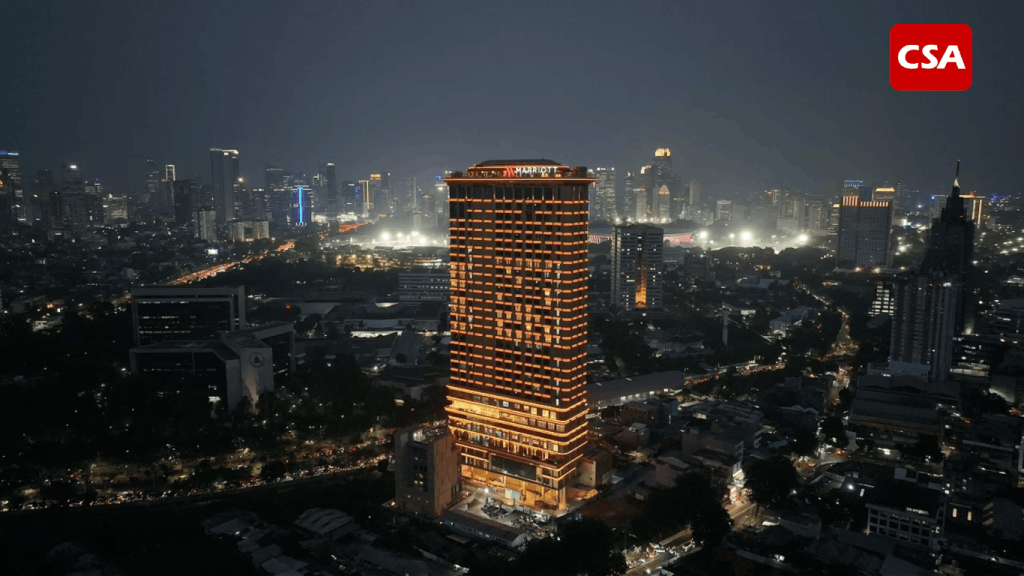
At Jakarta Marriott Hotel Gelora, CSA Indonesia delivered an integrated audio visual installation covering public areas, meeting spaces, and guest rooms. The scope included Samsung Hospitality TVs and soundbars in the guest rooms, alongside other audio and visual technologies throughout the property.
This project illustrates how in-room entertainment can form part of a wider hospitality technology environment. It also highlights the importance of coordinating different systems according to the function of each hotel area.
Hotels can explore CSA Indonesia’s broader Hotel, Villa, and Apartment Solutions to understand the range of audio visual services available for hospitality environments.
Maintenance and Management After Deployment
Implementation does not end when the televisions display content correctly. The system requires ongoing monitoring and maintenance to remain suitable for hotel operations.
Hotel teams should check device condition, network connectivity, software updates, and platform availability. A problem in one component may affect specific functions such as channel access, casting, or content updates.
Configuration records should also be maintained whenever the hotel replaces devices or expands the system. These records help technical teams identify faults and keep the installation consistent.
Inspection schedules should reflect equipment usage and manufacturer recommendations. Hotels should also confirm how technical support will be handled when a fault occurs.
For more information, read Audio Visual Maintenance: A Complete Guide to Maintaining Integrated AV System Performance and Reliability.
Conclusion
Hotel room televisions can become digital interaction points that connect entertainment, property information, and selected guest services. IPTV provides a content distribution method, guest casting gives visitors more flexibility, while PMS integration and centralized content management can make information more relevant and easier to manage.
However, the guest experience depends on more than television features. Network infrastructure, platform compatibility, session security, and operational simplicity all influence the success of an implementation.
Hotels should plan the system around actual guest requirements and operational capabilities. With the right integration approach, in-room television can become a practical part of a connected hospitality experience.
FAQ
What are Hospitality TV Systems?
They are television solutions designed for hotels and other accommodation properties. Depending on the platform, they may support channel distribution, hotel information, guest casting, content management, and selected interactive services.
What is the role of IPTV in a hotel?
IPTV distributes television content through an IP-based network. It allows hotels to deliver supported channels and video services through a planned network infrastructure.
Do all hospitality TVs support guest casting?
No. Casting support depends on the television model, software platform, and supported technology. Hotels should confirm compatibility before purchasing equipment.
Can hotel television systems integrate with a PMS?
Yes, when the PMS and television platform support the required integration. This can help display selected guest information and apply functions based on room status.
How does guest casting protect guest privacy?
A properly configured system uses room-level access controls, connection authentication, and session management. It should also clear guest access after check-out.
Do hotels need to replace every television to implement IPTV?
Not always. Existing televisions may work with compatible set-top boxes or additional devices. A technical assessment is necessary to confirm whether the equipment can support the planned system.