
The Importance of Integrating Video Conferencing and Sound Systems in Meeting Rooms has become increasingly significant for organizations seeking to improve business communication in the digital era. As hybrid work environments and cross-location collaboration continue to grow, meeting rooms are no longer designed solely for in-person discussions. Today, a single meeting may involve participants joining from different offices, cities, or even countries simultaneously.
Unfortunately, many companies focus heavily on video conferencing platforms while overlooking the quality of the audio systems that support them. As a result, even when video quality appears excellent, communication remains ineffective because participants struggle with unclear audio, echo, background noise, or inconsistent sound levels.
This reality demonstrates that successful meetings depend not only on visual quality but also on clear and reliable audio. For this reason, integrating video conferencing technology with professional sound systems has become essential for creating meeting spaces that support effective communication, seamless collaboration, and higher business productivity.
Why Communication Quality Is Critical in Modern Meeting Rooms
The primary purpose of any meeting is to exchange information and make informed decisions.
However, this process becomes difficult when participants cannot hear or understand each other clearly.
In modern workplaces, communication has become increasingly complex because meetings often include both in-room participants and remote attendees.
When communication quality suffers, organizations may experience:
- Misunderstood information
- Repeated discussions
- Reduced participant engagement
- Slower decision-making processes
- Lower team productivity
Therefore, companies must ensure that every participant enjoys an equal communication experience, regardless of their location.

Why Video Conferencing Alone Is Not Enough
Many organizations assume that implementing a video conferencing platform is sufficient to support modern meeting requirements.
In reality, this is not the case.
Video conferencing platforms simply provide the connection between participants in different locations.
The success of communication still depends heavily on the supporting technologies installed within the meeting room.
Consider a meeting room equipped with a high-quality camera but relying on a basic microphone that cannot capture every participant’s voice effectively.
Remote attendees may see the speaker clearly, yet struggle to understand the discussion.
In other situations, sound from the speakers may be picked up again by microphones, creating disruptive echo and feedback.
These challenges remain common in meeting rooms that lack proper system integration.
Why Sound Systems Are the Foundation of Effective Meetings
In professional communication environments, audio quality often plays a more important role than visual quality.
Participants can usually follow a presentation even if video quality temporarily decreases.
However, communication immediately becomes difficult when voices are unclear.
This is why professional sound systems serve as the foundation of modern meeting rooms.
A properly designed audio system ensures that every participant can hear and be heard clearly throughout the meeting.
Key functions of a professional meeting room sound system include:
Even Sound Distribution
Properly positioned speakers distribute sound consistently throughout the room without creating areas that are too loud or too quiet.
Improved Speech Intelligibility
Modern audio technologies enhance voice clarity, making conversations easier to understand.
Noise and Interference Reduction
Professional systems minimize background noise, feedback, and other audio disruptions.
Support for Two-Way Communication
Both remote and in-room participants can interact naturally without technical obstacles.
What Happens When Video Conferencing and Sound Systems Are Not Integrated?
Many organizations still use standalone devices that operate independently.
This approach often creates communication challenges that negatively affect meeting performance.
Disruptive Echo
Audio from speakers is picked up again by microphones, creating distracting echoes.
Inconsistent Audio Levels
Participant voices may fluctuate in volume throughout the meeting.
Remote Participants Cannot Hear Clearly
Microphones fail to capture all conversations occurring within the room.
Unnatural Communication
Participants frequently need to repeat themselves because information is not transmitted effectively.
Reduced Meeting Efficiency
Valuable meeting time is wasted resolving technical issues.
While these issues may seem minor, they can significantly impact business discussions and decision-making processes.
How Video Conferencing and Sound System Integration Works
Integration allows all communication technologies to function as a unified ecosystem.
When someone speaks, microphones capture the audio and send it to an audio processing system.
The system then performs several functions, including:
- Eliminating background noise
- Reducing echo
- Balancing audio levels
- Optimizing voice clarity
After processing, the audio is transmitted to the video conferencing platform and delivered to remote participants.
At the same time, audio from remote participants is received and distributed through the meeting room sound system.
This process occurs in real time, enabling natural and uninterrupted communication among all attendees.

Read Also: Meeting Room Sound System: The Key to Effective Communication in Modern Meeting Spaces in 2026
Benefits of Integrating Video Conferencing and Sound Systems in Meeting Rooms
Organizations that implement integrated communication systems enjoy numerous long-term advantages.
Improved Communication Quality
Information can be delivered more clearly to all meeting participants.
Better Hybrid Meeting Experiences
Remote and in-person attendees receive a consistent communication experience.
Reduced Technical Disruptions
Integrated systems automate many processes, reducing user errors.
Increased Team Productivity
Discussions remain focused because participants are not distracted by technical issues.
Faster Decision-Making
Clear communication enables teams to make informed decisions more quickly.
Enhanced Corporate Professionalism
Well-executed meetings create a positive impression on clients and business partners.
The Role of Integration in Supporting Hybrid Work
Hybrid work has become a key strategy for many organizations.
This flexible working model allows employees to collaborate from various locations.
However, without proper technology integration, communication gaps can emerge.
Participants physically present in the meeting room often dominate discussions because remote attendees struggle to hear or contribute effectively.
Integrated audio and video systems eliminate these challenges.
Every participant gains equal opportunities to engage in conversations and contribute ideas.
As a result, communication becomes more inclusive, collaborative, and productive.
Key Factors to Consider When Integrating Video Conferencing and Sound Systems
Organizations should carefully evaluate several factors to achieve the best results.
Microphone Quality
Microphones must capture voices clearly from all areas of the meeting room.
Proper Speaker Selection
Speaker systems should match the size and acoustic characteristics of the room.
Digital Signal Processor (DSP)
DSP technology significantly improves overall audio quality.
Room Acoustics
Proper acoustic treatment helps reduce unwanted sound reflections and interference.
Professional System Integration
All technologies should be designed to operate harmoniously within a unified ecosystem.
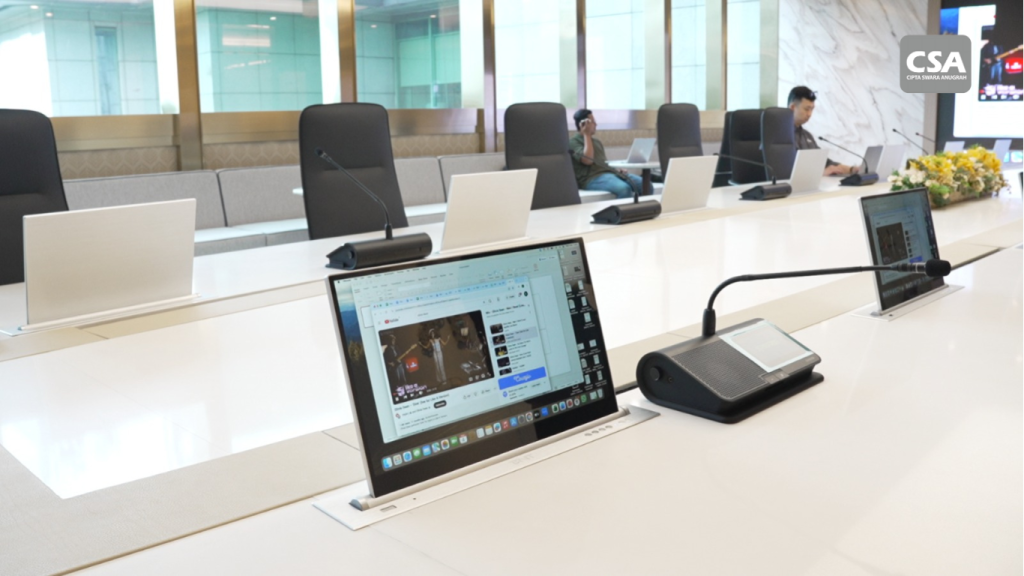
CSA Indonesia Helps Create Fully Integrated Meeting Rooms
Building a modern meeting room requires more than high-quality equipment.
Organizations also need proper planning, system design, and technology integration to ensure optimal performance.
CSA Indonesia specializes in Audio, Visual, Lighting, and Automation solutions, helping organizations create meeting environments that support modern communication and collaboration requirements.
Through a consultative approach, CSA Indonesia assists clients from the initial needs assessment phase through system design, equipment selection, installation, integration, commissioning, and ongoing maintenance.
Available solutions include:
- Video Conferencing Solutions
- Professional Sound Systems
- Integrated AV Systems
- Smart Meeting Rooms
- Interactive Displays
- Automation Control Systems
With properly integrated systems, organizations can create meeting experiences that are more professional, productive, and future-ready.
Conclusion
The importance of integrating video conferencing and sound systems in meeting rooms cannot be overlooked in today’s business environment. High-quality communication serves as the foundation of successful meetings, especially when participants join from multiple locations. Without proper integration, issues such as echo, poor audio clarity, and communication barriers can significantly reduce productivity.
By implementing a fully integrated solution, organizations can ensure that all communication technologies work together seamlessly. This not only improves meeting quality but also supports collaboration, operational efficiency, and long-term digital transformation initiatives.
Frequently Asked Questions (FAQ)
What does video conferencing and sound system integration mean?
It refers to connecting video conferencing technologies and audio systems so they function as a unified communication ecosystem.
Why is audio quality so important in meetings?
Because verbal communication carries most of the information exchanged during discussions. Poor audio makes it difficult for participants to understand each other.
What are the main benefits of integration?
Improved communication quality, fewer technical issues, enhanced collaboration, and more professional meeting experiences.
What is echo in video conferencing?
Echo occurs when sound from speakers is picked up again by microphones, creating repeated audio.
How can echo be reduced in meeting rooms?
Using DSP technology, appropriate microphones, and professionally designed audio systems can significantly minimize echo.
Do all meeting rooms need integrated audio-visual systems?
Yes, especially meeting rooms that support hybrid work, remote collaboration, or video conferencing activities.
What is the role of DSP in meeting room systems?
DSP processes audio signals to improve voice clarity while reducing noise, echo, and other audio disturbances.
How does integration support hybrid work?
It ensures that remote and in-room participants experience the same level of communication quality and engagement.
What happens if video conferencing and sound systems are not integrated?
Organizations may experience poor audio quality, communication difficulties, technical disruptions, and reduced meeting effectiveness.
Why should companies work with professional AV integrators?
Professional integrators design and implement systems that ensure all technologies operate efficiently and deliver the best possible user experience.