
An audio visual integrator for businesses helps companies plan, connect, and manage audio, video, lighting, and automation technologies as one coordinated system. These services support corporate facilities such as meeting rooms, boardrooms, training rooms, auditoriums, and conference spaces.
Buying high-quality equipment does not automatically guarantee a reliable AV system. Microphones, speakers, displays, cameras, and control devices must work together according to the room’s purpose and the users’ needs. Without proper planning, even advanced equipment can create operational difficulties.
Businesses therefore need to consider more than product specifications. They must evaluate system design, device compatibility, installation requirements, and the experience employees will have when operating the technology.
CSA Indonesia provides Audio, Visual, Lighting, and Automation solutions for professional environments. Its approach covers system planning, installation, integration, and maintenance to help businesses develop technology solutions that match their operational requirements.
What Does an Audio Visual Integrator Do?
An audio visual integrator designs and connects different technologies so they function as one coordinated system. Depending on the project, the work may include consultation, requirements analysis, site surveys, equipment selection, technical design, installation, configuration, testing, and commissioning.
A corporate AV system may include microphones, speakers, displays, projectors, conferencing cameras, digital signal processors, video conferencing equipment, and room control interfaces. Each component has a specific function, but the complete system must operate according to a consistent workflow.
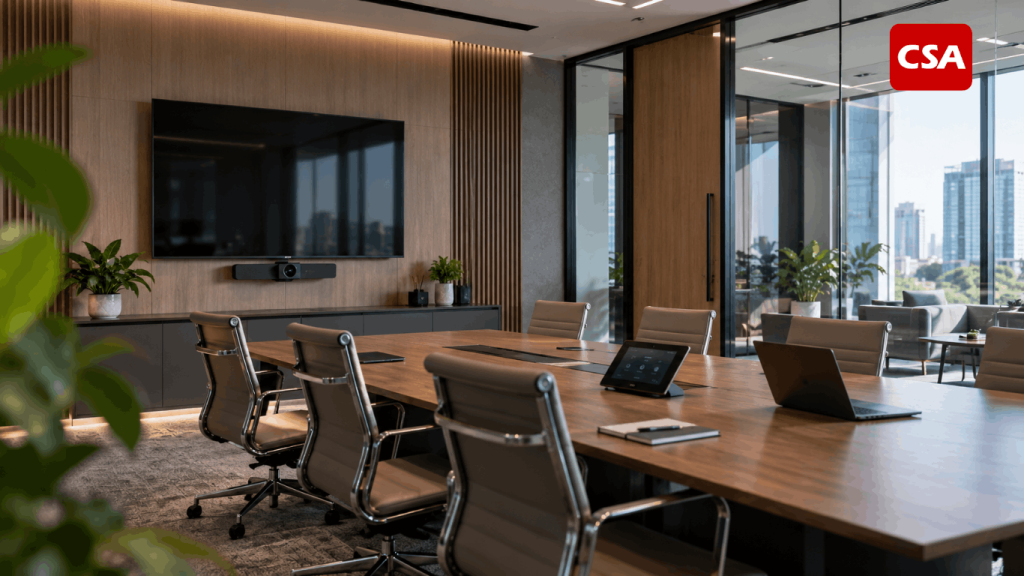
Consider a company upgrading its main meeting room. Employees need to present documents, conduct video conferences, and share content with colleagues at other locations. The room may require a display, conferencing camera, microphones, speakers, and a centralized control interface.
An integrator evaluates how these components should connect and how employees will use them. The objective is to create a practical operating experience rather than a collection of disconnected devices.
For a more detailed explanation, read CSA Indonesia’s article on what an AV system integrator does and how the integration process works.
Read Also: AV System Integrator Services for Companies: Solutions, Services, and Project Experience
Why Do Businesses Need Integrated AV Systems?
Corporate facilities often serve several purposes. A meeting room may support internal discussions, client presentations, and remote collaboration throughout the day. A training room may host workshops, demonstrations, and hybrid learning sessions.
These activities place different demands on the technology. An integrated system helps businesses organize those requirements into a coordinated solution.
Simplifying Meeting Operations
Meetings often involve several devices that need to work together. Users must select the correct presentation source, manage audio levels, operate displays, and connect to conferencing platforms.
When devices operate independently, employees may need to perform several manual steps before a meeting begins. This can create delays and increase reliance on technical support.
A properly designed system can simplify common tasks through a centralized interface or predefined operating modes. Employees can focus on the meeting rather than the equipment.
Supporting Hybrid Collaboration
Hybrid meetings require clear communication between participants in the room and those joining remotely. Camera placement, microphone coverage, speaker performance, and network connectivity all influence the experience.
An integrator considers these elements together. Microphone placement must suit the seating arrangement, while cameras need to capture participants at appropriate angles.
The system should also support presentation sharing and transitions between different meeting activities. A consistent workflow makes the room easier to operate.
Businesses can explore CSA Indonesia’s article on audio visual systems for meeting rooms for further insights into workplace collaboration technology.
Improving Consistency Across Multiple Rooms
Companies with several meeting rooms may want employees to follow similar operating procedures in every space. Without common standards, each room can have different controls, connection methods, and equipment configurations.
A coordinated design can establish consistent operating principles. This makes employee training and technical troubleshooting easier.
The equipment does not need to be identical in every room. Instead, the design should provide a consistent user experience while accommodating the requirements of each space.
Supporting Future Expansion
Business requirements change as companies expand offices, introduce new communication platforms, or modify room functions.
A system designed only around immediate needs may become difficult to expand later. An integrator can assess infrastructure, compatibility, system capacity, and potential upgrade requirements during the planning stage.
This does not mean every future feature must be installed immediately. It means the initial design should account for realistic development plans wherever practical.
What Systems Can Be Integrated in a Corporate Environment?
Different facilities require different technical configurations. The right approach starts with understanding how each space will be used.
Meeting Rooms and Boardrooms
Meeting rooms typically support presentations, discussions, and video conferencing. Depending on their size and function, they may require displays, cameras, microphones, speakers, wireless presentation systems, and room controls.
Boardrooms may need more advanced arrangements. These can include multiple displays, several microphone positions, centralized control, and connections to different presentation sources.
The design should consider room dimensions, seating layouts, viewing angles, and the typical number of participants. Equipment selection should follow these requirements rather than rely on specifications alone.
Companies planning a new meeting space can also review CSA Indonesia’s article on audio visual meeting room solutions.
Training Rooms
Training facilities need to support clear instruction and effective interaction. Typical components may include a projector or display, an audio system, instructor microphones, and connections for presentation devices.
Companies conducting hybrid training may also need cameras and video conferencing equipment. The system should make it easy for instructors to present materials and communicate with participants joining remotely.
The configuration depends on the training format, room size, and expected activities.
Auditoriums and Multipurpose Spaces
Auditoriums and multipurpose spaces often accommodate larger audiences and a wider variety of events. Their systems may include loudspeakers, microphones, audio mixers, displays, projectors, and stage lighting.
Audio coverage is especially important. The system should help audiences hear presenters clearly across the intended listening area.
Lighting and visual equipment also need to suit the planned activities. A presentation, town hall, and product launch may require different configurations.
Video Conferencing Systems
Video conferencing combines cameras, microphones, speakers, processing equipment, and communication platforms. These components must work together to support clear two-way communication.
Good image quality alone cannot compensate for poor audio. Echo, background noise, inconsistent volume, and unsuitable microphone placement can make meetings difficult to follow.
The design should therefore consider audio and video performance, connectivity, and the way users share content.
Lighting and Room Automation
Some corporate projects require more than audio and video. Lighting and automation can also contribute to the overall room experience.
Depending on the project, the system may coordinate selected lighting scenes with presentation or meeting modes. Room controls may also manage compatible displays and other connected equipment.
The level of automation should reflect actual operational needs. A straightforward control interface is often more useful than a complicated system filled with rarely used functions.

What Is the Difference Between an AV Integrator and an Equipment Vendor?
An equipment vendor generally focuses on supplying products. Its services may include helping customers choose devices based on specifications, availability, and budget.
An integrator takes a broader approach by considering how those devices work together within the complete system. The scope may include design, installation, programming, configuration, testing, and commissioning.
| Aspect | Equipment Vendor | AV Integrator |
|---|---|---|
| Primary focus | Supplying equipment | Developing an integrated system |
| Requirements analysis | Depends on the service offered | Commonly part of project planning |
| System design | Depends on the service offered | A core part of integration work |
| Device compatibility | Depends on the scope | Evaluated across the proposed system |
| Testing and commissioning | Depends on the agreement | Can be included in project delivery |
| Technical documentation | Depends on the service offered | May include system diagrams and configuration records |
| Post-installation support | Depends on the agreement | May include maintenance and technical assistance |
These roles are not mutually exclusive. Some vendors also provide integration services, and integrators may supply equipment as part of their projects.
The important consideration is the agreed scope of work. Businesses should understand who is responsible for system design, compatibility, testing, and final performance.
When several technologies must operate together, clear responsibility for the complete system can reduce coordination problems and simplify troubleshooting.
How Does the AV Integration Process Work?
A structured process helps companies manage technical requirements, coordinate stakeholders, and evaluate project results. Although the details vary, most projects follow several key stages.
1. Requirements Analysis
The process begins by understanding the business objectives. The integrator needs to know how the room will be used, who will use it, and which activities the system must support.
A boardroom used for executive meetings has different requirements from a training room used for employee workshops. Companies should explain their priorities, existing technical problems, and expectations for daily operation.
This information provides the foundation for the proposed solution.
2. Site Survey
The technical team examines the physical space and available infrastructure. The survey may cover room dimensions, seating arrangements, acoustic conditions, lighting, cable routes, power availability, and network connectivity.
These details influence equipment placement and installation requirements. Display positioning affects viewing comfort, while speaker placement influences sound coverage.
A site survey also helps identify potential constraints before the team finalizes the design.
3. System Design and Equipment Selection
The integrator develops a technical design based on the requirements and site conditions. Depending on the project, the design may include equipment lists, connection diagrams, device locations, signal routing, and control configurations.
Equipment selection should consider compatibility, performance, room conditions, and future requirements. The most expensive device is not necessarily the most suitable choice.
Businesses should review the proposed design and confirm that it supports their intended activities before approving the project.
4. Installation and Integration
After approval, the team proceeds with equipment procurement and installation. Technicians install and connect devices according to the agreed design.
Coordination with IT teams, electrical contractors, interior designers, and other stakeholders may be necessary. This is particularly important for new buildings and office renovation projects.
The installation should also consider cable management, equipment access, and future maintenance requirements.
5. Configuration, Testing, and Commissioning
Installed equipment must be configured and tested before the system is ready for regular use. The team checks device connections, control functions, audio quality, video performance, and other agreed requirements.
Testing should reflect real operating scenarios. Technicians can verify the process of starting a meeting, sharing a presentation, switching audio sources, and connecting remote participants.
Commissioning confirms whether the completed system meets the agreed functional requirements. Any identified issues should be addressed before handover.
For further information about implementation, see CSA Indonesia’s article on AV system integrator services for companies.
6. User Training and Handover
Employees need to understand how to operate the system. The handover may include operating instructions, basic user training, technical documentation, and guidance for handling common issues.
Clear documentation also helps the company’s IT or facilities team manage the installation after completion.
The project team should explain which tasks users can perform themselves and which problems require technical support.
7. Maintenance and Technical Support
An AV system may require ongoing maintenance, software updates, performance checks, or troubleshooting. The exact requirements depend on the equipment and operating environment.
Businesses should review warranty conditions and support arrangements before approving the project. They should also understand service coverage and the process for reporting technical problems.
A clear maintenance plan helps companies manage their systems after the initial installation.
How to Choose the Right AV Integration Partner
Selecting a provider involves more than comparing equipment brands or quotation totals. Businesses should evaluate the provider’s experience, technical capabilities, project process, and support arrangements.
Review Relevant Project Experience
Ask about projects the provider has completed in similar environments. Experience with corporate offices may be relevant for companies planning meeting rooms, while hospitality projects may require different technical expertise.
A portfolio can help demonstrate the types of facilities and systems the provider has handled. Businesses should also ask how the provider approaches project challenges and coordinates different technical requirements.
Evaluate System Design Capabilities
A suitable provider should explain why a particular configuration meets the company’s needs.
The proposed design should reflect the room’s purpose, user requirements, infrastructure, and budget. A list of equipment alone does not explain how the complete system will operate.
Ask for sufficient technical detail to understand the proposed solution and its limitations.
Check Integration and Testing Capabilities
The provider should explain how different components will connect and how the team will test the finished system.
Compatibility matters across signal connections, supported formats, network requirements, control interfaces, and conferencing platforms.
Businesses should also understand the testing process and how the provider will verify that the agreed functions work correctly.
Compare Project Scope and Costs
Two quotations may cover different services even when they describe similar equipment.
One proposal may include equipment and installation only. Another may include site surveys, system design, programming, commissioning, documentation, and training.
Compare the detailed scope before evaluating the final price. Confirm which services are included, which items are optional, and whether additional work may incur extra charges.
Assess After-Sales Support
Technology becomes part of a company’s operational infrastructure once installed. Businesses should understand how the provider handles technical issues after handover.
Ask about warranty terms, support channels, maintenance options, and expected response arrangements. These details are particularly important for rooms used for executive meetings, customer presentations, or corporate events.
CSA Indonesia has also published seven things to consider before choosing an AV system integrator. The checklist provides another perspective on evaluating technical partners before making a decision.
What Factors Affect the Cost of an AV Integration Project?
Project costs depend on the number of devices, technical complexity, site conditions, and agreed scope of work. A small meeting room will generally have different requirements from a large auditorium or a facility with multiple connected spaces.
Businesses should assess several factors when preparing their budgets.
Equipment and System Requirements
The number and type of displays, cameras, microphones, speakers, processors, and control devices affect equipment costs. Specifications should match the room’s intended use and technical requirements.
Choosing equipment with unnecessary features can increase spending without improving the user experience. The goal is to select components that perform their intended functions and work effectively with the rest of the system.
Design and Installation Complexity
The physical environment can influence the work required. Cable routes, mounting requirements, existing infrastructure, and coordination with other building systems may affect installation time and resources.
Projects involving multiple rooms or complex signal routing may also require more extensive design and configuration work.
Integration, Programming, and Testing
The budget should account for the technical work needed to connect and configure devices. Depending on the project, this may include control programming, signal routing, commissioning, documentation, and user training.
Businesses should confirm that the quotation clearly identifies these activities. This makes it easier to compare proposals and understand the complete project scope.
Long-Term Maintenance
The initial project cost is only one part of the investment. Companies should also consider maintenance, technical support, and potential equipment upgrades.
Planning these requirements early helps businesses evaluate the system’s long-term suitability rather than focusing solely on the initial purchase.
When Should a Business Consider Professional AV Integration?
Not every technology requirement needs a complex integration project. A simple installation involving one display or speaker may only require basic setup.
Professional integration becomes more relevant when:
- Multiple audio, video, and control devices need to operate together.
- Meeting rooms must support hybrid collaboration.
- Several rooms require consistent operating procedures.
- Existing systems experience compatibility or usability problems.
- New facilities or renovations require coordinated AV planning.
- The company needs structured documentation and ongoing technical support.
- The project includes connected audio, visual, lighting, and automation technologies.
The decision should reflect system complexity and its importance to daily operations. When several components depend on one another, coordinated planning can help reduce technical uncertainty.
CSA Indonesia as an AV Integration Partner
CSA Indonesia provides Audio, Visual, Lighting, and Automation solutions for business and professional environments. Its services include design, installation, and maintenance for projects with different technical requirements.
Corporate facilities need solutions that reflect their operational goals. A meeting room may prioritize conferencing and presentation workflows, while an auditorium may need extensive audio coverage, visual displays, and lighting control.
CSA’s project portfolio covers different sectors, including corporate, government, hospitality, and entertainment. Its project experience includes Danantara Indonesia, the Ministry of Agriculture, and Mövenpick Resort, each with different requirements for integrated technology.
This range of applications illustrates why AV projects need to start with the users, the physical environment, and the intended workflow. The system should follow those requirements rather than apply the same configuration to every facility.
Businesses preparing for a project can begin by documenting room functions, identifying problems with existing equipment, and setting budget priorities. These details provide a more useful starting point for technical consultation.
Companies can explore CSA Indonesia’s AV system integration services for businesses to learn more about its service scope and project experience.
The most suitable solution is not necessarily the one with the largest number of devices. It is the one that connects the right technologies, supports the intended workflow, and meets the company’s operational requirements.
Conclusion
Professional AV integration involves more than installing individual devices. It requires a coordinated approach to requirements analysis, system design, equipment selection, installation, configuration, testing, and support.
For businesses, the benefits depend on how well the system matches the needs of its users and facilities. Meeting rooms, training spaces, auditoriums, and corporate offices all require different considerations.
Before choosing a provider, companies should review project experience, technical capabilities, proposed scope, testing procedures, and after-sales support. A well-planned solution can make technology easier to operate and manage while supporting the company’s long-term needs.
FAQ
What does an audio visual integrator do?
An AV integrator designs and connects audio, video, lighting, and control technologies into a coordinated system. Services may include installation, configuration, testing, commissioning, and maintenance.
Why do businesses need AV integration?
Integration helps different devices work together according to a planned workflow. This can simplify meetings, support hybrid collaboration, and make systems easier to operate.
What is the difference between an AV integrator and an equipment supplier?
An equipment supplier generally focuses on providing products. An integrator can also handle system design, compatibility, configuration, installation, and testing, depending on the agreed scope.
How long does an AV integration project take?
The timeline depends on the project size, system complexity, equipment availability, site conditions, and installation requirements. A realistic estimate should follow a review of the project scope.
Can existing AV equipment be integrated into a new system?
Yes, if the existing equipment and infrastructure are compatible with the proposed design. A technical assessment can determine which devices can be retained and which may need replacement.
What should businesses prepare before consulting an AV integrator?
Prepare the room’s intended use, estimated number of users, existing equipment details, current technical problems, preferred functions, and indicative budget. These details help the provider assess the requirements.