
An Automation System Integrator plays an important role in creating modern, efficient, and connected corporate and hospitality environments. The concept brings lighting, audio visual equipment, control systems, and other technologies together within a unified ecosystem.
Modern offices, meeting rooms, hotels, restaurants, and event venues increasingly depend on connected technology. Each device has a specific function, but operating them separately can make daily activities more complicated.
A professional integrated system changes that approach. Instead of treating every device as an independent component, the system connects them through a coordinated workflow.
Users can control multiple functions through a centralized interface. Predefined scenes can also activate several devices according to specific activities.
What Is an Automation System Integrator?
An Automation System Integrator is a professional partner that designs and connects different technologies so they can operate as one coordinated system.
The role goes beyond equipment installation. An integrator must understand the client’s requirements, room characteristics, network infrastructure, and operational workflow.
These factors determine how each component should communicate and interact.
A corporate or hospitality project may include:
- Lighting control
- Audio systems
- Displays
- LED walls
- Projectors
- Video conferencing systems
- Motorized curtains or blinds
- Touch panels
- Sensors
- Network infrastructure
- Room control systems
The objective is to make complex technology easier to operate.
Users should not need to understand the technical configuration behind every device. They should simply be able to select the required function and let the system execute the appropriate commands.
This approach becomes particularly valuable in facilities that operate multiple rooms or different types of spaces.
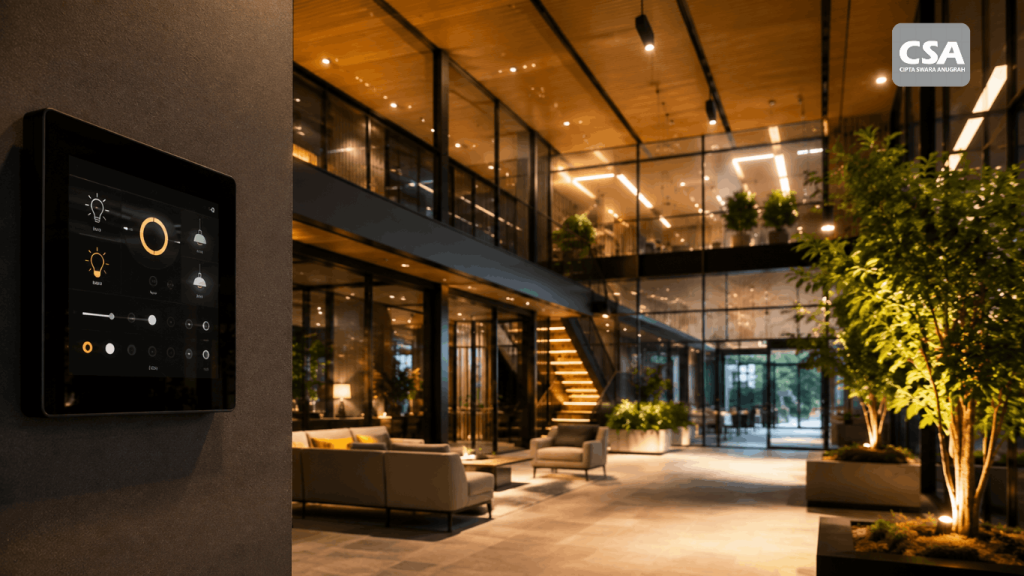
Read Also: Benefits of Smart Lighting Automation Systems for Businesses and Commercial Spaces
Why Do Corporate Environments Need Integrated Systems?
Corporate environments increasingly rely on technology for meetings, presentations, collaboration, and communication.
A modern meeting room may contain displays, cameras, microphones, speakers, lighting, curtains, and conferencing equipment. When each device has its own control method, users must manage them individually.
This can create unnecessary delays.
For example, employees may spend several minutes connecting a laptop, selecting the correct display input, adjusting microphones, and preparing video conferencing equipment.
These small tasks can become significant when meetings happen throughout the day.
Businesses can explore How to Create a More Efficient Meeting Room with AV Technology to understand how room requirements, AV equipment, conferencing, automation, and control can work together.
An integrated approach allows users to start a meeting with fewer manual steps.
Room Control Scenarios for Meeting Spaces
Corporate facilities can create predefined scenarios based on different activities.
Common examples include “Meeting,” “Presentation,” and “Video Conference” modes.
When a presentation mode starts, the display can activate and select the required input. Lighting can also adjust to create better viewing conditions.
A video conference mode can prepare the camera, microphones, speakers, and display at the same time.
This approach improves consistency and reduces the possibility of operational errors.
It also helps employees focus on the meeting rather than dealing with technical procedures.
Start with the Actual Room Requirements
Not every meeting room needs the same technology.
A small huddle room has different requirements from an executive boardroom. Room dimensions, seating capacity, meeting formats, and collaboration requirements all influence the system design.
Businesses should therefore assess their needs before selecting equipment.
Important considerations include:
- How many people normally use the room?
- How frequently do remote participants join?
- Does the room require content sharing?
- How many microphones are needed?
- What type of display suits the room?
- Does the room require centralized control?
- Will the system need future expansion?
Companies can also review How to Determine Audio Visual Requirements for Your Office before deciding on equipment.
This assessment helps companies avoid purchasing technology that does not match actual usage.
The goal is not to fill a room with as many devices as possible. The goal is to build a system that supports the way people use the space.
The Role of Lighting Control in Modern Spaces
Lighting plays an important role in creating a comfortable and functional environment.
Different activities often require different lighting conditions. A presentation, video conference, internal discussion, and informal meeting may each require a different setting.
Lighting control allows these conditions to become predefined scenes.
Users can select the required scene instead of manually adjusting individual lights.
For example, presentation mode can reduce lighting around the display area. A video conference mode can create more suitable illumination for cameras.
Hospitality facilities can apply similar concepts across different areas.
Hotels can create lighting scenes for lobbies, ballrooms, restaurants, and meeting rooms. Restaurants can also use different settings for daytime and evening operations.
Businesses can learn more about Benefits of Smart Lighting Automation Systems for Businesses and Commercial Spaces when planning lighting solutions for commercial environments.
Automation can improve consistency while supporting more efficient energy management.
Integrating Audio Visual Systems for Better Experiences
Audio visual technology has become an essential part of corporate and hospitality facilities.
However, installing high-quality equipment does not automatically create an effective system.
Displays, cameras, microphones, speakers, and other devices must work according to a coordinated workflow.
In a meeting room, for example, a camera should capture the appropriate viewing area. Microphones should cover participants across the room.
Speakers should also deliver clear speech throughout the seating area.
The same principle applies to larger facilities.
Conference rooms and ballrooms may distribute audio and video across multiple areas. The system needs to maintain consistent performance while giving operators sufficient control.
This is why Why Should Audio Visual Systems Be Designed as One Integrated System? rather than treating each device as an independent component.
Integration should become part of the design process from the beginning.
Video Conferencing and Hybrid Collaboration
Hybrid meetings have become an important part of modern corporate communication.
Employees may sit in the same room while clients, managers, or colleagues join remotely. This setup requires more than simply placing a camera and microphone inside a meeting room.
The camera needs suitable coverage. Microphones need sufficient pickup across the seating area.
Speakers must also deliver clear audio to participants inside the room.
The relationship between video conferencing and the room’s audio system is equally important.
A properly designed system allows remote participants to hear conversations clearly. People inside the room can also communicate without constantly adjusting technical settings.
Companies can explore The Importance of Integrating Video Conferencing and Sound Systems in Meeting Rooms to understand why these technologies should operate as part of a connected workflow.
The objective is to make remote participants feel like active members of the meeting.
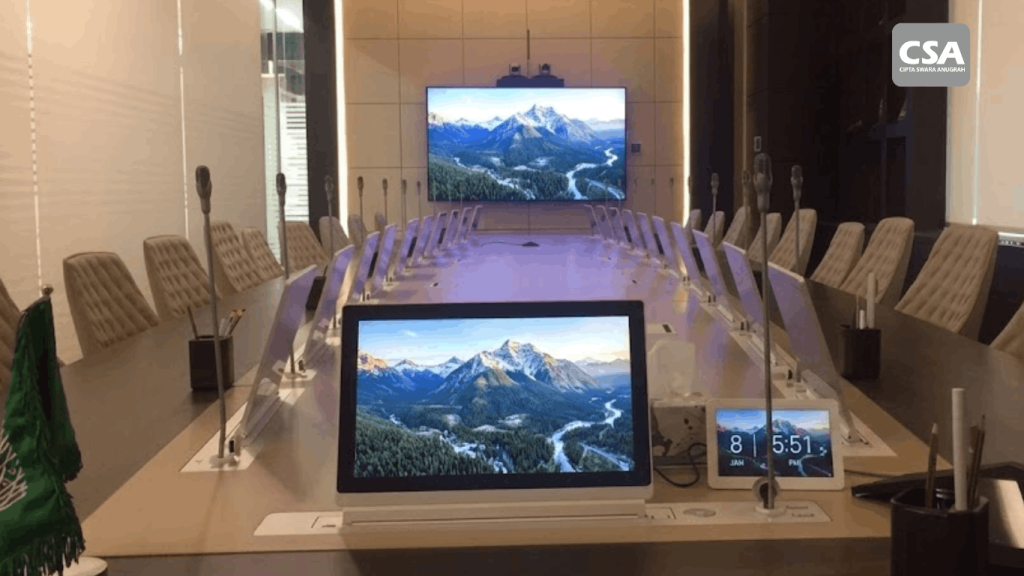
Read Also: Room Automation System: Smart Meeting Room Integration Technology for Modern Businesses
Control Systems as the Central Management Platform
A control system acts as the coordination center for different devices.
Users can manage displays, audio, video conferencing, lighting, and other functions through a centralized interface.
The interface can take the form of a touch panel, wall panel, application, or dedicated control device.
The right solution depends on the facility and its users.
For meeting rooms, simplicity should remain a priority. Employees, executives, clients, and visitors should be able to operate essential functions without extensive technical training.
Businesses can also learn more about What Is a Room Control System? How It Works and Its Benefits for Smart Meeting Rooms when planning centralized room management.
A simple interface reduces the number of steps required to start meetings and operate the room.
Applications in the Hospitality Industry
Hospitality facilities have different operational requirements from corporate offices.
Hotels, restaurants, lounges, ballrooms, and event venues each have unique workflows.
The system should therefore reflect the function of each space.
In a ballroom, the system can connect audio, video, lighting, and motorized curtains. Operators can then select a predefined scene based on the event.
A seminar may require a different configuration from a wedding. A gala dinner may need another lighting and audio arrangement.
With properly designed scenes, operators can prepare spaces faster.
Restaurant Audio and Multi-Zone Systems
Restaurants can also benefit from integrated technology.
A multi-zone audio system allows operators to control different areas independently. The dining area may require a different volume level from a lounge.
Outdoor areas can also require separate settings depending on their location and activity.
The right audio design can support the atmosphere without becoming a distraction.
This approach becomes especially useful for hospitality businesses that need consistent audio performance across multiple areas.
Businesses can also consider Tips for Choosing the Right Sound System for Your Business Needs before determining the appropriate audio solution.
CSA Indonesia for Corporate and Hospitality Integration
CSA Indonesia provides integrated AV and automation solutions for corporate and hospitality environments.
Its services include AV Integration, Smart Lighting Automation, Sound System Installation, LED Wall Rental, and Restaurant Audio Solutions.
The company approaches each project based on the requirements of the facility.
For corporate environments, CSA Indonesia can support meeting rooms, conference rooms, executive spaces, and other workplace facilities.
For hospitality projects, solutions can be applied to hotels, restaurants, lounges, ballrooms, and other commercial spaces.
CSA Indonesia also works with established AV and control platforms, including Q-SYS, Crestron, and Extron.
The platform selection depends on the project’s requirements, system scale, number of devices, infrastructure, and future expansion plans.
This project-based approach allows the system to serve a practical purpose rather than simply adding more technology.
CSA Indonesia also provides AVL Integrator Services in Indonesia that connect audio, visual, and lighting requirements within an integrated solution.
Why Choosing the Right Integrator Matters
An integrated system depends on more than the quality of individual equipment.
Design, installation, networking, programming, configuration, and commissioning must work together.
A problem in one part of the system can affect the overall user experience.
An experienced integrator can translate business requirements into a practical technology solution.
They can also consider future expansion during the initial design stage.
This becomes important for companies with multiple offices or hospitality businesses with several operational areas.
Standardized system architecture can create a more consistent experience across different locations.
The Importance of Scalability
Technology requirements can change as a business grows.
A meeting room may require additional conferencing equipment in the future. A hotel may add new spaces or expand its control system.
The initial design should therefore consider future requirements.
A scalable architecture can make upgrades easier.
It can also reduce the need to replace an entire system when only specific components require improvement.
Businesses should also consider current smart meeting room requirements when planning their facilities. The Modern Smart Meeting Room Standards for Companies in 2026 provide useful considerations for collaboration, hybrid communication, content sharing, automation, and centralized control.
The objective is to build a system that remains useful beyond the initial installation.
Design Around the User Experience
Technology should simplify operations rather than create additional technical obstacles.
Meeting rooms are used by people with different levels of technical knowledge. The interface should therefore remain intuitive.
Starting a meeting, sharing content, adjusting volume, or activating a video conference should require as few steps as possible.
The same principle applies to hospitality.
Hotel staff, restaurant operators, and event teams need systems that support fast and reliable operations.
A well-designed interface allows users to focus on their responsibilities rather than troubleshooting technology.
The Implementation Process
A successful project should begin with a detailed needs assessment.
The integrator needs to understand the purpose of the space, expected users, operational workflow, and technical requirements.
The next stage involves system design.
At this stage, the relationships between lighting, AV equipment, control systems, networking, and supporting devices are defined.
Once the design is approved, installation can begin.
The integrator then configures and programs the system according to the agreed scenarios.
Commissioning is another important stage.
Every function should be tested to ensure that the system performs according to the design.
Users and operators should also receive proper documentation and training.
This helps internal teams understand the system and perform basic operations correctly.
Building Smarter and More Efficient Spaces
Integrating lighting, audio visual technology, and control systems creates a more practical approach to managing modern facilities.
Instead of operating every device independently, users can work with predefined scenarios.
This makes daily operations simpler and more consistent.
For corporate environments, integrated technology can improve meeting room efficiency and workplace collaboration.
For hospitality businesses, it can support guest experiences while simplifying staff operations.
The key is to design the technology around actual business requirements.
Automation should not exist simply because the technology is available.
It should solve a real operational challenge.
Conclusion
Automation System Integrator services play an important role in connecting different technologies across corporate and hospitality environments.
Lighting, audio visual equipment, control systems, conferencing technology, and other devices can operate within one coordinated ecosystem.
This approach simplifies device management and reduces unnecessary manual procedures.
It can also improve consistency, user experience, and operational efficiency.
CSA Indonesia provides solutions for AV integration, smart lighting, sound systems, LED walls, restaurant audio, and control technologies.
Its project-based approach allows each solution to follow the requirements of the facility.
For companies and hospitality businesses planning an integrated technology environment, proper planning is essential.
A well-designed system will be easier to operate, maintain, and expand as business requirements evolve.
FAQ
1. What is an Automation System Integrator?
An Automation System Integrator is a professional partner that designs and connects multiple technologies so they can operate as one coordinated system. These technologies may include lighting, audio visual equipment, control systems, networking, and other supporting devices.
2. What are the benefits of an integrated system for corporate environments?
An integrated system can simplify room operations, reduce manual procedures, improve consistency, and make technology easier for employees to use.
3. Can integrated systems be used in hotels and restaurants?
Yes. These solutions can be implemented in meeting rooms, ballrooms, restaurants, lounges, lobbies, and other hospitality spaces. Each area can have its own configuration and control scenarios.
4. Which technologies can be integrated?
Depending on the project, the system can integrate lighting, displays, LED walls, projectors, speakers, microphones, cameras, video conferencing equipment, motorized curtains, sensors, and control systems.
5. What services does CSA Indonesia provide?
CSA Indonesia provides AV Integration, Smart Lighting Automation, Sound System Installation, LED Wall Rental, and Restaurant Audio Solutions for corporate and hospitality projects.
6. Does CSA Indonesia work with Q-SYS, Crestron, and Extron?
Yes. CSA Indonesia has experience with Q-SYS, Crestron, and Extron. The platform can be selected according to the project’s requirements, system scale, and future development plans.
7. Can an integrated system be expanded in the future?
Yes. A properly designed system can accommodate future expansion. Scalable infrastructure makes it easier to add new devices, rooms, or functions as business requirements change.